
National semiconductor centre launched to boost chip research

The Vietnam National Multi-Project Wafer Coordination Centre was launched on June 26 with the participation of technology companies, international semiconductor corporations, research institutes, and key universities.
 |
| The launch of the Vietnam National Multi-Project Wafer Coordination Centre in Hanoi. Photo: The MST |
The launch is clear evidence of the government's commitment to concretising Resolution 29-NQ/TW, and Resolution 57-NQ/TW, aiming to enhance technological self-reliance gradually, making Vietnam an important link in the global semiconductor supply chain, in line with the goals of the Strategy for the Development of Vietnam's Semiconductor Industry to 2030, with a vision to 2050, and making Vietnam one of the few Southeast Asian countries with national-level infrastructure supporting chip prototyping.
Speaking at the ceremony, Minister of Science and Technology Vu Hai Quan stated that the draft amendments to the law on high technology and the system of guiding documents have been completed. The semiconductor industry and strategic technologies are currently receiving high priority.
The launch demonstrates a strong commitment from the regulatory authorities: a rapid transformation from a legal framework to practical infrastructure. Essentially, all the necessary conditions for the semiconductor industry to take off are now available.
The centre is expected to help shorten product development time, reduce prototyping costs, and promote the emergence of Vietnamese-made chip products.
Sharing his thoughts on the significance of the event, Nguyen Khac Lich, director general of the MST’s Authority of ICT Industry, said, "In the digital age, semiconductor chips are the foundation of strategic technologies such as AI, 5G, robotics, and electric vehicles. These are not just electronic components, but also a measure of a nation's strategic self-reliance."
Lich stated that the biggest hindrance currently is the ability to realise design concepts into actual products. "The centre will be a crucial link, helping ideas remain at the drawings or simulation stage in the laboratory, but also take the decisive step to become real chip products, which are tested, refined, and gradually brought to market."
The centre is under the Authority of ICT, having the role to provide shared infrastructure to support the entire process from design, trial production, packaging, testing to commercialisation of products.
The centre provides design tools, support for design appraisal and verification; acting as a connection point with chip manufacturing factories, packaging and testing units, and international technology partners to organise trial production for universities, research institutes and domestic businesses.
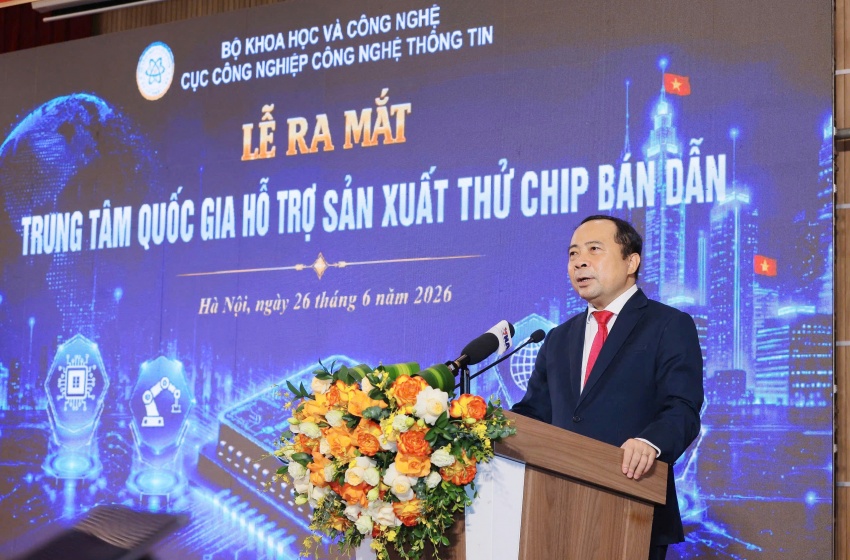 |
| Minister of Science and Technology Vu Hai Quan made a speech at the launch. Photo: The MST |
After trial production, the centre supports chip quality assessment, connecting with government support programmes and investment funds to promote product commercialisation. In the future, it will gradually build a post-manufacturing evaluation, testing, and analysis laboratory (Post-Silicon Lab).
The centre will be developed in three phases. In the 2026-2027 phase, the state will support 100 per cent of the pilot production costs to encourage universities, research institutes, businesses, and design groups to participate in the research, development, and testing of semiconductor chip products, while gradually building the operational capacity of the Multi-Project Wafer model in Vietnam.
During the period of 2028-2030, the centre will continue to receive partial support for pilot production costs, while simultaneously improving shared infrastructure, laboratory systems, design tools, testing environments, and specialised technical support services, contributing to enhanced design quality and product commercialisation potential.
From 2030 onwards, the centre aims to master advanced technologies, expand international cooperation, and gradually become a reputable semiconductor chip prototyping support centre in Southeast Asia, contributing to enhancing Vietnam's position in the regional and global semiconductor value chain.
At the launch ceremony, representative of the centre signed memoranda of cooperation with 19 domestic and international partners. Notably, these included leading technology corporations in the global semiconductor supply chain such as Intel, Infineon, Amkor, Cadence, and Synopsys; manufacturing service providers from leading global foundries like TSMC and Global Foundries; major Vietnamese universities such as the Vietnam National University Ho Chi Minh City, Vietnam National University Hanoi, and Hanoi University of Science and Technology; and domestic technology corporations and enterprises such as Viettel, FPT, and VSAP Lab.
The agreements focus on research, training of high-quality workers, supporting chip design, prototyping, packaging, and testing; sharing technical infrastructure; and connecting experts and businesses with training and research institutions, contributing to the formation of a network linking the state, businesses, research institutes, and universities.
Also within the framework of the event, the centre announced the establishment of a professional advisory team with the participation of 21 reputable experts in the semiconductor industry from technology corporations, universities, and research institutes both domestically and internationally to support strategic development planning and in-depth technical expertise for the centre and universities, research institutes, and businesses in Vietnam.
 | FPT exports first chip shipment to Japan Tech major FPT Corporation has delivered its first commercial shipment of power chips to a Japanese electronics corporation through Restar Corporation, a Japanese trading company for semiconductors and electronic components. |
 | Viettel starts construction of semiconductor chip production plant Viettel has launched construction of Vietnam’s first semiconductor chip manufacturing plant, marking a major step in building domestic capabilities in high-tech industries. |
 | Talent boost vital for semiconductor chip industry Vietnam and Japan are deepening their relationship in developing personnel to support the former’s burgeoning semiconductor industry. Prof. Usagawa Tsuyoshi, of the Vietnam-Japan University under the Vietnam National University in Hanoi, spoke with VIR’s Thanh Thanh about the evolving partnership and what Vietnam must do to cultivate a world-class semiconductor workforce. |
 | Dutch semiconductor giant to build $1 billion production facility in Vietnam Dutch chipmaking equipment supplier BE Semiconductor Industries NV (Besi) has revealed its plan to construct a new production facility in Vietnam. |
What the stars mean:
★ Poor ★ ★ Promising ★★★ Good ★★★★ Very good ★★★★★ Exceptional
 Tag:
Tag:
Themes: Digital Transformation
- Amazon Kuiper licensed for private satellite telecommunications network in Vietnam
- AWS ramps up security tools amid growing AI risks
- Machine vision and 3D: How logistics and warehousing are catching up with manufacturing
- Nvidia proposes areas of strategic cooperation with Vietnam
- Draft legal amendments target red tape and decentralisation
Related Contents









Latest News




More News
- Expanding education partnerships to drive mutual growth (October 06, 2026 | 16:04)
- VTG 2026 to showcase textile and footwear innovation in Ho Chi Minh City (October 06, 2026 | 16:00)
- Infineon boosts Vietnam footprint with Ho Chi Minh City office (October 06, 2026 | 10:02)
- Vietnam Customs expands priority enterprise scheme to 74 firms (October 03, 2026 | 08:00)
- ASL Law opens Danang office (October 02, 2026 | 22:12)
- Project ACTIVE 2.0 launches in Vietnam to boost cervical cancer care (October 02, 2026 | 22:02)
- Vietnam launches first embodied AI conference to advance robotics ecosystem (October 02, 2026 | 17:00)
- DKSH Performance Materials – A trusted partner in Vietnam’s evolving personal care landscape (October 02, 2026 | 14:28)
- Ghanaian delegation reviews PSL Machinery’s cashew factory-management and implementation roadmap (October 02, 2026 | 10:18)
- People living with chronic kidney disease and diabetes should be aware of infectious disease risks (September 30, 2026 | 18:00)


Latest News



 Mobile Version