

Vietnam's seafood exports grow in first seven months

 |
| Photo: baodautu.vn |
According to Vietnam Association of Seafood Exporters and Producers (VASEP), Vietnam’s seafood exports totalled nearly $6.86 billion in the first seven months of 2026, an increase of 11.5 per cent on-year. In July, seafood exports reached $1.1 billion, up 4.8 per cent compared to the same period in 2025.
China and Hong Kong remained Vietnam’s largest seafood market in July, importing more than $267 million, up 24.7 per cent on-year. During the first seven months, exports reached nearly $1.74 billion, an increase of 34.5 per cent.
Exports to the United States exceeded $159 million in July, up 6.3 per cent, while cumulative exports reached more than $1.05 billion, increasing just 0.3 per cent.
Exports to Japan totalled more than $144 million in July, rising 3.8 per cent, while cumulative exports increased 2.6 per cent. Exports to CPTPP markets reached more than $1.783 billion during the first seven months, up 8.1 per cent, making the bloc one of Vietnam’s most stable export destinations.
In contrast, exports to the EU declined 10.9 per cent in July and 2.7 per cent over the first seven months. South Korea fell 10.8 per cent in July, ASEAN declined 6 per cent, and the Middle East dropped 16 per cent.
VASEP noted that the scenario of seafood exports exceeding $12 billion in 2026 remains achievable following the $6.86 billion recorded during the first seven months. However, export growth in the remaining months of the year is expected to slow considerably from the current 11.5 per cent pace. The most immediate challenge comes from the US Section 301 tariff. The 12.5 per cent tariff imposed on Vietnam creates three concrete consequences.
First, new contracts with US buyers are likely to be renegotiated. Importers may request lower free on board prices, tariff-sharing arrangements, or shorter-term agreements.
Second, Vietnam is placed at a competitive disadvantage compared with Ecuador, India, and Indonesia, which face a 10 per cent tariff. This difference is particularly important for whiteleg shrimp, canned tuna, and standard frozen seafood products.
Third, the new tariff is applied on top of MFN duties, anti-dumping duties, and countervailing duties where applicable. Consequently, purchasing decisions will increasingly be made based on individual exporters and specific product lines rather than simple country-to-country comparisons.
"On the positive side, Vietnam has introduced regulations prohibiting the import of goods produced with forced labour, effective from early September 2026. This provides a basis for continued dialogue with the US. However, in the short term, there has been no official indication that the 12.5 per cent Section 301 tariff will be revised in the near future,” VASEP added.
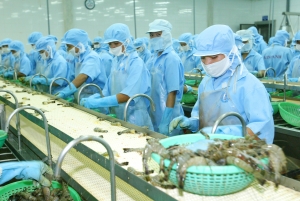 | Vietnam's seafood exports approach $5.8 billion in first half of 2026 Vietnam's seafood exports reached nearly $5.8 billion in the first half of 2026, up 12.8 per cent on-year, driven by stronger demand, market diversification, and improved product restructuring. |
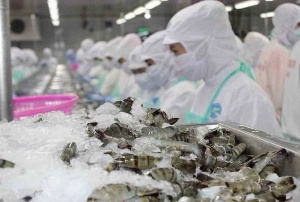 | China imports $1.4 billion of Vietnamese seafood in first half of 2026 Stronger demand from China – Vietnam's largest shrimp export destination – is creating fresh momentum for the industry's growth amid continuing uncertainty in the US market. |
 | Seafood Expo Asia draws exhibitors from four continents Seafood Expo Asia drew first-time exhibitors from four continents, with new national pavilions spanning wild-capture fisheries to smart aquaculture technology reflecting Asia's growing seafood demand. |
What the stars mean:
★ Poor ★ ★ Promising ★★★ Good ★★★★ Very good ★★★★★ Exceptional
 Tag:
Tag:Related Contents



Latest News






More News
- Sojitz in Vietnam: 40 years from individual projects to a business cluster 'KATAMARI' (October 08, 2026 | 09:00)
- Coteccons targets 'Quality Growth' with 25 per cent dividend plan (October 07, 2026 | 13:00)
- Vietnam Education Forum opens UK Education Mission's Hanoi visit (October 07, 2026 | 12:27)
- Tax authorities deactivate TINs of nearly 180,000 businesses (October 07, 2026 | 12:08)
- World Bank raises Vietnam's 2026 GDP growth forecast to 7.4 per cent (October 07, 2026 | 11:41)
- Vietstock 2026 to spotlight livestock innovation and green transition (October 07, 2026 | 09:00)
- Vietnam’s GDP grows over 9 per cent in first nine months (October 05, 2026 | 18:45)
- Vietnam earns $56.3 billion from agro-forestry-fishery exports (October 05, 2026 | 18:32)
- DSV balances resilience and decarbonisation in supply chains (October 05, 2026 | 18:20)
- Electronics exports reach $175.4 billion in the first nine months (October 05, 2026 | 18:12)



Latest News





 Mobile Version