

Talent boost vital for semiconductor chip industry

What is your assessment about the country’s semiconductor human resources (HR) training situation now, and can Vietnam meet investors’ demand for semiconductor HR?
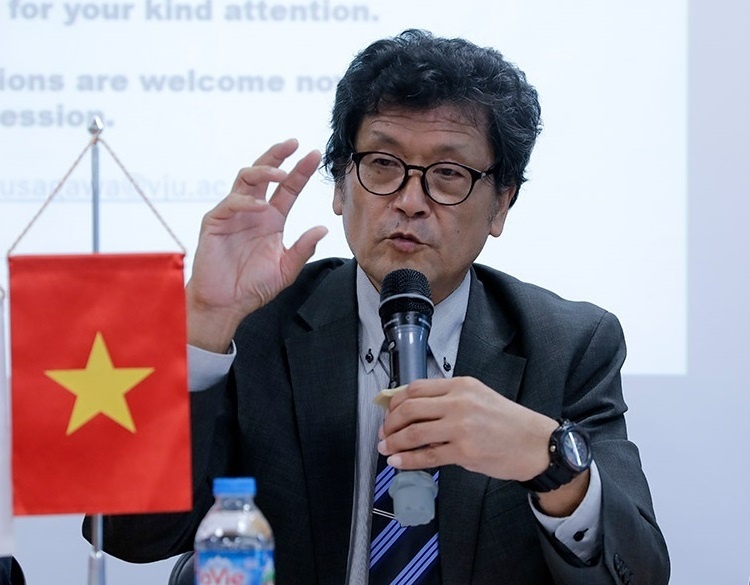 |
| Prof. Usagawa Tsuyoshi |
In Vietnam, the establishment of HR development for the semiconductor field in the higher education sector, namely universities and colleges, seems very prompt and reasonable to strengthen the semiconductor ecosystem.
Currently, HR demands are mainly in both the design and the assembly/testing/packaging (ATP) stages. HR supply has succeeded from a quality point of view for those stages, but from a quantity point of view, it is necessary to strengthen HR supply to meet investors’ demand because of the rapid and continuous expansion of the semiconductor market.
Considering that Vietnam seems to realise a complete ecosystem domestically in the near future, HR for the chip fabrication stage could not be excluded. This means that HR for chip fabrication as well as HR for the supply chain (such as materials, consumables, and maintenance) must be intensified as soon as possible because of the latency of HR development.
The technology used in the ATP stage is rapidly shifting from 2D to 2.5D and 3D called advanced packaging. Because advanced packaging requires collaboration with chip fabrication as well as the design stages, semiconductor HR development requires comprehensive and systematic education.
Of course, HR is only one of the key issues to expand the semiconductor industry, but without suitable quality and sufficient quantity of HR, it is not possible to expand. Thus, continuous attention on HR development is required to meet investors’ demand.
What experiences can Vietnam learn from Japan in semiconductor HR development, especially experiences in attracting investors into HR development?
Concerning the current semiconductor industry in Vietnam, there are many opportunities to learn about design and ATP through lectures by top engineers and activities such as site visits and internships. However, there are few such opportunities for the chip fabrication stage. In Japan and other Asian countries with established fabrication industries, HR development is carried out in collaboration with the higher education sector and industry; thus, trainees can learn through on-site or specialised training. Notably, Japan has several training sites focusing on chip fabrication and other stages for both students and recurrent trainees.
In 2025, the Vietnam-Japan University launched a new semiconductor training programme that has quickly attracted a large number of students. Throughout their studies, these students receive direct instruction from Japanese professors and gain access to valuable internship opportunities in Japan, which allow them to experience advanced manufacturing environments firsthand.
Moreover, their employment prospects are exceptionally strong, as the demand for semiconductor talent among foreign enterprises operating in Vietnam continues to rise. This model demonstrates how international academic–industry cooperation can effectively accelerate the development of a high quality workforce for the semiconductor industry.
Because the semiconductor industry is highly knowledge-intensive and competitive, it is not possible to generate profit without suitable manpower. This necessitates a systematic HR development scheme that must be continuously improved to meet industry demands.
What opportunities and challenges are you seeing for Vietnam in semiconductor HR development?
As noted, there are missing or weak segments in the semiconductor industry ecosystem in Vietnam. Global demand for HR, especially high-quality talent, in the semiconductor industry is high; thus, talent raised in Vietnam may have many opportunities to join global companies outside of Vietnam.
On the one hand, it is a risk of brain drain; however, those who have joined global semiconductor industries will provide better opportunities in the near future to strengthen the semiconductor ecosystem in Vietnam.
One thing we need to share with Vietnamese talent is the volatility of the semiconductor industry, which is called the silicon cycle, where HR demand fluctuated around 1990-2010s in Japan. It is not yet clear whether the silicon cycle will appear again or not, but many companies in the semiconductor industry, including those in the supply chain, have survived and taken the majority of the market.
I hope the higher education sector as well as the semiconductor industry will provide a bright future for young people.
Vietnam aims to train at least 50,000 semiconductor engineers by 2030 under its national development strategy. Do you think that this goal is feasible?
According to the public information about Vietnam, the number of engineers in semiconductor industry is less than 10,000. TSMC opened a new chip fabrication plant in Kumamoto, Japan, and it announced that more than 1,000 employees are needed to run one plant. In 2024, TSMC recruits more than 250 fresh graduates, and it plans to recruit more for another plant. This might be an extreme example, but usually HR demands for semiconductor industry is large because the manufacturing volume of a fab is large.
Considering the current speed of expansion of semiconductor industry, the goal by 2030 is understandable. From the supply side, the quantity could be achieved, however, the major issue is quality, especially graduate level engineers. According to an annual report from TSMC, more than half of employees have graduate level degrees. Many Japanese graduate schools in engineering have a capacity of 50-80 per cent of related undergraduate programmes.
What policies are needed for Vietnam to develop its semiconductor HR successfully?
Firstly, more encouragement is required to support mutual interaction between the education sector and industry because educational content needs to keep pace with industrial advancements. Suitable practical experience cannot be provided without industry support, as semiconductor fabrication equipment is too expensive for educational institutions to obtain.
In order to strengthen the talent pipeline, it is necessary to encourage young talent to continue their studies in graduate school. Of course, financial support is preferable, but more promotion is needed to attract high school students or even younger individuals to the semiconductor, AI, and related high-tech fields.
What the stars mean:
★ Poor ★ ★ Promising ★★★ Good ★★★★ Very good ★★★★★ Exceptional
 Tag:
Tag:Related Contents





Latest News




More News
- Significant steps made in related-party transactions (August 21, 2026 | 15:51)
- New challenges for workforce data and HR policy management with PIT changes (August 17, 2026 | 10:32)
- Leading in AI: from pilot initiatives to enterprise value (August 10, 2026 | 07:00)
- Programme launched to develop new Vietnamese business leaders (July 28, 2026 | 13:50)
- Vietnam must build talent and innovation to attract quality investment (July 09, 2026 | 08:00)
- AI-ready workforce key to Vietnam's next decade, analysts say (July 01, 2026 | 15:55)
- VIFC shouldn't try to be Dubai, says VinaCapital chief economist (June 24, 2026 | 14:17)
- Highly skilled workforce and fiscal incentives key to driving high-tech growth (June 17, 2026 | 16:17)
- KPMG and Anthropic to redefine client services with artificial intelligence tie-up (May 25, 2026 | 08:00)
- FDI a crucial component to double-digit growth (May 15, 2026 | 11:38)


Latest News





 Mobile Version