


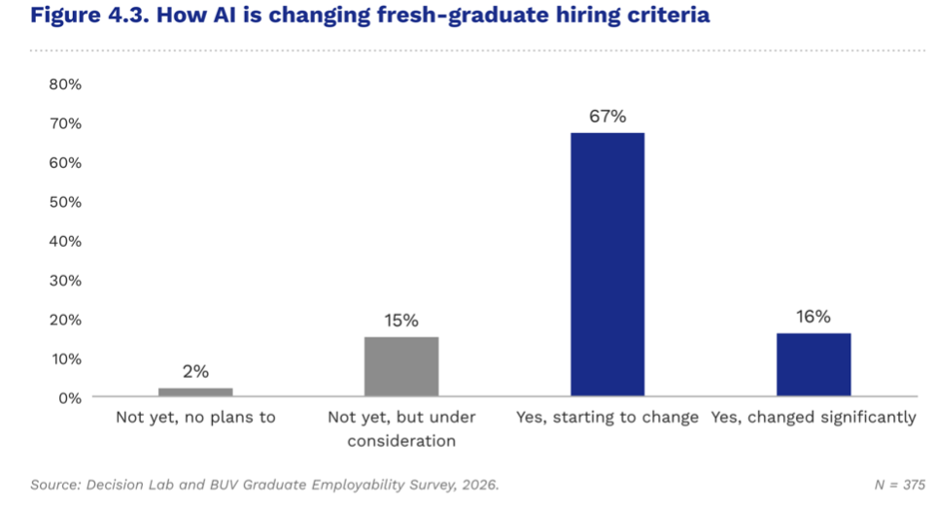
AI beginning to reshape recruitment criteria

 |
| Source: BUV |
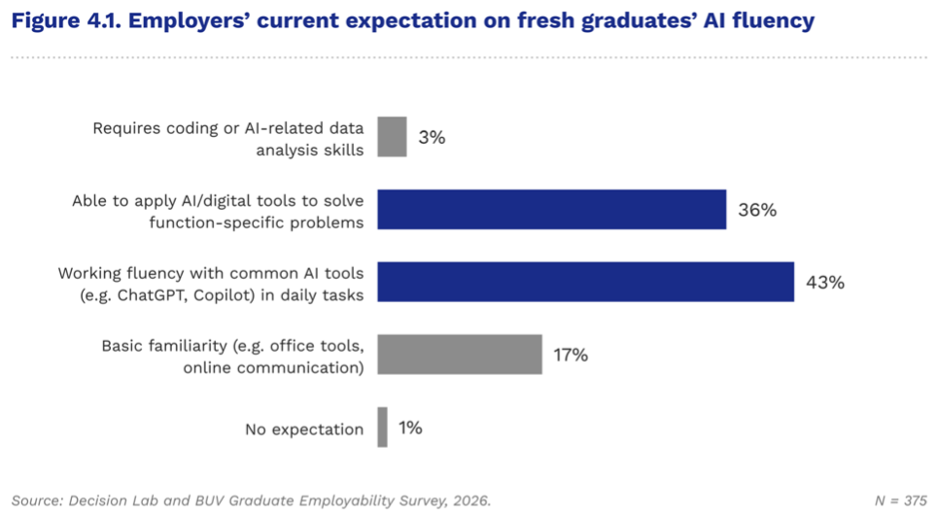
Some 83 per cent of employers say AI has changed, or is beginning to change, their hiring criteria, while 94 per cent report higher expectations for digital and AI capabilities than they had two to three years ago. However, businesses are not necessarily looking for AI engineers. Instead, they want graduates who can use common AI tools fluently in their daily work or apply them to solve problems specific to their roles.
These are among the key findings of the Vietnam Employability Report 2026: Beware the Gap – Are Graduates Set up for Success in a World of New Possibilities?, released on October 8 by British University Vietnam (BUV) in collaboration with research firm Decision Lab. The research surveyed 375 domestic and international companies on their hiring decisions for fresh graduates.
The findings were presented at the International Conference on Educational Cooperation in the Digital Era and Education & EdTech Exhibition, hosted by the Ministry of Education and Training.
Widest gaps emerge in real-world working situations
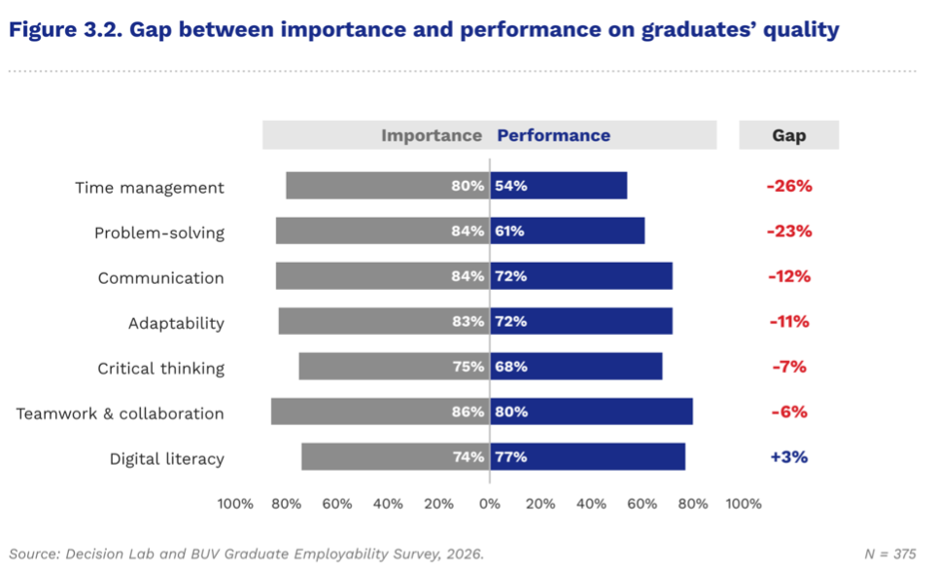
The report assessed seven capability areas among fresh graduates. Employers considered all seven important, with between 74 and 86 per cent rating each as important. Yet graduates fell short of employers’ expectations in six of the seven areas.
Time management recorded the widest gap, at 26 percentage points, followed by problem-solving at 23 points. Communication and adaptability showed gaps of 12 and 11 points, respectively. Digital literacy was the only capability area in which graduates exceeded expectations, by three percentage points.
These shortcomings become particularly apparent when young employees face urgent tasks, incomplete information, or work requiring coordination with several people. In such situations, employers need staff who can manage their commitments, flag potential delays early, and propose solutions independently rather than wait for detailed instructions.
 |
| Source: BUV |
The findings suggest that the gap between education and employment is not simply a matter of academic knowledge. It also concerns graduates’ ability to apply what they have learnt, organise their work independently, and make decisions in real-world situations.
Employers also tend to favour international degrees, with more than half expressing a preference for graduates with such qualifications. Their perceived advantages extend beyond English-language proficiency. Employers describe these graduates as typically more confident, more comfortable working in multicultural environments, and more willing to ask questions, challenge assumptions, and present their views to senior colleagues.
While 83 per cent of employers say AI has changed, or is beginning to change, their hiring criteria, only 3 per cent require AI programming or data analysis skills. Instead, 79 per cent want graduates to use common AI tools fluently in their daily work or apply AI to the specific problems they encounter in their roles.
This points to a shift towards combining technological proficiency with problem-solving and adaptability. As AI tools become more widely available, candidates’ competitive advantage will depend not only on their ability to use technology, but also on how effectively they evaluate information, choose appropriate approaches, and take responsibility for their work.
However, collaboration between businesses and universities remains largely concentrated on recruitment. Although 59 per cent of surveyed employers take on student interns, only 15 per cent contribute to curriculum design, while 23 per cent do not collaborate with any university.
The report identifies three conditions for internships to genuinely build capability: meaningful work, close supervision, and evidence of the student’s contribution. Expanding internship opportunities therefore needs to go hand in hand with improving the quality of workplace experience and encouraging businesses to play a more active role in education and training.
 |
| Source: BUV |
From qualifications to workplace capabilities
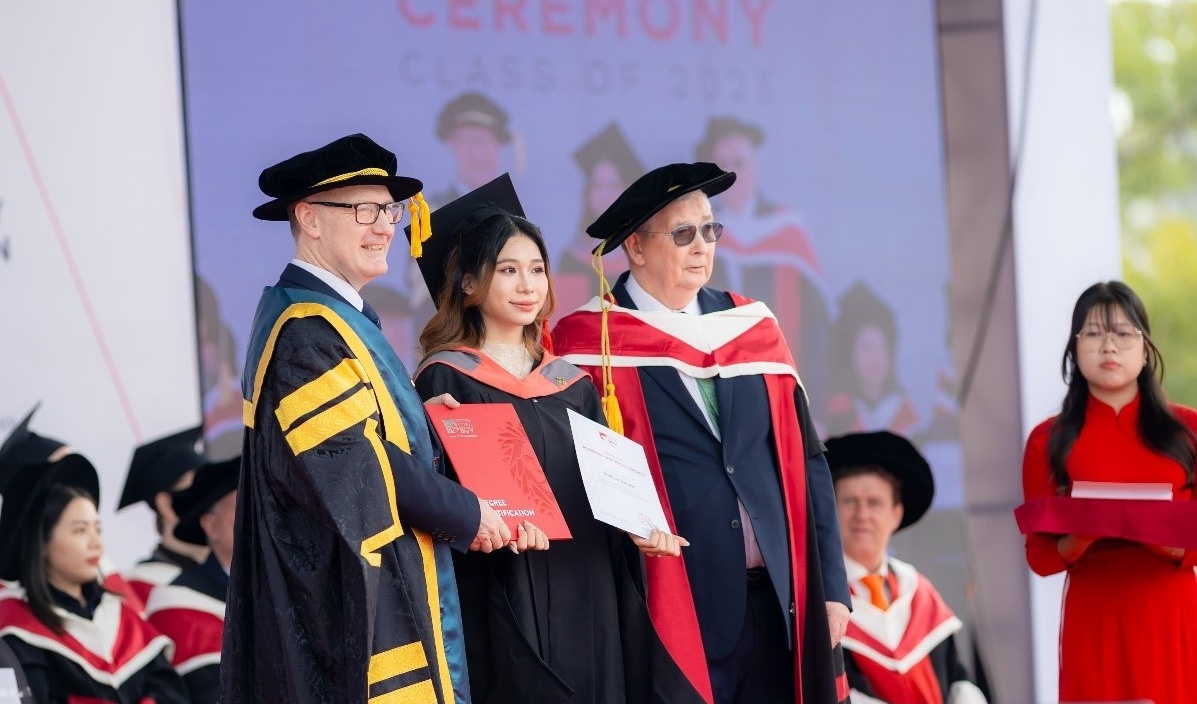
Against this backdrop, BUV introduced its new “Degree Plus” education model, which combines an academic degree with additional professional and personal skills development, alongside international experiences. Under the model, students receive a Global Employment Passport upon graduation, in addition to a degree awarded by a UK university.
The model is built around three pillars. The Professional Skills pillar includes modules on time management, project management, applied AI, and digital literacy. The Personal Skills pillar focuses on strategic thinking, problem-solving, resilience, and adaptability. The International Mobility pillar provides opportunities for students to participate in exchanges, study programmes, and internships abroad through the university’s international partner network.
Students can also apply their knowledge through internships and real-world projects with more than 500 corporate partners in BUV’s network. The approach aims to bring academic learning closer to labour-market requirements, moving beyond qualifications alone as a measure of graduate readiness.
The model is also positioned in the context of Politburo Resolution No.71-NQ/TW on breakthroughs in education and training development. The resolution highlights the need to raise digital and AI competency standards, develop the qualities and capabilities of Vietnamese people for a new era, and prepare Vietnamese citizens to become global citizens.
“The more powerful technology becomes, the sharper human judgement needs to be. The key question is no longer simply what qualification a student holds at graduation, but what their actual capabilities allow them to do on their first day at work,” said Paul Bennett, chief marketing officer at BUV.
According to the report, closing the gap between qualifications and capabilities requires action from government, employers, universities, and students alike. Stronger dialogue between educational institutions and the labour market, more responsive curricula, and regular feedback mechanisms will be essential to preparing graduates for an evolving economy.
Rick Bennett, deputy vice-chancellor and vice-president at BUV, said, "The university was making the full report publicly available and would continue the research regularly for the benefit of the wider education sector."
These issues were also explored at a panel discussion, “Shaping the Talent Profile for the Industry 4.0 Era,” which examined how universities, employers, and other stakeholders could work more closely together on curriculum design, expanded workplace opportunities, and regular feedback from the labour market.




What the stars mean:
★ Poor ★ ★ Promising ★★★ Good ★★★★ Very good ★★★★★ Exceptional
 Tag:
Tag:
Related Contents







More News
- NSRP navigates global energy supply volatility (October 08, 2026 | 16:59)
- Minitab launches campaign to combat illegal software use in Vietnam (October 08, 2026 | 15:54)
- Raising construction materials supply chain standards amid green transition (October 08, 2026 | 14:00)
- Samsung Vietnam to deepen cooperation with local manufacturers (October 08, 2026 | 12:00)
- Sojitz in Vietnam: 40 years from individual projects to a business cluster 'KATAMARI' (October 08, 2026 | 09:00)
- Coteccons targets 'Quality Growth' with 25 per cent dividend plan (October 07, 2026 | 13:00)
- Vietnam Education Forum opens UK Education Mission's Hanoi visit (October 07, 2026 | 12:27)
- Tax authorities deactivate TINs of nearly 180,000 businesses (October 07, 2026 | 12:08)
- World Bank raises Vietnam's 2026 GDP growth forecast to 7.4 per cent (October 07, 2026 | 11:41)
- Vietstock 2026 to spotlight livestock innovation and green transition (October 07, 2026 | 09:00)


Latest News





 Mobile Version