
Vietnam’s creative industries at turning point

Vietnam stands at a rare moment of opportunity, but success will depend on strategic communication, stronger industry-academia collaboration, and mindset shifts across society.
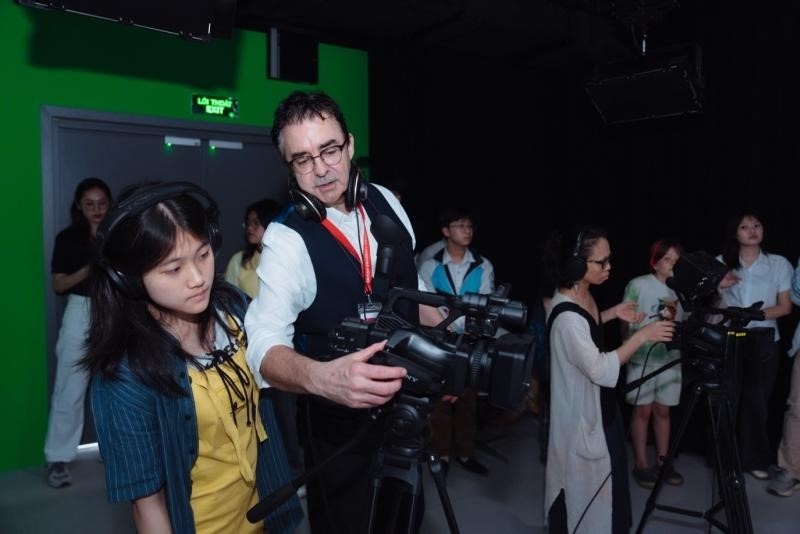
At an international conference on communications and the creative industries at the British University Vietnam (BUV) Campus in Hung Yen province on November 2, Prof. Rick Bennett, deputy vice-chancellor and vice-president of BUV, opened with a reminder that creative careers in Vietnam still face deep-rooted cultural scepticism. From families preferring “stable” jobs to widely underestimation of creative careers, the struggles are real.
He shared stories of students who had to fight for the right to study creative fields, including a fashion student who went on a five-day hunger strike to convince her parents. “In Vietnam, a lot of people in our classrooms have suffered trying to get their parents to realise that it is valuable,” he said.
But the economic case is clear. Creative industries, from design and film to fashion, advertising, games, and digital content, are fast-growing contributors to global GDP. Bennett emphasised that Vietnam has also recognised this. “The National Strategy for the Development of Cultural Industries shows how strongly the Vietnamese government values the creative industries,” he said.
Yet awareness among the public remains limited. Many parents still don't see creative degrees as pathways to stable careers. For educators, he argued, the mission is twofold: build confidence and deliver quality. “We certainly need to educate the public about the importance of creative industries and provide security through job creation.”
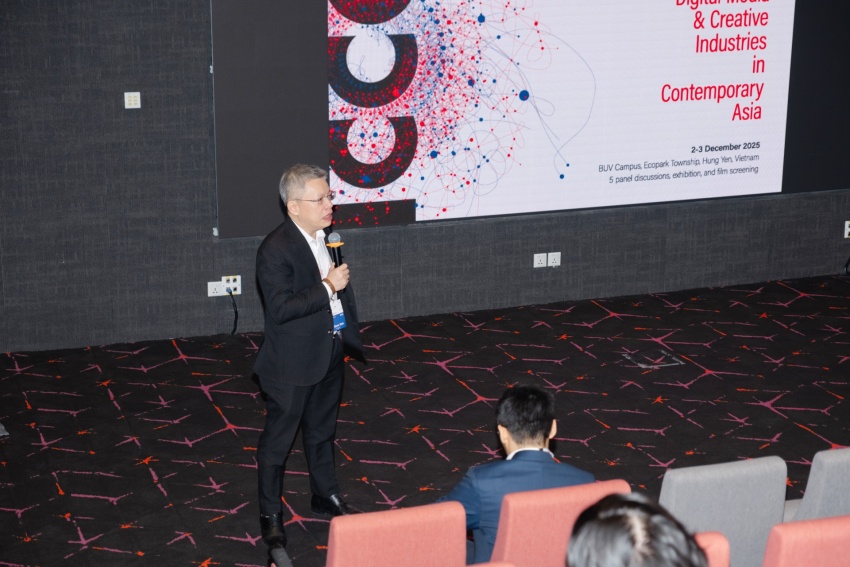 |
| Le Quoc Vinh, chairman and CEO of LeBros |
Soft power and storytelling: Vietnam's untapped assets
Le Quoc Vinh, chairman and CEO of LeBros and one of Vietnam's most influential communication strategists, expanded the discussion to the national level. Creative industries, he argued, are not just about producing cultural products, they are central to building Vietnam's soft power.
Using the example of Blackpink's concert in Hanoi, a cultural moment that boosted air travel, hotels, food, and merchandise spending, he noted that event-based creativity creates ripple effects across the economy. “Is the value of a concert just ticket sales?” he asked. “No. Thousands of people flew in and spent days in the city. That is the value of creative industries.”
Vietnam, he added, already has a wealth of cultural assets: food, landscapes, crafts, design heritage, a peaceful lifestyle, and the warmth of its people. But these assets are fragmented, invisible, or communicate without a clear strategy. Despite major cities earning UNESCO creative titles, he asked, “Do we see design around the city? I don't think so.”
Vinh called for Vietnam to learn from Korea, Japan, and Thailand, countries that have exported not just products, but narratives. “Korea did not export just K-Pop, they exported the narrative of Korean modernity,” he said. Likewise, Japan sells not just cuisine but the philosophy of preciseness and purity.
Vietnam needs similar clarity and cohesion: one national narrative, one communication strategy, and coordinated investment in creativity. “Soft power is crafted by storytellers, creators, brands, journalists, and students by all of us who carry the story of Vietnam to the world,” he concluded.
AI as catalyst and challenge for media transformation
Disruption is coming from another direction as well: AI. Dr. Nick Zhang from Hong Kong Baptist University, who leads research on AI in media, provided a sharp look at both the possibilities and the gaps in Vietnam and the region.
AI, he argued, is not just another tool. “AI is a fundamental shift in how content is created, distributed, and consumed.” But while major media groups can invest heavily, small- and mid-sized newsrooms, common in Vietnam, lack the resources to adopt AI effectively.
He highlighted a global paradox. Media leaders know AI matters, but their organisations lack strategy. “Generative AI use is very fragmented, and management sees the importance but doesn't know how to coordinate it,” he noted.
Zhang also raised the top challenges. Resource constraints as traditional advertising revenues decline; AI scepticism or fear among journalists; lack of technical knowledge, especially outside major cities; model bias, since most AI systems are trained on Western or Chinese datasets; gaps in cultural understanding, leading to accurate or tone-deaf AI-generated content; workflow mismatch between newsroom processes and AI capabilities.
He also warned of perception gaps. “Everyone thinks AI is super powerful,” he said. “But whether it can deliver what professionals want is a huge gap.” For example, AI may produce a news story that reads more like a press release, requiring extra human editing.
To address these issues, Hong Kong is developing integrated AI platforms with Google and Alibaba to help journalists use AI more efficiently while enabling researchers to study real-time human-machine interaction.
This model, Zhang argued, could inspire Vietnam. Universities can absorb the research and development burden, develop tailored tools, and provide training. “Curriculum redesign is very necessary,” he said. “We are in a permanent beta version, and we need to empower students with AI while keeping human-centric journalism.”
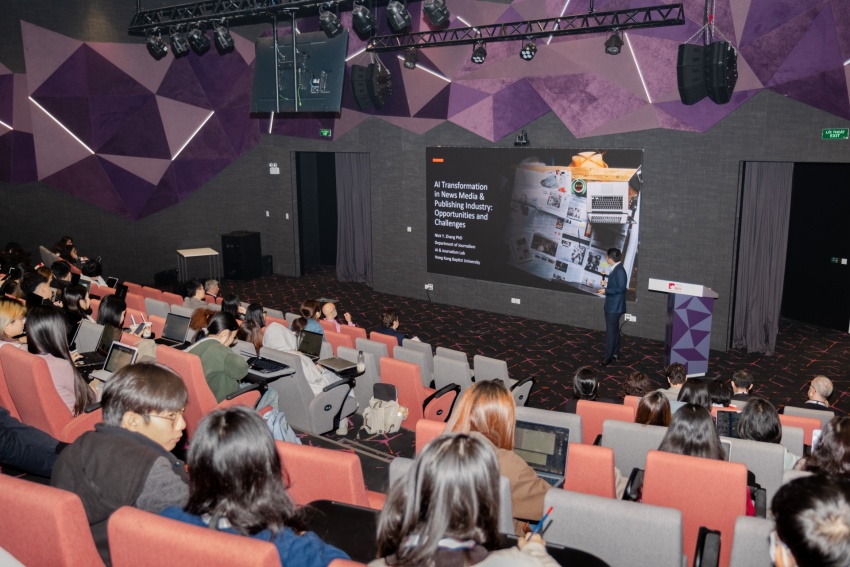 |
| Dr. Nick Zhang from Hong Kong Baptist University |
Vietnam's window of opportunity
Taken together, the three speakers painted a future where Vietnam's cultural strength, creative talent, and technological adoption converge. But to seize that opportunity, several shifts must happen: a national communication strategy; greater visibility of culture and creativity; AI literacy for journalists, creators, and students; industry-academia partnerships; and mindset change among families and society.
Vietnam already has compelling cultural stories, global attention, and a new generation of digitally native creators. What it needs now is coordination, communication strategies, and technological readiness.
As Vinh reminded, “Soft power is not built by the government alone. It is crafted by all of us who carry the story of Vietnam.”
Vietnam's next chapter will belong to those who can tell its story creatively, confidently, and intelligently, powered by the fusion of communication, culture, and technology.

What the stars mean:
★ Poor ★ ★ Promising ★★★ Good ★★★★ Very good ★★★★★ Exceptional
 Tag:
Tag:Related Contents





Latest News



More News
- IEAE Hanoi 2026 to spotlight smart electronics trends (October 19, 2026 | 17:44)
- Vietnam and EFTA member states sign free trade agreement (October 19, 2026 | 13:10)
- TC-HICT handles over 8.2 million TEUs since 2018 launch (October 17, 2026 | 16:56)
- Vietnam transforming AI ambitions into business impact (October 16, 2026 | 18:01)
- A broader platform for France-Vietnam cooperation (October 16, 2026 | 17:51)
- AEON to open 13th general merchandise store in Vietnam (October 14, 2026 | 17:56)
- Three international exhibitions open to boost industrial supply chain links (October 14, 2026 | 17:37)
- Garment and textile industry transitions towards high-value production (October 14, 2026 | 17:30)
- French business delegation meets MoF to discuss investment cooperation (October 14, 2026 | 11:37)
- Friso promotes global scientific collaboration on children’s gut health in Vietnam (October 13, 2026 | 16:18)










 Mobile Version