
Vietnam emerges as Southeast Asia’s fastest-growing digital economy

 |
| Source: e-Conomy SEA 2026 report |
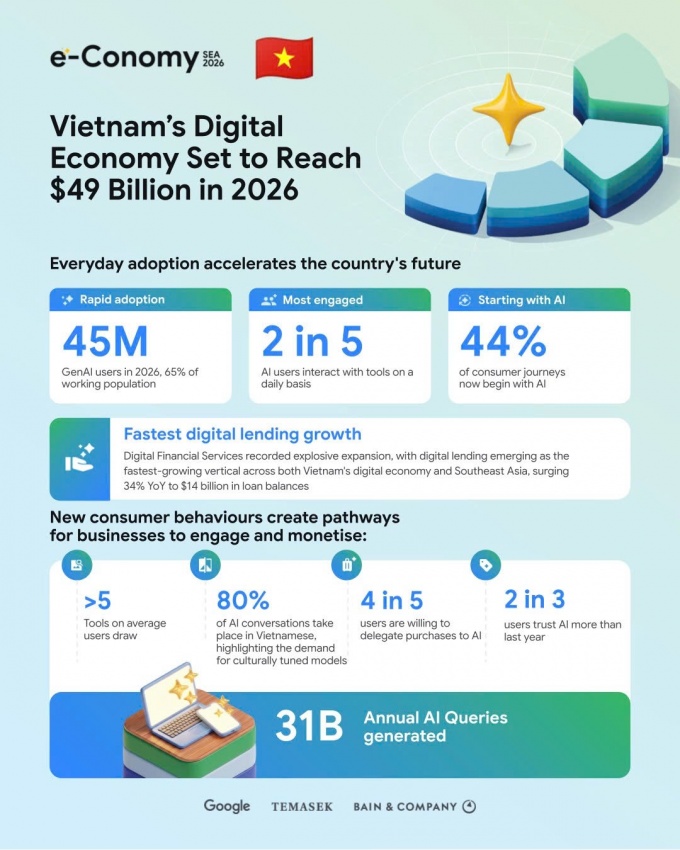
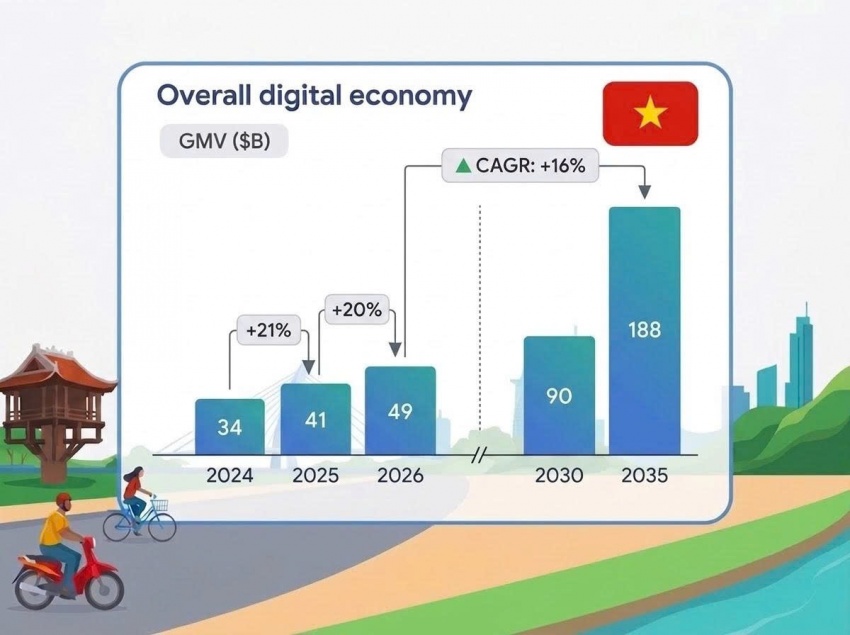
Vietnam's gross merchandise value (GMV) is projected to climb 20 per cent on-year to $49 billion in 2026, according to the annual e-Conomy SEA 2026 report released on November 5 by Google, Temasek, and Bain & Company.
The momentum is powered by double-digit expansion across all four core sectors, led by e-commerce and online travel, alongside rapid growth in digital financial services, particularly digital lending and payments.
Most digital economy sectors in Vietnam are sustaining target growth as platforms scale and monetise user behaviour. E-commerce remains the primary engine, accounting for two-thirds of the overall digital economy, growing 22 per cent on year to reach $32 billion in 2026 and tracking towards $61 billion by 2030, as platforms drive improved targeting and higher conversion with AI assisted features for consumers, while also expediting operational processes like listing through seller-oriented AI features.
Online travel sustains momentum with Vietnam's online travel sector recorded 15 per cent on year growth to reach $5 billion in GMV, matching Malaysia for the fastest expansion in SEA. Across SEA, standalone GenAI platforms have overtaken social media as the second-most popular starting point for travel planning, reflecting AI's growing role in trip discovery and itinerary planning.
This double-digit expansion extends across the wider digital ecosystem, demonstrated by growth enablers in online media (up 17 per cent on year to $7 billion in GMV in 2026). Complementing these drivers, mobility and food climbed 17 per cent on year to $6 billion GMV, as electric vehicle players intensify competition in this sector.
Parallel to commercial scale, Vietnam stands out as Southeast Asia's most highly engaged AI market. As Generative AI transitions from early adopters to mainstream workforce integration, Vietnam now counts 45 million GenAI users, representing 65 per cent of the working population, generating 31 billion annual AI queries.
This scale is matched by deep, daily engagement that outpaces all regional peers. Vietnam ranks first in Southeast Asia for daily GenAI use, with two in five users interacting with AI tools every day. Users are also folding these technologies into their routines, drawing on an average of at least five different tools. That engagement is reshaping commerce: 44 per cent of consumer journeys now begin with AI, and readiness for agentic technology is high, with four in five users willing to delegate purchases to AI agents.
Crucially, this rapid integration is happening natively. Vietnamese is the default language for AI interactions in the country, accounting for 80 per cent of conversations, the highest local-language usage rate across the SEA-6 region. This strong localised engagement results in a higher volume of tokens per interaction, underscoring a growing demand for locally tuned models tailored to the Vietnamese market.
“Vietnam’s digital economy continues to demonstrate strong growth, driven by active user uptake and proactive national AI policies,” said Marc Woo, managing director, Google Vietnam. “Reaching $49 billion in GMV while leading the region in daily, local-language AI engagement proves that Vietnamese consumers are exceptionally forward-looking. When nearly half of all consumer journeys starting with AI and four in five users are ready to trust AI agents with purchases, we are looking at a market uniquely positioned to turn everyday AI into unprecedented economic momentum.”
"Vietnam is the most engaged AI market in Southeast Asia. Its users lead the region on daily use, tools per user and AI-first journeys, backed by its standalone Law on AI and a National AI Development Fund. But the real measure of success is shifting from adoption to meaningful business outcomes. The companies that redesign how work gets done around AI, instead of simply adding it, will turn this momentum into lasting advantage," said Andrea Campagnoli, managing partner, Bain & Company Vietnam.
 |
| Source: e-Conomy SEA 2026 report |
Digital Financial Services recorded explosive expansion, with digital lending emerging as the fastest-growing vertical across both Vietnam's digital economy and Southeast Asia, surging 34 per cent on year to $14 billion in loan balances. Digital payments also accelerated rapidly to $197 billion GTV (up 21 per cent on-year) and are tracking towards $302 billion by 2030, propelled by a 38 per cent surge in non-cash transactions in early 2026.
In line with regional trends, private capital in Vietnam is undergoing a strategic recalibration. While deal values have moderated amid global investor caution, capital is being reallocated more constructively, shifting away from short-term user acquisition towards strong unit economics and foundational infrastructure, including Data Centres, Semiconductors, and Nascent sectors.


What the stars mean:
★ Poor ★ ★ Promising ★★★ Good ★★★★ Very good ★★★★★ Exceptional
 Tag:
Related Contents








Latest News
More News
- Vietnam accelerates 5G utilisation and prepares for 6G (October 30, 2026 | 18:28)
- Vietnam and Cambodia customs agree 2027–2028 cooperation plan (October 30, 2026 | 13:46)
- Vietnam strengthens inter-regional cooperation on enhancing AI capabilities (October 29, 2026 | 15:32)
- First zero-direct-emission electric barge operates in Vietnam (October 29, 2026 | 14:41)
- Deputy Finance Minister meets Chinese State Council research delegation (October 29, 2026 | 14:25)
- Vietnam and Denmark hold sixth intergovernmental committee session (October 28, 2026 | 12:35)
- Ho Chi Minh City announces first 10 official members of VIFC-HCMC (October 28, 2026 | 12:27)
- Science and tech funding disbursement set to accelerate (October 28, 2026 | 12:23)
- Geleximco and Chery forge strategic partnership to advance high-tech industrial development (October 28, 2026 | 10:00)
- Vietnam and Poland target $6 billion in bilateral trade (October 27, 2026 | 10:03)








 Mobile Version