
Quantum technology targeted for long-term advantage

At an international scientific conference on new advances in strongly correlated electronic systems held from June 1-5 in Quy Nhon, Deputy Minister of Science and Technology Le Xuan Dinh held discussions with leading scientists in quantum physics, condensed matter, and quantum materials.
 |
| Photo: The MST |
"Vietnam identifies quantum technology as a long-term strategic direction," Dinh said. "We are not approaching it as a fad, but rather aim to build substantial capacity, starting from a foundation of basic science, training workers, forming strong research groups, investing in shared infrastructure, and selecting application directions suitable to domestic conditions."
According to the Vietnam Quantum Technology Innovation Network (VNQuantum), the potential of quantum technology lies in computing, communication, security, sensors, and new materials. These fields are expected to form the foundation for the next generation of technology, similar to how the internet and smartphones transformed the world in recent decades.
"Quantum technology has strategic significance for many important fields. There are very complex problems that traditional computer systems struggle to solve effectively. This is where quantum computing can demonstrate its superior advantages," said Assoc. Prof. Dinh Trung Hoa, a member of the VNQuantum Steering Committee.
To build on this foundation, Vietnam needs to begin developing quantum technology through education and human resource training. This includes summer and winter schools, in-depth workshops, and inviting international experts to teach and update on new trends. Alongside sending young students to train at leading research centres abroad, Vietnam also needs mechanisms to attract reputable international scientists, creating conditions for them to build key research groups and train local personnel.
The country also needs to leverage its network of overseas Vietnamese intellectuals, connecting with scientists working at universities, research institutes, and major technology companies worldwide.
Regarding infrastructure, Vietnam needs to prioritise strengthening and connecting existing research institutes and universities, and investing in shared laboratories for fundamental research directions. Investment should be linked to specific problems and have a team with sufficient operational capacity. Quantum technology requires a long-term vision, potentially needing 5 to 15 years to develop capabilities and achieve clear applications.
During a working session on the Quantum Technology Development Project in May, Party General Secretary and State President To Lam explained that this is a national strategic issue that needs to be considered within the overall implementation of Resolution 57 and linked to fields such as national security, data, semiconductors, AI, and space technology.
Lam suggestedthat Vietnam must choose a path that suits its actual conditions, focusing on building substantive capacity in areas where it has the potential to participate in and master, and avoiding scattered investments or chasing trends.
Dr. Nguyen Quoc Hung, vice president of VNQuantum and director of the Institute of Quantum Technology at Vietnam National University, Hanoi, said, "Many major economies have already established long-term investment initiatives. The United States, for example, considers quantum technology a national priority with numerous large-scale research projects."
"The European Union is also implementing its own strategy and promoting related investment schemes," he added. "A global supply chain for materials, components, and equipment serving quantum technology is gradually forming, creating a new industrial ecosystem."
However, Hung noted that rapid development has brought a trend of tightening control over technology. "Many countries are increasing export barriers not only for core technologies but also for supporting ecosystems such as deep-freezing equipment, microwave control equipment, or operating protocol standards," he said.
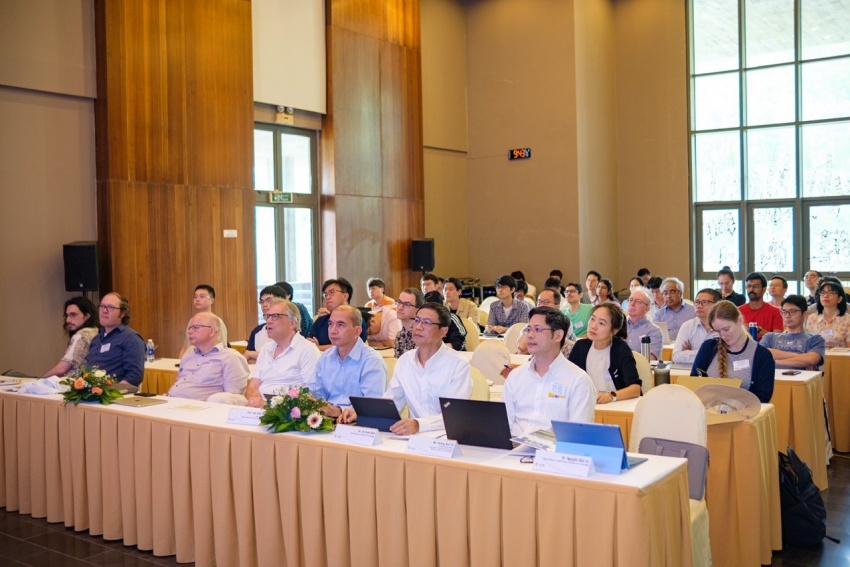 |
| Photo: the MST |
This makes the quantum race not simply a scientific competition, but also linked to national security, technological sovereignty, and the economic standing of each country.
Vietnam has now formed initial research centres in this field. Hanoi National University is a pioneer in establishing the Institute of Quantum Technology, focusing on quantum communication and security. At Ho Chi Minh City National University, it trains students in quantum computing, while the University of Technology develops many related research and training activities.
According to the development plan, Vietnam will focus on five priority areas: quantum communication and security; quantum simulation and algorithms; quantum sensors; quantum photonic materials and components; and training high-quality workers.
"Quantum technology is a challenging field but not beyond Vietnam's capabilities if a suitable strategy is in place," said Prof. Tran Hong Thai, president of the Vietnam Academy of Science and Technology. "If preparations begin now, Vietnam can fully participate in the global quantum value chain in a way that aligns with its capabilities and strategic interests."
 | Singapore's Aires advances region's first PQC and quantum tech patents The company's progress in post-quantum cryptography patents marks a significant step for Singapore's quantum technology sector. |
 | Strategic technology networks launched In a defining step towards establishing a high-tech-driven economy, Vietnam has launched three new high-level technology networks, including quantum technology, cybersecurity, and aerospace and unmanned aerial vehicles (UAVs). |
 | Nami Exchange partners with Cipher Core on quantum-resistant security Nami Exchange has entered a strategic partnership with Japan’s Cipher Core to bolster digital asset security with cutting-edge quantum-resistant technology. |
What the stars mean:
★ Poor ★ ★ Promising ★★★ Good ★★★★ Very good ★★★★★ Exceptional
 Tag:
Tag:Themes: Digital Transformation
- Vietnam-Australia forum boosts AI and digital technology cooperation
- Digital transformation shifts focus to added value
- Amazon Kuiper licensed for private satellite telecommunications network in Vietnam
- AWS ramps up security tools amid growing AI risks
- Machine vision and 3D: How logistics and warehousing are catching up with manufacturing
Related Contents






Latest News




More News
- Vietnam-Australia forum boosts AI and digital technology cooperation (October 13, 2026 | 11:30)
- Digital transformation shifts focus to added value (October 09, 2026 | 18:00)
- Melatec Dental Clinic - accompanying international clients on their smile care journey (October 09, 2026 | 17:25)
- 12 localities achieve double-digit growth in first nine months (October 09, 2026 | 17:00)
- CYE 2026 announces top 5 finalists (October 09, 2026 | 16:55)
- Robotics inspires Vietnam’s next generation of engineers (October 08, 2026 | 15:18)
- Vietnam among fastest AI adopters, Pearson-AWS study finds (October 07, 2026 | 12:26)
- Ho Chi Minh City Oncology Hospital signs MoU with Novartis Vietnam (October 07, 2026 | 10:36)
- Expanding education partnerships to drive mutual growth (October 06, 2026 | 16:04)
- VTG 2026 to showcase textile and footwear innovation in Ho Chi Minh City (October 06, 2026 | 16:00)







 Mobile Version