
Draft legal amendments target red tape and decentralisation

On August 7, at the National Assembly meeting, Minister of Science and Technology Vu Hai Quan presented the draft amendments to the Law on Radio Frequency, the Law on Telecommunications, the Law on Electronic Transactions, and the Law on Technology Transfer.
He said that the government had issued a number of resolutions to implement the policy of boosting decentralisation of power, reforming administrative procedures, reducing investment and business conditions, and effectively utilising telecommunications infrastructure to serve national defence and security.
These policies have contributed to reducing compliance costs, creating favourable conditions for citizens and businesses, and enhancing the effectiveness and efficiency of state management.
 |
| Minister of Science and Technology Vu Hai Quan. Photo: MST |
However, these mechanisms will expire on March 1, 2027. Amending the relevant laws is therefore necessary to provide a stable, consistent and sustainable legal framework.
The draft amendments focus on three key areas. The first is accelerating administrative reform and reducing the number of conditional investment and business lines.
For the Law on Radio Frequency, the draft removes licensing conditions that are no longer necessary or are already covered by other regulations, shifts from pre-approval to post-inspection, and abolishes regulations on training amateur radio operators. It also transfers responsibility for training and certifying maritime radio operators to the relevant specialised ministries.
For the Law on Telecommunications, the draft abolishes or simplifies several licensing conditions. It also removes domain name registration and maintenance services from the list of conditional business lines and shifts their management to a post-inspection mechanism.
For the Law on Electronic Transactions, the draft abolishes procedures for amending and renewing licences for trust service providers, helping reduce compliance costs for businesses.
The second area is further decentralisation of state management. Under proposed amendments to the Law on Technology Transfer, the Ministry of Science and Technology would be empowered to develop, approve and issue programmes and policies on technology imports, science and technology market development, technology transfer, application and innovation. The changes are intended to increase administrative autonomy and shorten processing times.
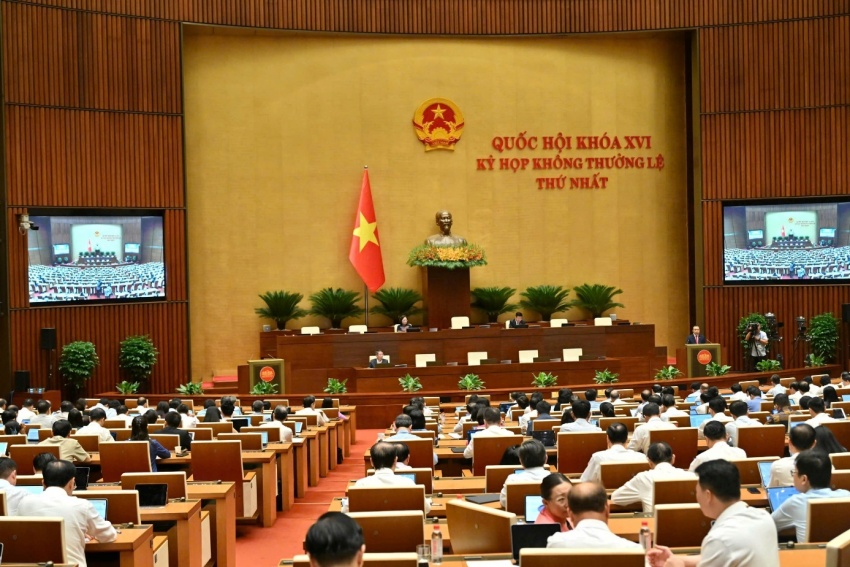 |
| The National Assembly meeting. Photo: MST |
Third, completing the legal framework for the effective use of telecommunications infrastructure to serve national defence and security.
Regarding the Law on Radio Frequency, the draft stipulates the licensing of frequency band usage in special cases for state-owned enterprises directly serving national defence and security, adjusting the initial licensing period from three years to five years and adjusting the time for evaluating the effectiveness of project implementation before allowing licence renewal to continue project implementation.
Regarding the Law on Telecommunications, the draft law adds a legal basis for sharing telecommunications infrastructure to ensure the fulfilment of national defence and security tasks; the government will specify the policy on free shared use of telecommunications infrastructure of enterprises wholly owned by the State for national defence and security tasks, and the mechanism to ensure the rights of these enterprises.
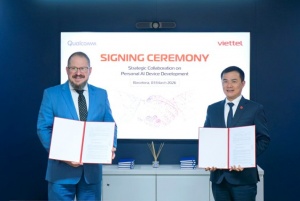 | Viettel and Qualcomm to co-develop AI smartphones Viettel has signed an MoU with American multinational Qualcomm Technologies to establish a strategic partnership for AI-integrated smart mobile devices. |
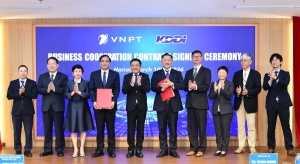 | Japanese wireless carrier to launch mobile services in Vietnam On May 1, KDDI Corporation and VNPT agreed to jointly develop and launch a mobile telecommunication sub-brand in Vietnam. |
 | Postal services revenue rises 30 per cent in May Revenue from postal services was estimated to reach VND8.5 trillion ($340 million) in May, a 30 per cent increase compared to the same period last year, reflecting the continued boom in demand for transportation and e-commerce. |
What the stars mean:
★ Poor ★ ★ Promising ★★★ Good ★★★★ Very good ★★★★★ Exceptional
 Tag:
Tag:
Themes: Digital Transformation
- Vietnam-Australia forum boosts AI and digital technology cooperation
- Digital transformation shifts focus to added value
- Amazon Kuiper licensed for private satellite telecommunications network in Vietnam
- AWS ramps up security tools amid growing AI risks
- Machine vision and 3D: How logistics and warehousing are catching up with manufacturing
Related Contents







Latest News



More News
- AI beginning to reshape recruitment criteria (October 09, 2026 | 16:49)
- Electronics firms boost raw material reserves sevenfold amid supply concerns (October 09, 2026 | 08:00)
- NSRP navigates global energy supply volatility (October 08, 2026 | 16:59)
- Minitab launches campaign to combat illegal software use in Vietnam (October 08, 2026 | 15:54)
- Raising construction materials supply chain standards amid green transition (October 08, 2026 | 14:00)
- Samsung Vietnam to deepen cooperation with local manufacturers (October 08, 2026 | 12:00)
- Sojitz in Vietnam: 40 years from individual projects to a business cluster 'KATAMARI' (October 08, 2026 | 09:00)
- Coteccons targets 'Quality Growth' with 25 per cent dividend plan (October 07, 2026 | 13:00)
- Vietnam Education Forum opens UK Education Mission's Hanoi visit (October 07, 2026 | 12:27)
- Tax authorities deactivate TINs of nearly 180,000 businesses (October 07, 2026 | 12:08)









 Mobile Version