
Vietnam and South Korea strengthen semiconductor cooperation

At the summit, the parties exchanged eight MoUs covering technology, supply chain development and workforce training, and held nearly 100 business matchmaking sessions to expand cooperation opportunities in AI and semiconductors.
The summit was jointly organised by the Department of Digital Technology and Artificial Intelligence under the Ministry of Science and Technology, FPT Corporation, the Korea AI Semiconductor Fabless Industry Association (KAISA), and the VINASA Semiconductor Industry Development Committee, under the auspices of the Ministry of Science and Technology.
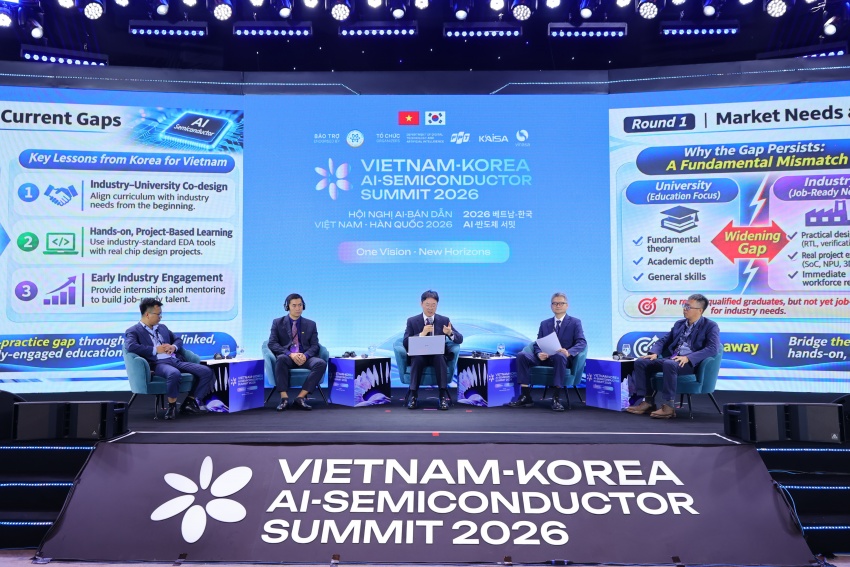 |
| Participants discussed unlocking semiconductor cooperation. Photo: Bich Thuy |
The summit aimed to strengthen cooperation between Vietnam and South Korea in technology development, workforce development and semiconductor supply chains.
Vietnam aims to have at least 100 chip design companies, one small-scale chip fabrication plant and 10 semiconductor packaging and testing plants by 2030. The country also targets annual industry revenue exceeding $25 billion and the training of 50,000 semiconductor professionals with university degrees or higher.
To achieve this, Vietnam needs to develop domestic capabilities while expanding international cooperation to access technology and manufacturing expertise and participate more deeply in global supply chains. With its strengths in technology, manufacturing capabilities and international semiconductor business networks, South Korea is an important partner in this process.
VKAISS 2026 was organised to strengthen connections among government agencies, businesses, research institutions and educational establishments in both countries, translating cooperation orientations into specific programmes and activities.
At the summit, Vietnamese and South Korean businesses, associations and educational institutions exchanged eight MoUs focusing on three key areas: business and semiconductor supply chain connectivity; technology development; and workforce training. The agreements aim to leverage the complementary strengths of both sides, boost applied research, commercialise products, and expand market access opportunities.
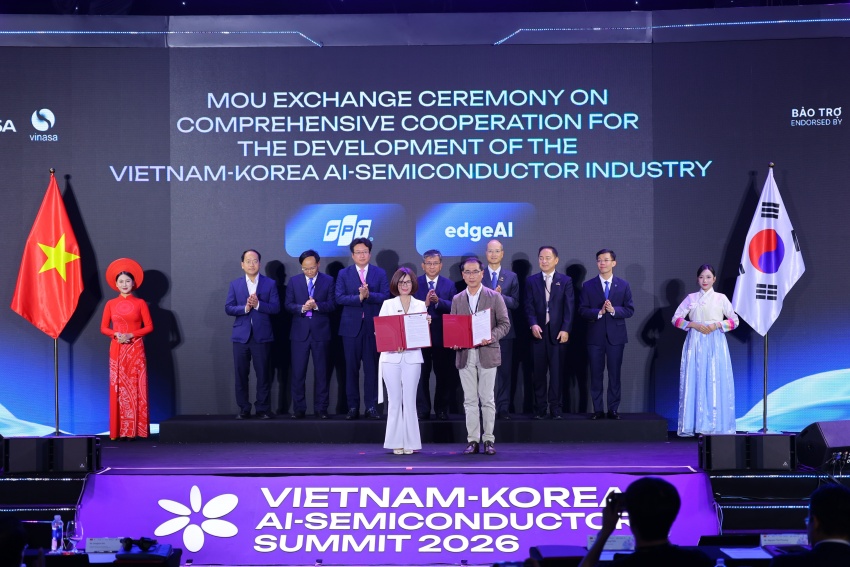 |
| MoU signing. Photo: Bich Thuy |
KAISA and the Bac Ninh Semiconductor Association established a cooperation relationship to connect South Korean semiconductor companies with electronics, semiconductor and supporting industry enterprises in Bac Ninh. The two sides aim to boost trade, expert exchanges and cooperation across chip design, manufacturing, packaging and testing.
In semiconductor packaging and testing, FPT established partnerships with HANA Micron, Supergate and EdgeAI, contributing to the expansion of its partner network across the semiconductor supply chain.
FPT and SKAIChips established a cooperation framework for semiconductor and AI projects. The two sides plan to explore the potential integration of SKAIChips' chips, circuit boards and low-power consumption technologies with FPT's AI models to develop practical application solutions. Areas of interest include food monitoring, electronic shelf labels, asset tracking and healthcare. The agreement also aims to identify customers and expand commercial opportunities in Vietnam, South Korea, Japan and Malaysia.
In education, FPT Polytechnic College signed cooperation agreements with Soongsil University and EdgeAI, while the Posts and Telecommunications Institute of Technology partnered with the Institute of Semiconductor Engineers. The parties will focus on exchanging lecturers, experts and learners; jointly developing specialised training programmes; conducting applied research; and organising industry-specific seminars.
Tran Trung Tinh, Deputy Minister of Science and Technology said that AI and semiconductors are two complementary fields that play an important role in the national technology self-reliance strategy.
“Vietnam's goals extend beyond attracting investment to gradually mastering technologies and participating more deeply in global value chains. On this basis, he outlined three key directions for cooperation with South Korea: shifting from investment and manufacturing cooperation toward joint research, design and product development; making high-quality workforce training a long-term pillar; and jointly building an open, safe and trusted AI–semiconductor ecosystem,” he said.
He also called on government agencies, research institutes, universities and businesses in both countries to translate these orientations into programmes and projects with clear objectives and roadmaps, while strengthening coordination to monitor the implementation of signed agreements.
Kim Kyung Ho, chairman of KAISA, said that combining South Korea's technology and semiconductor industrial capabilities with Vietnam's talented workforce and growing market would create strong synergies. He also expressed his expectation that VKAISS would develop into a sustainable cooperation platform between Vietnam and South Korea in AI and semiconductors.
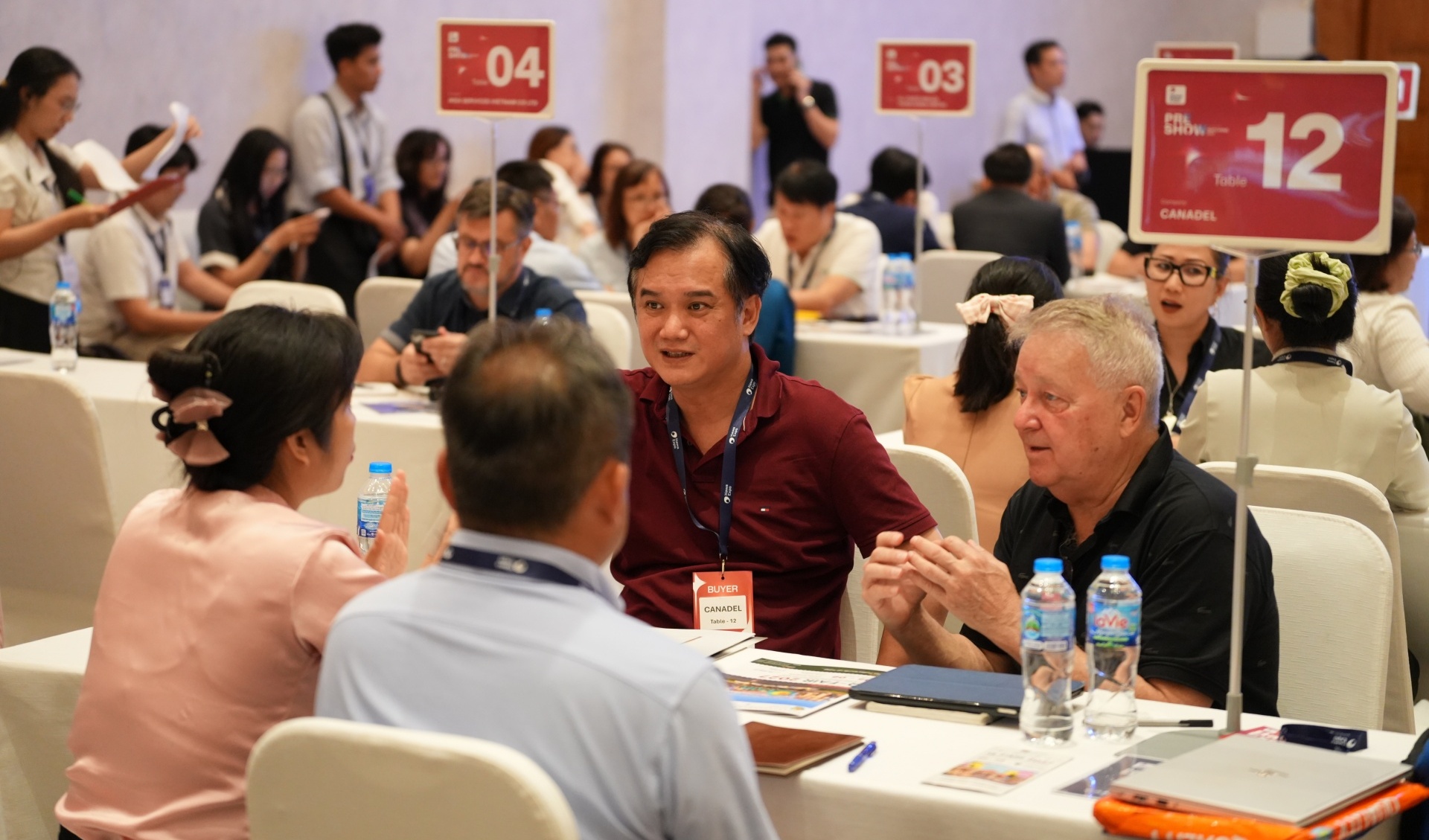
VKAISS 2026 also featured sessions on workforce development and AI–semiconductor supply chain connectivity, along with nearly 100 direct business matchmaking sessions between Vietnamese and South Korean companies.
As part of the event, the exhibition area showcased AI products and solutions, integrated circuit design, and chip packaging and testing technologies from FPT, HanelPT, VSAP Lab, Dnotitia, HyperAccel, ITDA Semiconductor, KAISA, Hanoi University of Science and Technology, and other participating organisations.
What the stars mean:
★ Poor ★ ★ Promising ★★★ Good ★★★★ Very good ★★★★★ Exceptional
 Tag:
Themes: Digital Transformation
- Vietnam and South Korea strengthen semiconductor cooperation
- Vietnam in global top 50 for digital competitiveness and AI
- Ericsson establishes R&D capability in Vietnam, reinforcing long-term commitment
- Industrial AI and Virtual Twins: Unlocking Vietnam’s next phase of industrial growth
- Building Vietnam’s digital future: Trustworthy agentic AI in 2026
Related Contents




More News
- Shopee livestream joins Ho Chi Minh City stimulus drive (November 12, 2026 | 15:36)
- Australia and Vietnam deepen food innovation and research ties (November 12, 2026 | 15:33)
- Vietnam in global top 50 for digital competitiveness and AI (November 12, 2026 | 15:25)
- BJC and MM Mega Market Vietnam connect supply and markets at Vietnam Foodexpo (November 12, 2026 | 10:05)
- US blueberry exports to Vietnam surge 160 per cent (November 11, 2026 | 14:39)
- Ericsson establishes R&D capability in Vietnam, reinforcing long-term commitment (November 10, 2026 | 18:52)
- Vietnam and Japan expand environmental cooperation under new deal (November 10, 2026 | 18:50)
- DKSH rolls out free breast cancer screenings in Ho Chi Minh City (November 10, 2026 | 09:34)
- Customs Department and VAFIE sign cooperation agreement to strengthen FDI engagement (November 10, 2026 | 09:19)
- US farm trade mission heads to Vietnam with record delegation (November 09, 2026 | 15:03)


 Mobile Version