
Digital transformation reshapes policy lending in Tay Ninh

Experience in the southern province of Tay Ninh shows that, while digitalisation saves time and costs, and makes transactions more transparent, the biggest challenge remains helping borrowers, particularly elderly people, become familiar with digital financial services.
 |
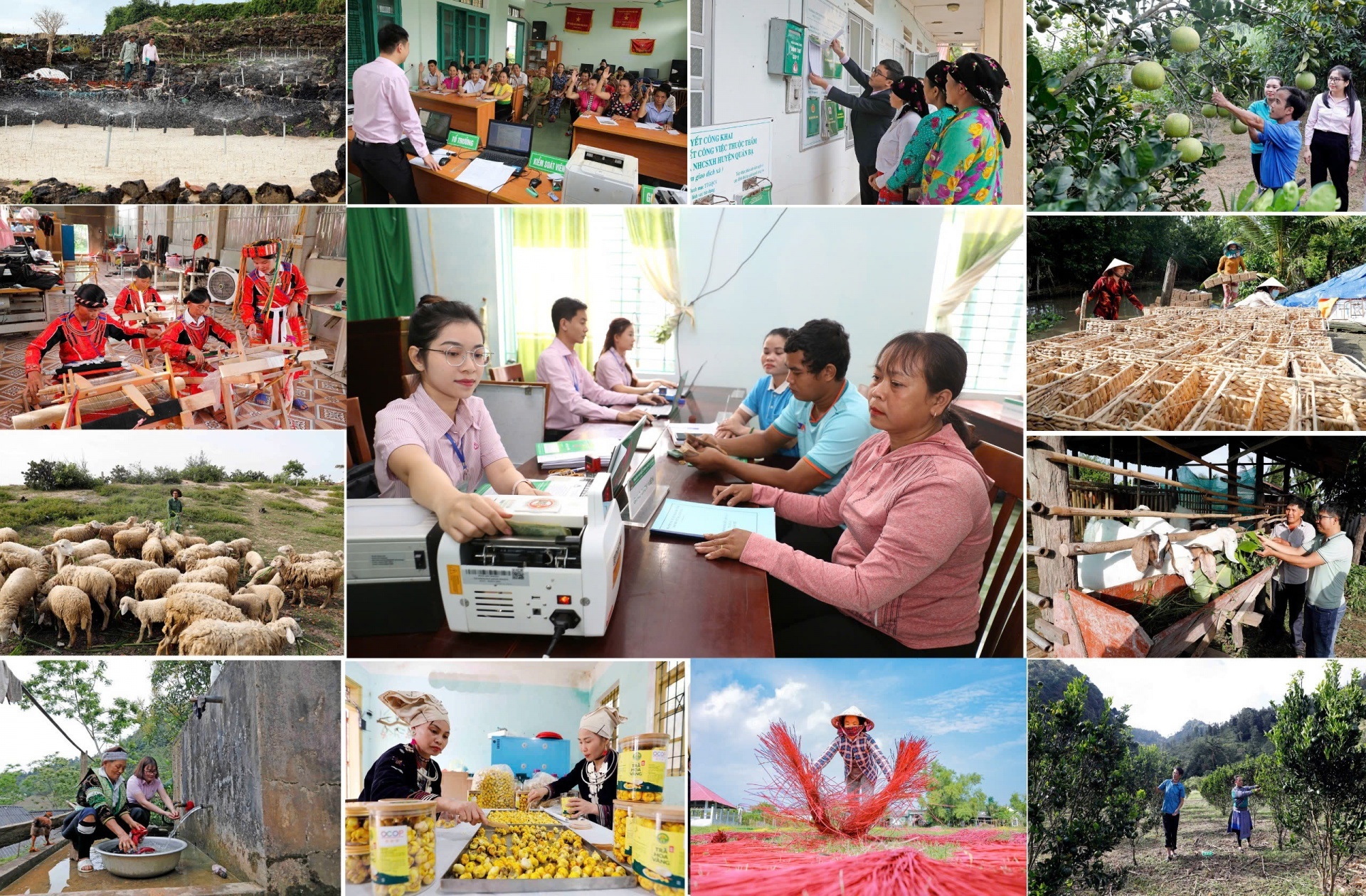
| Photo: VBSP |
Nguyen Thi Thanh Huong, a resident of Long An ward, Tay Ninh province, is among the borrowers under the student loan programme who have switched to paying interest through bank transfers since September 2026.
With annual loans of around $1,600 from the Vietnam Bank for Social Policies (VBSP), her family has significantly eased the financial burden of their children's education.
Previously, she had to arrange time each month to meet the head of her Savings and Credit Group to pay interest. Now, just a few taps on her phone allow her to complete the transaction at her convenience, without having to travel.
Huong was previously unfamiliar with electronic banking applications. With her children's guidance on basic operations such as paying electricity and water bills, and making purchases, she gradually developed the habit of conducting transactions online. This also laid the groundwork for her to adapt more quickly to VBSP's new payment methods.
At the Nhon Binh residential quarter Savings and Credit Group in Long An ward, the transition has been implemented through direct guidance for each member.
Group leader Tran Thi Mong Xuan said the group had 45 members, some of whom initially did not have bank accounts, did not use smartphones, or were unfamiliar with money transfer procedures.
To address these difficulties, the group leader informed members of the exact interest amounts due, guided them on current account holders' names and transfer amounts before making payments, and helped those without bank accounts open one.
For elderly members, families were encouraged to provide assistance. As a result, by September 2026, all members had switched to paying interest and making savings deposits through bank accounts.
This experience shows that digital transformation in policy credit is not simply about introducing technology into operational procedures. More importantly, it requires changing users' habits, particularly among groups with limited access to technology.
Improving management efficiency - safeguarding credit flows
In Tay Ninh, VBSP is focusing on two key areas: collecting monthly interest payments and savings deposits through bank accounts, and disbursing loans via bank transfers.
The aim is not only to reduce cash-based transactions but also to strengthen the monitoring and reconciliation of receipts and payments, minimise errors, and improve transparency in fund management.
However, implementation still faces challenges, as some borrowers remain accustomed to traditional transaction methods.
Elderly people, those without smartphones and those unfamiliar with banking applications often require repeated guidance. Concerns about transferring money to the wrong account or losing funds have also made some households hesitant to adopt the new methods.
According to Trinh Hoa Binh, head of Long An Savings and Credit Group, VBSP needs to work closely with socio-political organisations entrusted with managing policy credit programmes, as well as Savings and Credit Groups, to provide direct guidance in each area and help residents adapt to the new methods.
Those who are unable to complete transactions independently will continue to receive support. The target is for all borrowing households to pay interest and make savings deposits via bank transfers by November 2026.
Nguyen Thi Anh Hong, deputy director of Tay Ninh Branch of VBSP, said: “The branch is working with local authorities and relevant organisations to promote cashless transactions across the province.
Guidance is tailored to different groups, with particular attention paid to elderly people and those with limited exposure to technology, ensuring that borrowers can use the new methods safely and conveniently.”
The scale of policy credit in the province highlights the significance of this transition. As of September 2026, Tay Ninh Branch of VBSP managed an outstanding loan portfolio of approximately $537.8 million, serving more than 321,000 customers.
Of this total, loans for employment generation accounted for approximately $188 million; loans for clean water supply and rural environmental sanitation stood at around $160 million; and loans to poor households, near-poor households, and those recently escaping poverty totalled approximately $68 million. The student loan programme alone was supporting around 31,550 customers, with outstanding loans of approximately $97.72 million.
With an extensive customer network and a wide range of credit programmes, cashless transactions not only save borrowers time and money but also improve the efficiency of capital management and enhance transparency in credit operations.
At the same time, the role of Savings and Credit Group leaders is gradually shifting from directly collecting and remitting payments to helping residents access and use digital financial services.
In this way, digital transformation is changing not only transaction methods but also service quality, while helping ensure that policy credit funds are managed safely, and used more effectively.
 | VBSP expands policy lending to empower marginalised communities Vietnam Bank for Social Policies (VBSP) recorded strong credit growth and disbursement in the first five months of the year, laying the groundwork to fulfill its 2025 goal of expanding inclusive lending and supporting national development goals. |
 | New student loan policy eases financial burden for STEM education Vietnam’s new loan policy for STEM students offers low-interest financial support, easing economic pressure and empowering young talents to pursue education, research, and innovation without financial barriers. |
 | Policy lending accelerates in first half with $19 billion in loans Policy lending gathered pace in the first half of 2026 as the Vietnam Bank for Social Policies expanded concessional financing, creating jobs, supporting underprivileged groups and reinforcing the country's social security and inclusive growth agenda. |
 | Beyond loans, veterans turn capital into sustainable livelihoods After leaving the military, many veterans have turned timely access to credit into a springboard for building productive businesses, creating jobs and continuing to contribute to their communities. |
What the stars mean:
★ Poor ★ ★ Promising ★★★ Good ★★★★ Very good ★★★★★ Exceptional
 Tag:
Related Contents










Latest News
More News
- Visa: From rewards to recognition, customer loyalty is being redefined (November 10, 2026 | 14:58)
- Techcombank named Vietnam's best transaction bank (November 10, 2026 | 10:21)
- Building a culture of long-term investing in Vietnam (November 09, 2026 | 15:11)
- MoF proposes tax exemption for non-profit schools (November 09, 2026 | 15:06)
- New credit policy widens student loan access for disadvantaged families (November 09, 2026 | 15:01)
- VPBank wins two Euromoney cash management awards (November 06, 2026 | 10:07)
- Q3 earnings surge masks widening divide across financial and non-financial sectors (November 05, 2026 | 22:11)
- Vietnam and AIIB discuss expanding financial cooperation (November 05, 2026 | 17:11)
- Banks face rising bad debts amid push for debt market development (November 03, 2026 | 18:07)
- Fintech growth puts financial stability and resilience in focus (November 03, 2026 | 15:52)








 Mobile Version