
Dong Nai delegation learns from Hanoi rabies pilot

 |
| Photo: Viet Anh |
The delegation from Dong Nai City Sub-Department of Livestock Production and Fisheries, led by deputy director Nguyen Minh Hai, visited on November 13. Hanoi's approach follows the One Health direction, addressing the risk of rabies transmission at its source while safeguarding local livelihoods, supporting the national goal of no human deaths from rabies by 2030.
Rabies is a disease transmitted between animals and humans that is almost always fatal once symptoms appear, with dogs the main source of transmission. The collection, transport, slaughter, and sale of unvaccinated dogs and cats of unknown origin increase the risk of spread, and those directly involved in trading, slaughtering, and selling dog and cat meat form a high-exposure group. Supporting these businesses in moving away from the trade therefore helps reduce risk at the source, rather than responding only once outbreaks have occurred.
The project, a pilot model for rabies prevention and control that supports a phased transition away from the dog and cat meat trade in 14 Hanoi wards, was approved by Hanoi People's Committee in July last year. It is led by the Department of Agriculture and Environment and implemented by the Sub-Department of Livestock Production, Fisheries, and Veterinary Medicine, with technical support from the Soi Dog Foundation and the social enterprise Vietnam Social and Behaviour Change Communication for Sustainable Development (SBCC Vietnam). The model follows the One Health approach, connecting three pillars.
The first pillar is human health. The model reduces exposure for those who slaughter and process meat and for the community; improving understanding of disease prevention, wound treatment and post-exposure vaccination.
The second pillar is animal health. The model increases rabies vaccination rates for dogs and cats; strictly managing transport and slaughter activities; gradually improving the welfare of companion animals.
The third pillar is community and living environment. It reduces unhygienic slaughter points, improving food safety, and helping people to have stable and more civilised livelihoods.
The model operates through interagency coordination among the veterinary, health, police, and market surveillance sectors, commune, and ward authorities, and the residential community itself.
The core point that Hanoi shared with Dong Nai is the combination of state management and support for people. Business owners are encouraged to voluntarily stop trading, and are then accompanied through three steps: vocational training, startup support, and market linkage. People are respected and choose the occupation that suits their family's circumstances, which makes the transition more sustainable.
After more than one year of implementation in 14 wards, 28 businesses have stopped trading in dog and cat meat, 25 households have registered to take part in the livelihood transition, and Giang Vo Ward has become the first ward with no more of this activity. Changing occupation is a long process that requires the persistence of grassroots authorities and the determination of the trader themselves.
 |
| Photo: Viet Anh |
The delegation visited several businesses that have switched to new livelihoods and heard household owners describe their decision to change and their current lives. Having once slaughtered and sold dog and cat meat, these traders have moved into running billiards and beverage businesses, small trading, online sales, and more.
The owners' stories show that leaving their old trade was not easy: it was an occupation they had been attached to for many years and the main source of income for the whole family. What helped them overcome this was the persistent outreach of grassroots authorities and project staff, support in learning a trade and starting a business, and their wish for safer work and a more civilised life for their children and grandchildren. These accounts helped the delegation understand that livelihood transition means a change of behaviour as much as a change of work, built on trust between people and the government.
Ngo Dinh Loat, deputy director of Hanoi Sub-Department of Livestock Production, Fisheries, and Veterinary Medicine, said the city's model is still in its pilot phase and there is much left to do. "What we can share most are lessons from practice, including the things we have not yet achieved," he said. "Sustainable rabies prevention and control must begin at the source of infection, and the slaughter and sale of dog and cat meat of unknown origin, without proper veterinary hygiene conditions, is a very great hazard for the spread of rabies. If we want those who slaughter and sell dog and cat meat to transition into other economic sectors, we must accompany people so that they have new livelihoods."
Nguyen Minh Hai, deputy director of Dong Nai City Sub-Department of Livestock Production and Fisheries, said the delegation came to Hanoi in a spirit of learning. "We highly appreciate the One Health approach of the project in Hanoi, which places people at the centre and closely combines disease prevention and control with support for livelihood transition," he said.
"I went into the field myself and spoke to traders that have made the transition. They all said they agree with and support the policy through their own family's transition. That makes us feel very reassured. Dong Nai will study these experiences and apply them in a way that suits local conditions," he added.
The visit reflects the Dong Nai city veterinary agency's proactive approach to rabies prevention and control, learning directly from the Hanoi model to shorten its own implementation roadmap. It also shows that controlling disease at its source, linked to livelihood transition, is proving effective and drawing interest from provinces and cities across the country, all working towards the goal of no human deaths from rabies in Vietnam by 2030.
 |
| Photo: Viet Anh |
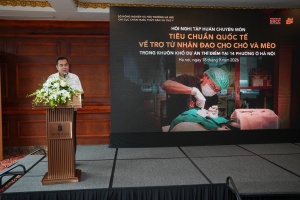 | Hanoi scales up training on humane euthanasia standards for dogs and cats Hanoi has expanded training on international standards for the humane euthanasia of dogs and cats to 120 ward officials, veterinary staff, and clinics. |
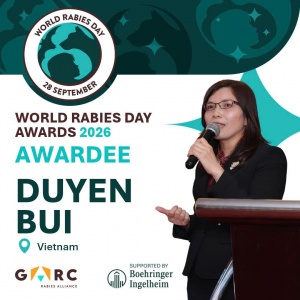 | Hanoi rabies project wins World Rabies Day award A pilot programme helping dog and cat meat traders in Hanoi shift to safer livelihoods has won international recognition for its work on rabies prevention and sustainable economic development. |
 | Hanoi students join push to stop rabies at source A Hanoi event has brought together students and animal welfare organisations in a push to stop rabies at its source, using youth engagement and education as the driving force. |
What the stars mean:
★ Poor ★ ★ Promising ★★★ Good ★★★★ Very good ★★★★★ Exceptional
 Tag:
Related Contents





Latest News
More News
- Chinese automakers in Vietnam: New competitive landscape and power of local partners (November 15, 2026 | 21:00)
- Vietnam and South Korea strengthen semiconductor cooperation (November 13, 2026 | 08:00)
- Shopee livestream joins Ho Chi Minh City stimulus drive (November 12, 2026 | 15:36)
- Australia and Vietnam deepen food innovation and research ties (November 12, 2026 | 15:33)
- Vietnam in global top 50 for digital competitiveness and AI (November 12, 2026 | 15:25)
- BJC and MM Mega Market Vietnam connect supply and markets at Vietnam Foodexpo (November 12, 2026 | 10:05)
- US blueberry exports to Vietnam surge 160 per cent (November 11, 2026 | 14:39)
- Ericsson establishes R&D capability in Vietnam, reinforcing long-term commitment (November 10, 2026 | 18:52)
- Vietnam and Japan expand environmental cooperation under new deal (November 10, 2026 | 18:50)
- DKSH rolls out free breast cancer screenings in Ho Chi Minh City (November 10, 2026 | 09:34)









 Mobile Version