
Disaster preparedness contest engages 8,000 students in Thai Nguyen

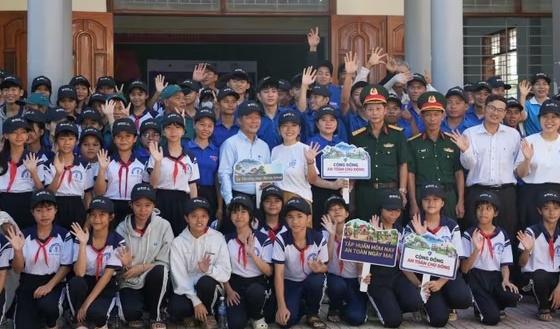
The month-long series of school-based extracurricular activities and competitions on disaster risk reduction concluded on October 8 with the provincial final of the 'Safer Homes - More Resilient Communities: Families and Communities Joining Hands for Disaster Risk Reduction and Climate Change Adaptation' contest.
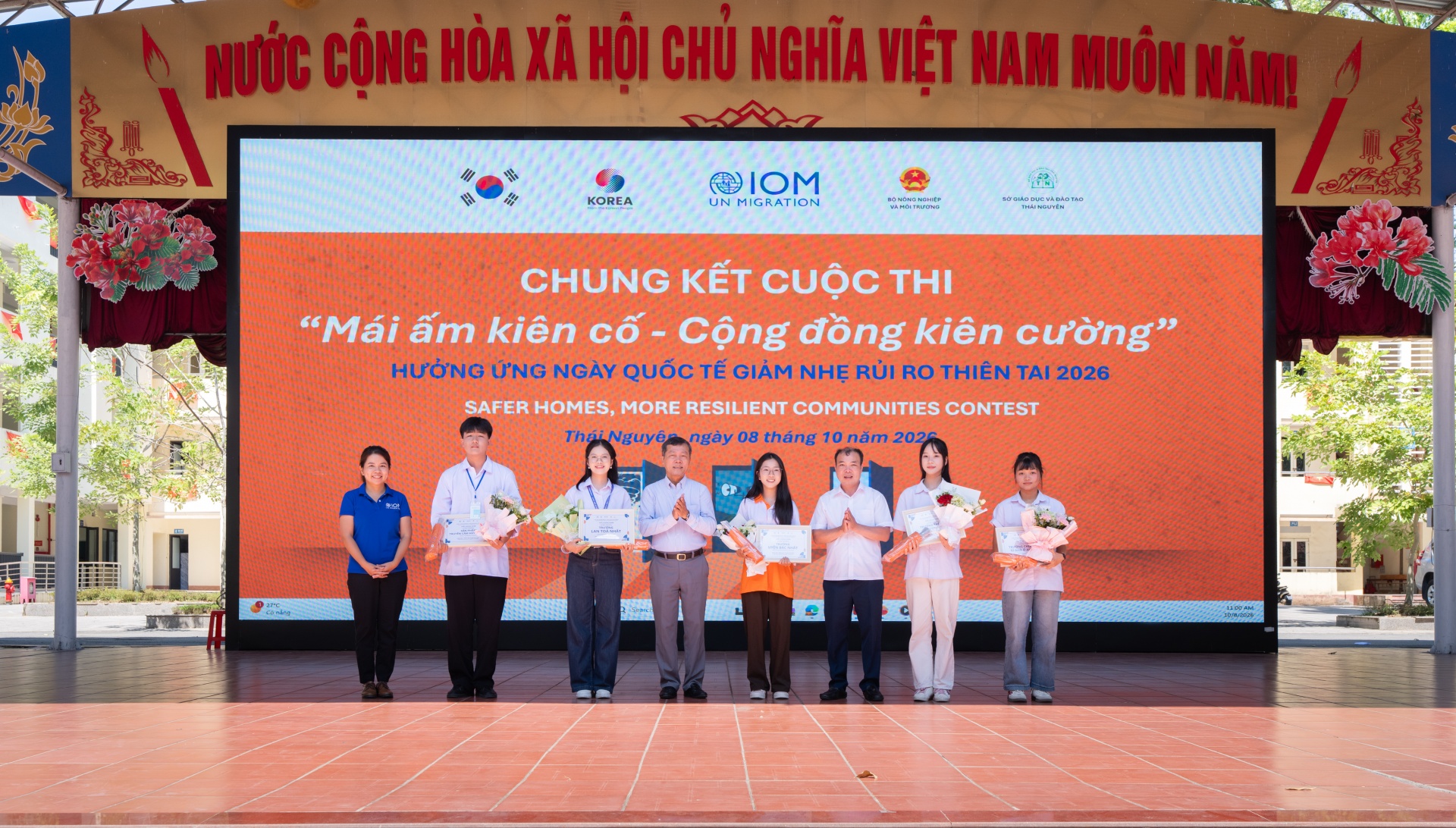 |
| Photo: IOM |
Nearly 300 participants, including representatives of government agencies, international organisations, participating schools, students, teachers and community members, attended the event.
The contest involved students and teachers from five high schools across Thai Nguyen Province. The month-long initiative culminated in a provincial final on October 8, and was held to commemorate the International Day for Disaster Risk Reduction, observed annually on October 13, under the theme 'Resilience Starts at Home'. It aimed to strengthen students’ practical knowledge of disaster preparedness and safer housing and encourage them to share and apply this knowledge within their families and communities.
With support from the South Korean government, the contest provided students with practical knowledge through a safer housing guidebook and quizzes developed by the International Organization for Migration (IOM) and Vietnam Disaster and Dyke Management Authority (VDDMA). Students applied what they had learned to identify local risks and propose practical solutions for safer, more disaster-resilient homes.
Following school-level activities, 50 top-performing students advanced to the provincial final to compete in the 'Safe Home Challenge', applying their knowledge to real-life scenarios. Five 'My Safe Home' videos, one from each school, were also selected, showcasing solutions developed by students together with their families. Finalist teams presented their videos and proposals to the judges.
“We learn from the success of the Quang Trung movement that community resilience is built from solid infrastructure or financial resources as well as from the solidarity, cohesion, and responsibility of everyone in the communities,” Nguyen Van Tien, deputy director general of VDDMA said.
Tien added that a safe home serves as the first line of protection against disasters. By identifying risks, discussing solutions and taking practical action with their families, students can help protect their homes and strengthen community resilience.
Reflecting this year’s IDDRR theme, 'Resilience Starts at Home', the contest extended learning beyond the classroom. Students assessed risks in their homes and surrounding areas, discussed them with family members and identified practical measures they could take together.
"Disaster preparedness begins with practical actions in our daily lives," Mitsue Pembroke, head of projects and partnerships at IOM Vietnam noted. "IOM remains committed to supporting the Vietnamese government in strengthening disaster preparedness and community resilience, drawing on its expertise and that of its partners in safer shelter and resilient housing to help students and their families identify risks and take practical steps towards safer homes and more resilient communities."
According to a representative of the Embassy of South Korea, post-disaster recovery should address immediate needs, support affected communities in rebuilding their lives, and strengthen their preparedness for future risks.
The South Korean government welcomes the active engagement of students in Thai Nguyen in learning about safer housing, disaster risk reduction and climate change adaptation, and in sharing this knowledge with their families and communities, the representative said.
The contest is part of a South Korean-funded project implemented by IOM to assist communities affected by the 2025 storms and floods in their recovery and strengthen their resilience to future disasters.
To date, IOM has supported affected families from immediate relief through to recovery. 2,000 households received multipurpose cash assistance immediately after the disasters, while 188 households in Cao Bang, Lang Son, Bac Ninh and Thai Nguyen received conditional cash assistance and technical guidance to repair and rebuild their damaged homes.
In addition to financial assistance, nearly 200 community members, construction workers and local officials participated in Build Back Better training to strengthen their practical knowledge and skills in safer housing construction.


What the stars mean:
★ Poor ★ ★ Promising ★★★ Good ★★★★ Very good ★★★★★ Exceptional
 Tag:
Tag:
Related Contents




Latest News
More News
- Citi's e for education campaign supports disadvantaged youth through vocational training (October 07, 2026 | 16:47)
- Hoiana launches scholarship programme for those in need (September 30, 2026 | 17:45)
- AEON Ekiden marks five years of connection (September 24, 2026 | 18:02)
- Keppel expands Bytes for Future programme to Hanoi (September 15, 2026 | 14:59)
- TCP and Central Committee of the Vietnam Youth Federation empower youth through community sport yards (August 26, 2026 | 15:13)
- SABECO strengthens community ties through Bia Saigon partnership (August 24, 2026 | 15:29)
- Government launches child protection programme for 2026–2030 (August 06, 2026 | 11:33)
- TMIV, Tohe host autism art event in Hanoi (July 13, 2026 | 17:06)
- TUI Academy Hanoi opens to bridge tourism skills gap (July 10, 2026 | 15:05)
- Panasonic to donate 1,000 flashlights to residents in Nghe An and Ha Tinh ahead of storm season (July 02, 2026 | 09:00)



 Mobile Version