
Vietnam’s first AI Law to take effect from March 2026

The National Assembly on December 10 adopted the Law on Artificial Intelligence, marking the first comprehensive legal framework of its kind in Vietnam. The legislation is expected to help the country align with global AI development trends and will take effect from March 1, 2026.
“The promulgation of the Law on Artificial Intelligence is an urgent requirement to institutionalise the Politburo’s resolutions and establish a specialised legal framework for a field with far-reaching impacts on the economy, society, national defence, security and human rights,” said Minister of Science and Technology Nguyen Manh Hung.
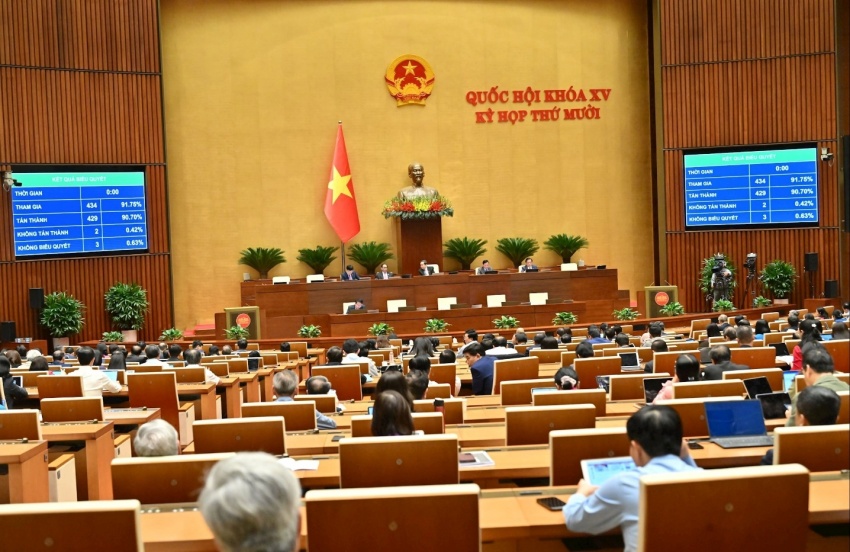 |
| Photo: Ministry of Science and Technology |
This law comprising 35 articles is designed with a management-for-development approach, ensuring a balance between risk control and innovation promotion, in line with international practices and supporting Vietnam's proactive integration with new technological standards.
The approach to building the law is to inherit humanity's experience in managing AI and apply it appropriately, including managing input through data; managing the framework for use through law and ethics; and managing consequences through accountability mechanisms.
Furthermore, the law is designed to strike a balance between managing and promoting AI development, ensuring a high level of security against key risks (drawing on the experience of the EU and South Korea), while simultaneously including policies to boost development (similar to Japan's approach) to capitalise on opportunities and avoid stifling innovation.
The law introduces a range of measures to encourage AI development, including the highest level of incentives and support for AI-related activities to stimulate innovation and market growth. It also establishes a controlled pilot, or sandbox, mechanism that allows selected projects to benefit from exemptions or reduced compliance requirements, alongside fast-track assessment and feedback processes defined by the government.
In terms of resources, the National Artificial Intelligence Development Fund will be reoriented to support strategic infrastructure and core technologies through dedicated financial mechanisms. The legislation further introduces a support-voucher scheme to help startups and small and medium-sized enterprises access computing infrastructure and training platforms, strengthening national competitiveness.
These directions are expected to reduce computing costs, remove barriers to market entry, and foster a more competitive and transparent AI ecosystem.
Alongside regulations on technology and management, the law places a significant emphasis on human resource development. The law requires the development of a long-term national AI human resource strategy; the integration of basic AI knowledge into general education; and encourages universities to open new majors, expand academic autonomy, and attract international experts. The national AI human resource development programme will contribute to the development of a high-quality workforce of AI experts and engineers in the future.
 | Vietnam plans to introduce Law on Artificial Intelligence Vietnam is planning to update its National Artificial Intelligence (AI) Strategy and Law on AI later this year. |
 | AI boom drives data centre surge in Southeast Asia AI is fuelling an unprecedented surge in data centre demand that Southeast Asia is not yet ready to meet. |
 | Innovation Day Hanoi 2025: AI-ready infrastructure to power Vietnam's future Schneider Electric, a leader in the digital transformation of energy management and automation, hosted Innovation Day 2025 in Hanoi on September 17, gathering more than 500 experts, customers, and partners from diverse sectors. |
 | Vietnam attends China-ASEAN ministerial roundtable on AI Vietnam is keen on expanding cooperation in training and developing AI talent, as well as promoting research and academic exchange between Vietnamese institutions and global partners. |
What the stars mean:
★ Poor ★ ★ Promising ★★★ Good ★★★★ Very good ★★★★★ Exceptional
 Tag:
Tag:Themes: Digital Transformation
- Vietnam-Australia forum boosts AI and digital technology cooperation
- Digital transformation shifts focus to added value
- Amazon Kuiper licensed for private satellite telecommunications network in Vietnam
- AWS ramps up security tools amid growing AI risks
- Machine vision and 3D: How logistics and warehousing are catching up with manufacturing
Related Contents







Latest News





More News
- Vietnam-Australia forum boosts AI and digital technology cooperation (October 13, 2026 | 11:30)
- Digital transformation shifts focus to added value (October 09, 2026 | 18:00)
- Melatec Dental Clinic - accompanying international clients on their smile care journey (October 09, 2026 | 17:25)
- 12 localities achieve double-digit growth in first nine months (October 09, 2026 | 17:00)
- CYE 2026 announces top 5 finalists (October 09, 2026 | 16:55)
- Robotics inspires Vietnam’s next generation of engineers (October 08, 2026 | 15:18)
- Vietnam among fastest AI adopters, Pearson-AWS study finds (October 07, 2026 | 12:26)
- Ho Chi Minh City Oncology Hospital signs MoU with Novartis Vietnam (October 07, 2026 | 10:36)
- Expanding education partnerships to drive mutual growth (October 06, 2026 | 16:04)
- VTG 2026 to showcase textile and footwear innovation in Ho Chi Minh City (October 06, 2026 | 16:00)







 Mobile Version