
New Law on High Technology sets incentives and safeguards

On December 10, the National Assembly adopted the amended Law on High Technology, introducing stronger incentives and support measures to create additional refinements for the domestic high-tech market. The law comprises six chapters and 27 articles, regulating high-tech activities, policies to encourage and encourage innovation, and measures supporting the development of strategic technologies.
The law affirms that the state identifies high technology and strategic technology development as a central driver of rapid and sustainable socioeconomic growth, while strengthening national defence, security, and technological self-reliance. It applies the highest levels of incentives in investment, taxation, land use, and related policies to high-tech and strategic technology activities.
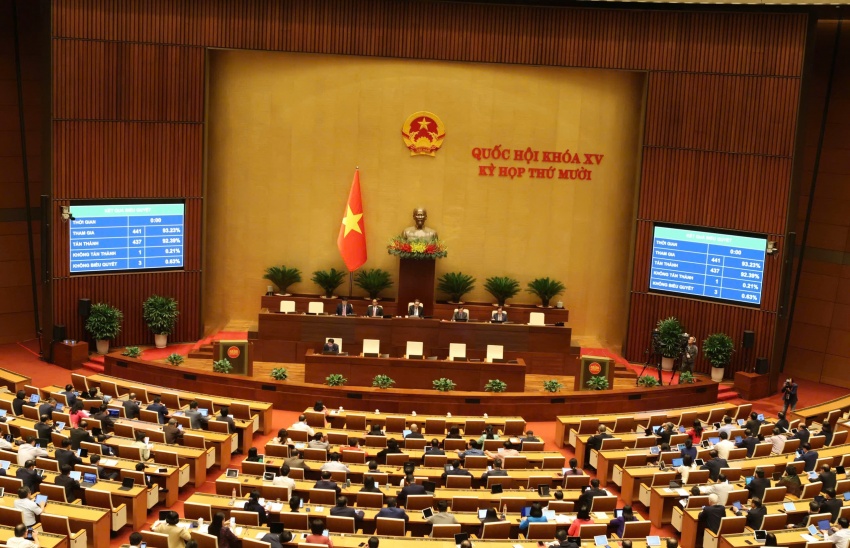 |
| Photo: MST |
The state implements a focused and targeted investment policy; prioritising the allocation of state budget funds for science, technology, and innovation to finance research, development, testing, application, and commercialisation of high-tech and strategic technologies; investing in the development of technical infrastructure, digital infrastructure, and technological infrastructure to meet the requirements of digital transformation, green transformation, and improving productivity, quality, added value, and competitiveness of goods and services.
It also has policies to support and strengthen linkages between research institutes, higher education institutions, and businesses to create a solid foundation for science, technology, and innovation; apply specific mechanisms to develop, localise, master, and apply technology; and develop high-tech enterprises, strategic technology enterprises, and high-tech and strategic technology startups.
The law sets out preferential mechanisms to attract, develop, and retain high-tech and strategic technology talent, alongside support for organisations investing in training and workforce development in line with science, technology, and innovation policies.
Under the law, policies on high-tech and strategic technologies will be issued and adjusted in a timely, transparent, and stable manner to support innovation, public-private cooperation, and ecosystem development. It also introduces controlled testing mechanisms to facilitate the rollout of new products and services, while strengthening policy communication and enforcement. The law prohibits the misuse of high-tech and strategic technologies that harm national interests, public health, the environment, social ethics, or national defence and security.
The law will take effect from July 1, 2026.
 | Intel reveals plans to expand operations in Vietnam US chipmaker Intel plans to shift its assembly, packaging, and testing operations from its Costa Rica facility to potential markets such as Vietnam, part of its ongoing global strategic transition and adjustments to optimise its manufacturing operations. |
 | Vietnam’s growth formula evolves as high-tech and green industries take lead Vietnam is entering a new phase of economic transformation where foreign direct investment (FDI), high-tech industries, environmental, social, and governance (ESG) commitments, and human resources quality will define its growth path. Industry leaders highlight that the next generation of industrial parks must evolve to be green, smart, and integrated to meet investors' rising standards and Vietnam's net zero ambitions. |
 | High-tech policy shifts must safeguard incentives International businesses are seeking more legal improvements to unlock technology investment inflows in Vietnam. |
 | High-tech law aims to boost innovation and investment The amended High-Tech Law is set to strengthen the legal framework for high-tech development and boost the country’s technological and innovation capacity. |
What the stars mean:
★ Poor ★ ★ Promising ★★★ Good ★★★★ Very good ★★★★★ Exceptional
 Tag:
Tag:
Themes: Digital Transformation
- Amazon Kuiper licensed for private satellite telecommunications network in Vietnam
- AWS ramps up security tools amid growing AI risks
- Machine vision and 3D: How logistics and warehousing are catching up with manufacturing
- Nvidia proposes areas of strategic cooperation with Vietnam
- Draft legal amendments target red tape and decentralisation
Related Contents









Latest News






More News
- Sojitz in Vietnam: 40 years from individual projects to a business cluster 'KATAMARI' (October 08, 2026 | 09:00)
- Coteccons targets 'Quality Growth' with 25 per cent dividend plan (October 07, 2026 | 13:00)
- Vietnam Education Forum opens UK Education Mission's Hanoi visit (October 07, 2026 | 12:27)
- Tax authorities deactivate TINs of nearly 180,000 businesses (October 07, 2026 | 12:08)
- World Bank raises Vietnam's 2026 GDP growth forecast to 7.4 per cent (October 07, 2026 | 11:41)
- Vietstock 2026 to spotlight livestock innovation and green transition (October 07, 2026 | 09:00)
- Vietnam’s GDP grows over 9 per cent in first nine months (October 05, 2026 | 18:45)
- Vietnam earns $56.3 billion from agro-forestry-fishery exports (October 05, 2026 | 18:32)
- DSV balances resilience and decarbonisation in supply chains (October 05, 2026 | 18:20)
- Electronics exports reach $175.4 billion in the first nine months (October 05, 2026 | 18:12)



Latest News





 Mobile Version