
Vietnam growth nears double digits, UOB raises forecast

 |
| Source: UOB |
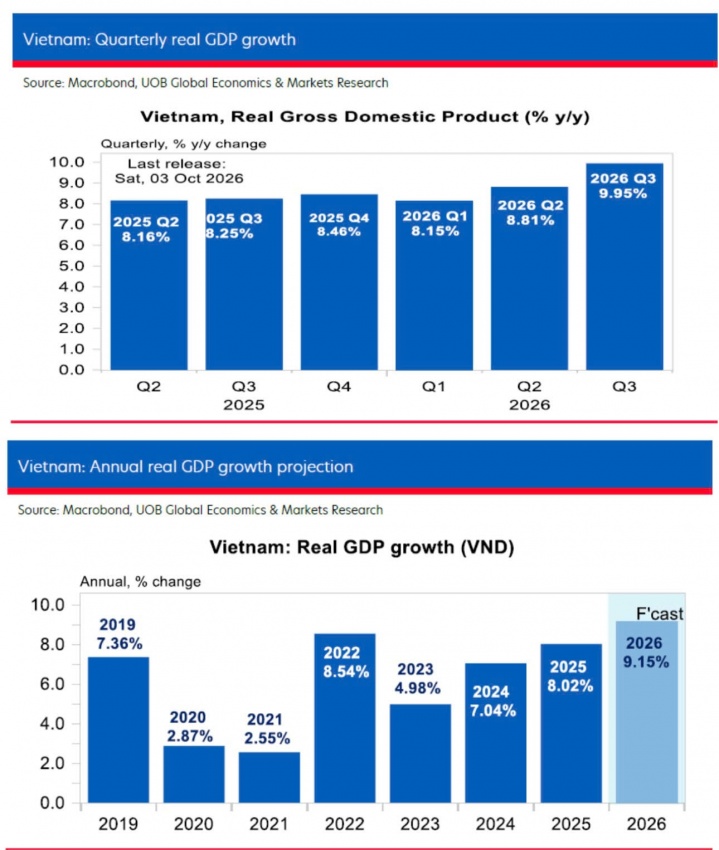
In a macro note released on October 13, United Overseas Bank (UOB) said data from the National Statistics Office showed GDP growth of 9.95 per cent on-year in the third quarter, up from a revised 8.8 per cent in the second quarter and above both the Bloomberg consensus of 8.65 per cent and UOB's forecast of 9 per cent.
It was the fastest quarterly pace since 2022, with upward revisions to the first and second quarters meaning growth accelerated in every quarter this year and nine-month growth reached 9 per cent, against 7.8 per cent a year earlier.
By sector, industry and construction expanded 12.5 per cent in the third quarter, services by a little over 9.5 per cent, and agriculture by 4.2 per cent. Over nine months, industry and construction grew by more than 11 per cent and accounted for just under half of the increase in gross value added, while services grew 8.7 per cent and contributed 45 per cent, and agriculture grew 4 per cent.
On the expenditure side, final consumption rose 8.5 per cent over nine months and gross capital formation by 17.9 per cent, the latter reflecting the public investment drive. Exports of goods and services increased 21.3 per cent, while imports rose 27.2 per cent. Growth is also spreading regionally, with 12 of 34 provinces and cities recording nine-month GDP growth of at least 10 per cent.
"Vietnam remains the fastest-growing economy in ASEAN by a wide margin," UOB noted.
Industrial production rose 16.7 per cent in September, with manufacturing up 17 per cent and electricity output up 15.5 per cent. Over nine months, industrial production was up 12.3 per cent and retail sales of goods and services rose 13.4 per cent. Electronics remain the anchor, with exports of computers, electronics, and components reaching about $111 billion by mid-September, underscoring Vietnam's exposure to the global AI build-out.
"Forward-looking indicators, however, are softer," UOB noted. The S&P Global manufacturing Purchasing Managers' Index (PMI) eased to just under 51.9 in September from 53.3 in August, a three-month low, and new export orders fell for a second month at the fastest pace since April. Business confidence, though, rose to its highest since February, and output price inflation eased for a fifth month.
The investment pipeline remains strong, reflecting continued supply chain diversification into Vietnam. Registered foreign direct investment surged 76.4 per cent to $50.36 billion over nine months, while disbursed investment rose 12 per cent to just over $21 billion, the highest nine-month level in five years. State-budget investment disbursement reached 50.5 per cent of the annual plan by end-August, up 18.5 per cent on-year, and rose 20.4 per cent in September, leaving roughly half of the record $42 billion plan for the fourth quarter.
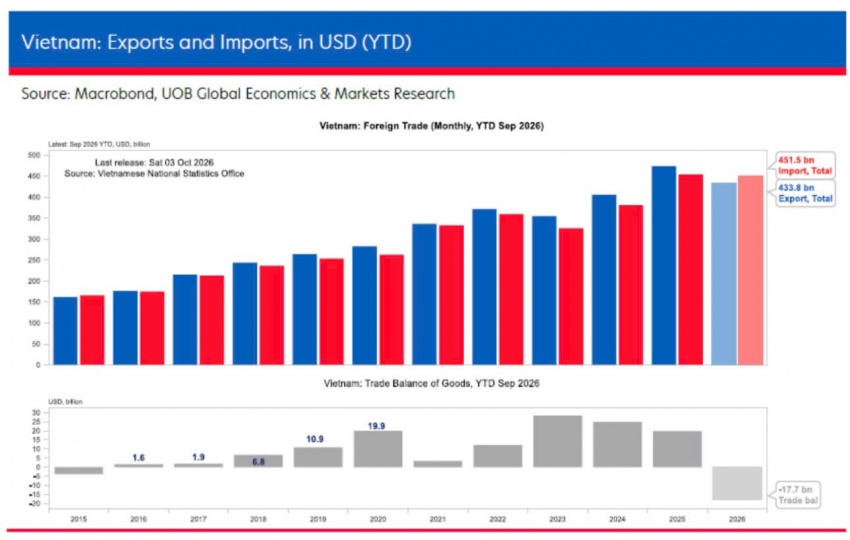
September exports rose 39 per cent to $59.5 billion, beating the 26.6 per cent consensus, while imports increased almost 46 per cent to $58.2 billion. "The resulting $1.27 billion surplus is the first after nine straight monthly deficits and broadly in line with our July call for the balance to return to surplus towards end-2026," UOB noted.
Over nine months, exports grew 24.5 per cent to $434.3 billion and imports rose 36.7 per cent to $453.7 billion, leaving a record $19.4 billion deficit against a near $17 billion surplus a year earlier. Energy remained the main drag, with refined fuel import values surging close to 80 per cent despite an 11.5 per cent rise in volumes, while crude oil volumes fell 13.5 per cent, but values rose 14.4 per cent. Production inputs made up 94 per cent of imports, consistent with capacity expansion rather than a consumption-led import boom.
The US remained the largest export market at $140 billion, with the bilateral surplus up nearly 24 per cent to over $122.6 billion, keeping Vietnam exposed to the Section 301 tariff regime and the 40 per cent transshipment penalty. With the fourth quarter seasonally strong for exports and energy prices off their peak, UOB expects further monthly surpluses, though the full-year balance is likely to remain in deficit.
 |
| Source: UOB |
Headline consumer price index (CPI) rose 0.62 per cent on-month in September, lifting inflation to 5.1 per cent on-year from 4.9 per cent in August, the highest since May. Transport led the increase at 4 per cent on-month due to higher domestic fuel prices, with new academic-year tuition fees adding to education costs. Core inflation was steadier at 4.45 per cent on-year.
The brief relief in June and July has reversed. Third-quarter CPI averaged 4.8 per cent on-year, and the nine-month average of 4.52 per cent now sits at the 4.5 per cent ceiling, with core averaging 4.26 per cent. Over nine months, fuel prices rose 11 per cent, resulting in housing and construction materials rising almost 6.7 per cent, food 4.7 per cent, and education 3.36 per cent.
The picture is mixed for the fourth quarter. Pass-through from energy remains visible, demand is strong, and credit growth is still running near 16 per cent on-year as of late August. In contrast, PMI output price inflation has eased for five months, and the base from the final quarter of 2025 is higher than earlier in the year.
"We expect headline CPI to hover around 5 per cent in the fourth quarter, pushing the full-year average to roughly 4.7 per cent, above the official target of 4.5 per cent," UOB forecasted.
Given the third-quarter upside surprise and upward revisions to the first half, UOB has raised its 2026 GDP growth forecast to 9.2 per cent from 8.5 per cent. This implies fourth-quarter growth of about 9.7 per cent, supported by year-end public investment disbursement, a seasonally strong export quarter, and record foreign investment inflows. It also allows for a slower pace than the third quarter given the high base of almost 8.5 per cent and softening export orders.
"For 2027, we raise our forecast to 8.8 per cent from 8.4 per cent, as the foreign investment pipeline translates into capacity and Resolution No.19-NQ/TW keeps the policy push on growth, industrial upgrading, and higher-value manufacturing," UOB noted.
"The official 10 per cent target would require roughly 12.5 to 13 per cent growth in the fourth quarter and likely remains beyond reach, though 2026 growth is set to beat last year's 8 per cent by a clear margin," UOB forecasted. Key risks include energy price spikes given the unresolved US-Iran conflict, a harsher US tariff outcome, power supply constraints, and delays in public investment execution.
What the stars mean:
★ Poor ★ ★ Promising ★★★ Good ★★★★ Very good ★★★★★ Exceptional
 Tag:
Tag:Related Contents








Latest News
More News
- Smart factories need skills, finance and trust to scale (October 14, 2026 | 17:33)
- Sanofi-Aventis Vietnam appoints new head of Vaccines and country lead (October 12, 2026 | 17:21)
- Measurable outcomes a must for businesses (October 12, 2026 | 09:27)
- Vietnam’s growth ambitions hinge on effective policy reforms (October 12, 2026 | 09:00)
- 100 entrepreneurs honoured with Thanh Giong Cup 2026 (October 12, 2026 | 08:00)
- French experts share AI and digital governance insights in Hanoi (October 11, 2026 | 08:00)
- Digital government push focuses on data connectivity and AI (October 10, 2026 | 08:00)
- Ho Chi Minh City holds dialogue with businesses to address operational hurdles (October 09, 2026 | 17:27)
- AI beginning to reshape recruitment criteria (October 09, 2026 | 16:49)
- Electronics firms boost raw material reserves sevenfold amid supply concerns (October 09, 2026 | 08:00)









 Mobile Version