
HCMC unveils 100-year plan, targets $7.7 billion in financial-centre investment

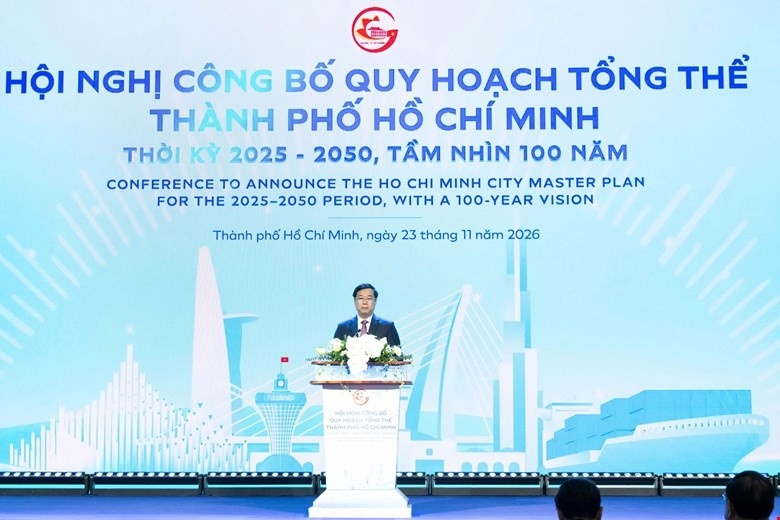 |
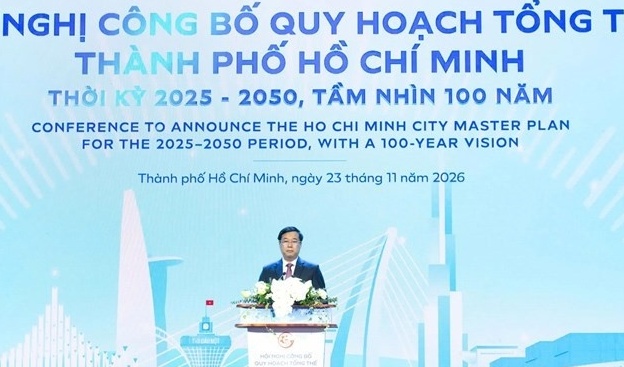
| The announcement ceremony for Ho Chi Minh City’s 100-year master plan. Photo: CTTDT Quoc Hoi |
The city is holding a month-long exhibition of the plan at the City Planning Exhibition Centre.
The plan was adopted by tHo Chi Minh City People’s Council under Resolution No.123/2026/NQ-HDND on October 30, and approved by the municipal committee the following day. It covers the city’s full administrative area after the merger: about 6,772. square kilometres, comprising 168 commune-level administrative units, including 113 wards, 54 communes and Con Dao Special Zone.
The population, including permanent residents, people staying for more than six months and converted population, is projected to reach 18 million by 2030, 20.5 million by 2035, 23 million by 2040, 25 million by 2045 and about 27 million by 2050.
By 2030, the city aims to become a civilised, modern, dynamic and innovative special-class urban area, serving as a centre for economics, finance, culture, society, science and technology, innovation, logistics and international integration. It also seeks to rank among the world’s 100 global and liveable cities.
By 2045, Ho Chi Minh City aims to become an international economic and financial centre, as well as a regional hub for culture, society, sci-tech, and innovation, ranking among the world’s 100 best cities. Its longer-term vision, to 2075 and beyond, is to become a liveable, smart, modern and comprehensively developed global city on a par with leading cities worldwide.
The plan targets average regional GDP growth of at least 10.5 per cent a year in 2026-2030. By 2030, regional GDP is expected to reach $200-$225 billion, with regional GDP per capita of at least $14,500. By 2050, the corresponding targets are $2-$2.5 trillion and at least $90,000 per capita.
A central priority is to shift the growth model away from reliance on capital, land and labour towards productivity, sci-tech, innovation, and higher value-added services.
The city is planned as a multipolar, multi-centred megacity, structured around five growth poles, five satellite centres, five strategic connectivity systems and 10 development management zones.
The five growth poles are the central international finance and services hub; an eastern innovation hub; a northern industrial and logistics hub; a southern seaport, free-trade and energy-industrial hub; and a western urban, education and healthcare hub.
The satellite centres are Con Dao; Vung Tau-Long Hai-Ho Tram; Hoc Mon-Cu Chi; Bau Bang; and Bac Tan Uyen. They are intended to complement the growth poles by expanding local jobs, services and infrastructure, while easing pressure on the urban core.
The five strategic connectivity systems cover north–south links, east–west links, multimodal connections between industry, production and logistics, multi-layered urban infrastructure, and green and blue networks.
Infrastructure priorities include public transport, urban rail, expressways, inter-regional links, seaports, logistics and flood prevention. By 2050, the urban rail network is planned to include 18 metro lines spanning about 960 km, alongside around 450 km of light rail and tramway.
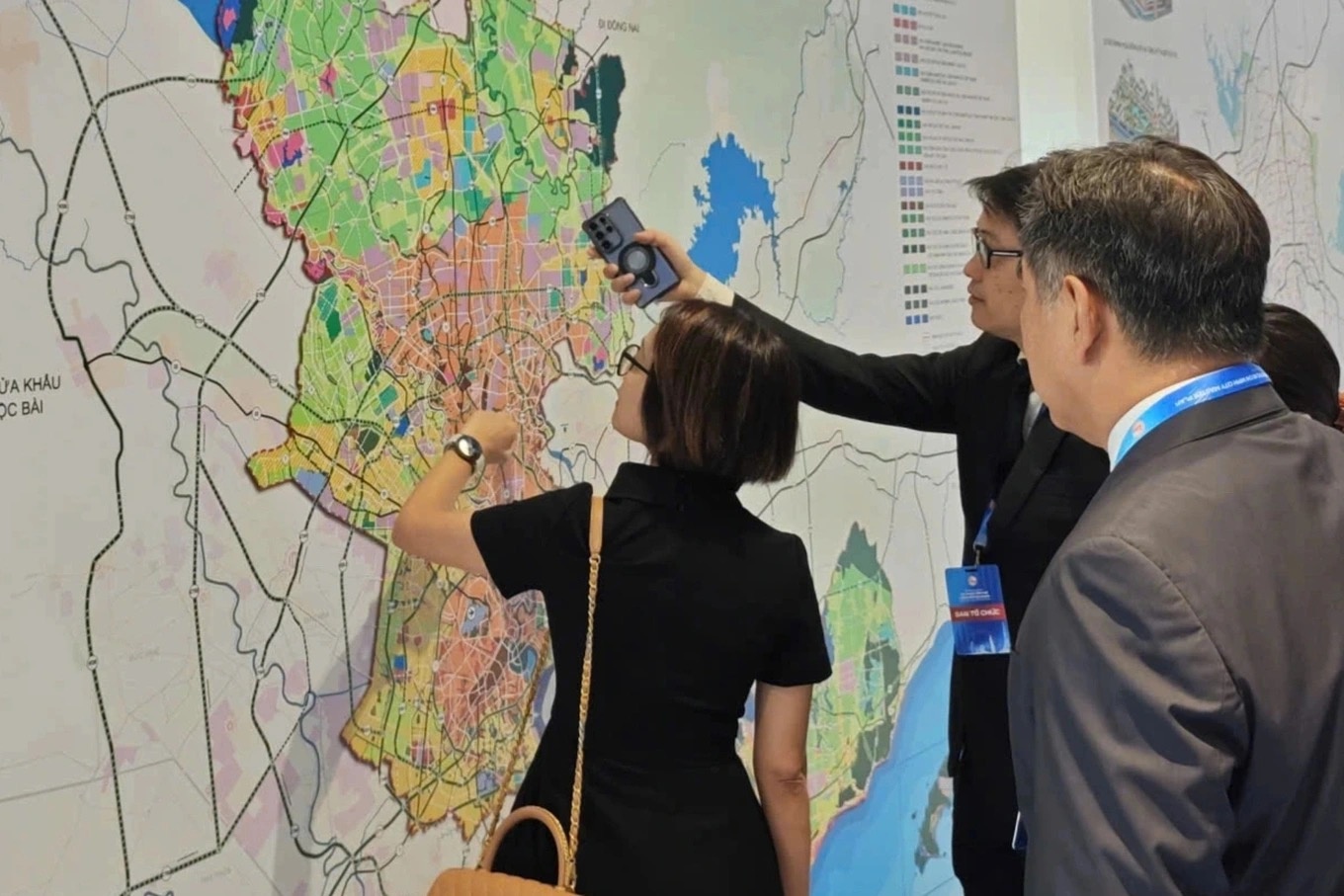 |
| The announcement ceremony for Ho Chi Minh City’s 100-year master plan. Photo: Bao Chuong/Dan tri |
The plan also prioritises quality of life through social housing, urban renewal, upgrades to old apartment blocks and canal-side areas, more green space, better education and healthcare, and climate adaptation. The city aims to develop 200,000 social housing units by 2030. Public transport is targeted to account for 35-50 per cent of passenger journeys by 2030 and 65 per cent in 2045-2050.
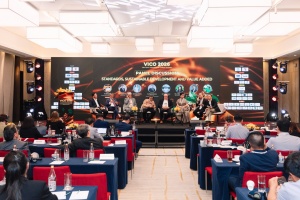
Separately, the Vietnam International Financial Centre in Ho Chi Minh City announced seven new members at the conference. Following two rounds of membership announcements, the centre is expected to mobilise and arrange about $7.7 billion in investment by 2030. This comprises $2.7 billion projected from its first 10 members and a further $5 billion linked to the seven new members. The figure represents expected capital mobilisation and investment, rather than funds already raised.
What the stars mean:
★ Poor ★ ★ Promising ★★★ Good ★★★★ Very good ★★★★★ Exceptional
 Tag:
Related Contents



Latest News
More News
- Vietnam and South Korea seek to deepen film industry cooperation (November 20, 2026 | 18:29)
- Ho Chi Minh City seeks to attract greater investment from Singapore (November 20, 2026 | 11:56)
- Ho Chi Minh City steps up efforts to restore distinct coral species (November 20, 2026 | 11:32)
- Ho Chi Minh City proactively adapts to climate change (November 19, 2026 | 12:39)
- Vietnam promote food exports to EU market (November 19, 2026 | 12:02)


Latest News



 Mobile Version