
Translating scientific evidence into practice for dengue control

The event was organised by the Vietnam Administration of Disease Prevention under the Ministry of Health (MoH), in collaboration with Hanoi Medical University (Centre for Training and Technology Transfer), the Centre for Community Health Research and Injury Prevention (CCHIP), Takeda Pharmaceuticals Vietnam, and other partner organisations.
It was attended by representatives from the Ministry of Health, the World Health Organization (WHO), and Departments of Health and Centres for Disease Control and Prevention (CDCs) from 34 provinces and cities nationwide.
 |
| The Dengue Summit 2026 in Hanoi. Photo: Thai Binh |
Held for the second consecutive year, the summit served as a forum for sharing the latest data, scientific evidence, and international experience in dengue treatment and prevention, helping translate scientific knowledge into practice in Vietnam.
The summit featured four thematic sessions, more than 15 in-depth presentations, and more than 60 scientific research posters, covering epidemiology, clinical practice, communication, prevention, digital technology, and health policy.
Dengue is one of the world's fastest-growing mosquito-borne infectious diseases, with an estimated 100-400 million infections annually.
In Vietnam, dengue has remained persistent for more than four decades. Since 1980, the country has recorded hundreds of thousands of cases each year, with deaths reported annually. The dengue incidence rate per 100,000 people is significantly higher than that of other infectious diseases - ranking first in incidence and second in mortality among infectious diseases in Vietnam.
In 2025, Vietnam recorded 184,903 cases - the highest in the Asia-Pacific region, surpassing the Philippines, Indonesia, and Bangladesh. In the first 10 months of 2026, Vietnam recorded 170,684 dengue cases and 21 deaths. The disease circulates year-round across all provinces and cities, and is spreading to northern mountainous provinces such as Tuyen Quang and Son La – the areas that previously reported few cases.
All four dengue virus serotypes are circulating in Vietnam, with dominant serotypes varying over time and by region. Cyclical shifts in circulating serotypes, combined with climate change, rapid urbanisation, and insecticide-resistant mosquito populations, have made dengue outbreaks increasingly difficult to predict.
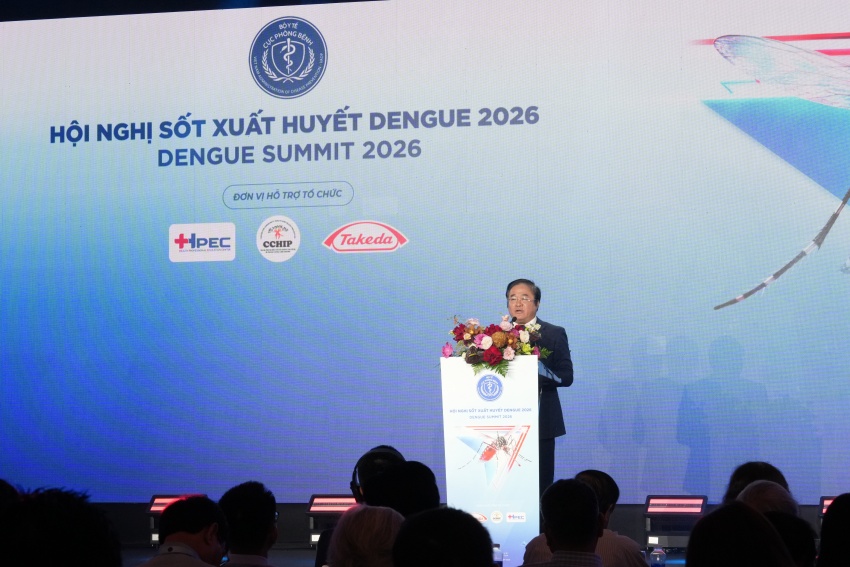 |
| Dr. Hoang Minh Duc, director general of the Vietnam Administration of Disease Prevention. Photo: Thai Binh |
Dr. Hoang Minh Duc, director general of the Vietnam Administration of Disease Prevention, said, “Vietnam needs decisive, proactive, and evidence-based disease prevention strategies. At the same time, adapting relevant international experience to local conditions, alongside vector control and greater public awareness, is essential for improving prevention outcomes and reducing the burden.”
During the plenary session, experts presented evidence showing how vaccination programmes have contributed to measurable progress in several countries.
Dr. Rosana Richtmann, director of the Infection Control Committee (ICC), Santa Joana Hospital and Maternity, São Paulo, Brazil, former president of the São Paulo Society of Infectious Diseases, said that Brazil has implemented dengue vaccination in its public health system since 2024, starting in 521 municipalities and expanding to all 2,752 municipalities, with 24 million doses distributed.
"Real-world data from São Paulo during 2024–2025 show that a two-dose schedule reduced the risk of symptomatic dengue by 73.1 per cent and the risk of hospitalization by 87.9 per cent. Protection was sustained despite the re-emergence of DENV-3. In Indonesia, dengue vaccination is also being implemented alongside health technology solutions to strengthen proactive prevention in high-risk areas," she said.
The draft 2026 National Guidelines for Dengue Diagnosis and Treatment, presented at the summit by the National Hospital for Tropical Diseases, introduced key updates to the prevention chapter. The draft underscores the importance of dengue prevention, particularly in the absence of a specific antiviral treatment. It recommends a comprehensive approach that combines dengue vaccination in accordance with current regulations with surveillance activities, the MoH recommended preventive measures, and vector control interventions such as bite prevention and elimination of mosquito breeding sites.
The coordinated use of proactive prevention measures is seen as a policy signal aligned with WHO recommendations for an integrated dengue control strategy.
To translate scientific advances into practice, coordination among regulatory agencies, the medical community, and healthcare partners is essential. As a scientific partner for the second consecutive year, Takeda Pharmaceutical Company Vietnam supports efforts to boost evidence-based prevention solutions and raise community awareness about dengue.
Benjamin Ping, country head, Takeda Vietnam, said that whilst the awareness of dengue in Vietnam was relatively high, research shows that most people in Vietnam do not fully understand the risks, severity and urgency associated with dengue to themselves and their families. More proactive preventive action is needed to reduce the burden of Dengue in Vietnam.
“Takeda is working alongside international partners and health authorities to support evidence-based prevention solutions aimed at protecting public health including the use of vaccination as part of an integrated prevention and control strategy," he said.
With dengue occurring year-round, experts at the summit called for coordinated implementation of proactive prevention measures at all levels - from strengthening epidemiological surveillance and treatment capacity to behaviour change and encouraging appropriate vaccination.
The vaccine currently available in Vietnam is the first and only dengue vaccine approved by the MoH. The vaccine is also recommended by WHO for use in countries with a high dengue burden and has received WHO prequalification for quality, safety, and efficacy.
To date, the vaccine has been approved in 43 countries, with over 32 million doses distributed globally, and has been integrated into public immunisation programmes in Brazil, Argentina, Colombia, Indonesia, Honduras, Paraguay, Peru, and Thailand.
What the stars mean:
★ Poor ★ ★ Promising ★★★ Good ★★★★ Very good ★★★★★ Exceptional
 Tag:
Themes: Healthcare Platform
- Translating scientific evidence into practice for dengue control
- Vaccination in comprehensive cardiovascular care: From recommendations to clinical practice
- Breast cancer awareness push gains
- Ministry of Health clarifies draft organ donation law amendments
- Ho Chi Minh City Oncology Hospital signs MoU with Novartis Vietnam
Related Contents









More News
- 79 per cent of people with chronic conditions say respiratory viruses disrupt daily life: survey (November 05, 2026 | 17:25)
- From adversity to empowerment: A woman's mission to help others (November 04, 2026 | 12:05)
- Vaccination in comprehensive cardiovascular care: From recommendations to clinical practice (October 31, 2026 | 08:00)
- Ministry of Health clarifies draft organ donation law amendments (October 28, 2026 | 12:22)
- SABECO, VFF expand Ambassadors of National Progress Award (October 19, 2026 | 13:17)
- Overseas employment costs fall for Vietnamese workers (September 09, 2026 | 12:20)
- SABECO strengthens community ties through Bia Saigon partnership (August 24, 2026 | 15:29)
- Vietnam strives to build safer digital environment to protect children online (August 21, 2026 | 17:19)
- RE:ACT challenge aims to turn youth ideas into community impact (August 10, 2026 | 10:09)
- Financing options for shock-responsive social protection in Vietnam (July 30, 2026 | 14:59)





 Mobile Version