
New investment model proposed for Hanoi's sci-tech projects

This was the assessment of Minister of Science and Technology Vu Hai Quan at the meeting between Prime Minister Le Minh Hung and the Standing Committee of Hanoi City Party Committee on June 11.
Specifically, the five significant advantages are the high-level political attention and determination from the city's leadership; increasingly improved institutions, with the Capital City Law and superior policies; and large financial resources capable of investing in long-term and large-scale projects.
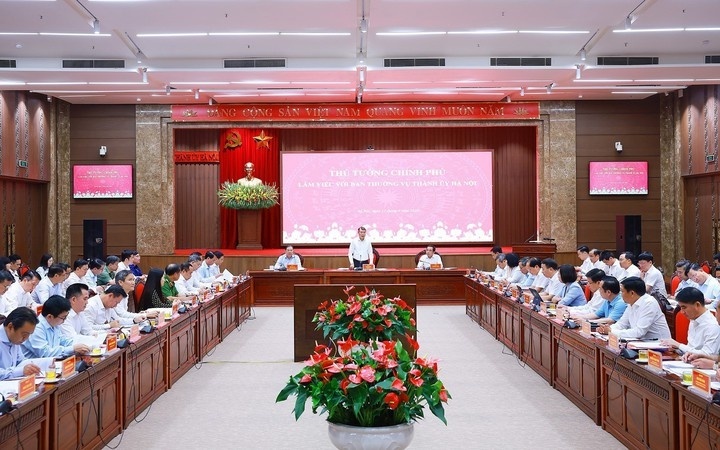 |
| Prime Minister Le Minh Hung chaired the meeting. Photo: The MST |
Furthermore, Hanoi has a high-quality workforce, with a concentration of leading universities and research institutes nationwide; it also has sufficient space, infrastructure, and land to implement activities related to sci-tech and digital transformation.
With these advantages, the minister proposed coordination between the Ministry of Science and Technology and Hanoi in implementing projects under a 40-40-20 investment model (central government, Hanoi, and enterprises). The focus would be on developing strategic technologies, supporting tech startups, and building key research, testing, and laboratory centres.
Hanoi is encouraging the formation of an innovation ecosystem, fostering a controlled testing mechanism for level-4 autonomous transportation technology, opening up space to promote technology commercialisation, and accelerating the implementation of a controlled testing mechanism for digital technology products and services.
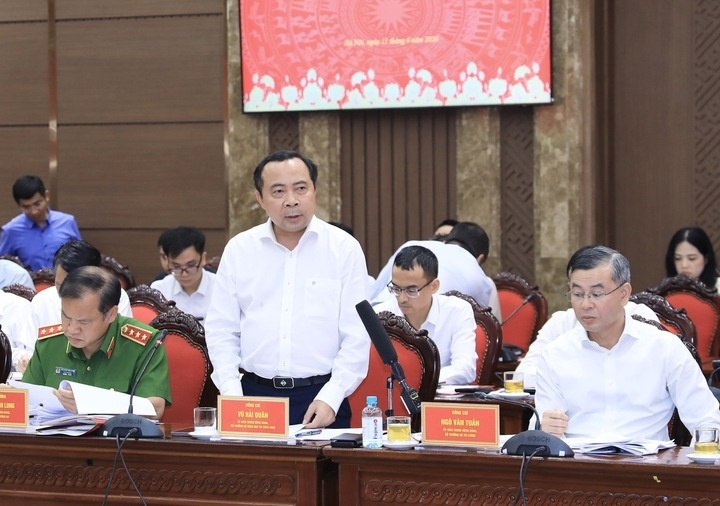 |
| Minister of Science and Technology Vu Hai Quan. Photo: The MST |
The acceleration in implementation of a controlled testing mechanism (sandbox) for digital technology products and services aims to create a favourable environment for innovation and promote digital transformation. This is one of the solutions to concretise the central government's major policies on the development of sci-tech, innovation, and digital transformation.
Simultaneously, it involves the implementation of the Law on Digital Technology Industry 2025, the Law on Science, Technology and Innovation 2025, and the government’s Decree 353/2025/ND-CP detailing some provisions and measures for organizing and guiding the implementation of the Law on Digital Technology Industry.
In the context of the rapid emergence of many new technologies and business models without a complete legal framework, the sandbox mechanism is implemented to create a safe testing space for businesses, while also providing regulatory agencies with more practical basis to refine policies.
In May, the Hanoi Department of Science and Technology established an evaluation council to allow controlled testing of the proposed 'Level 4 Autonomous Passenger Transport System', which includes mini-buses, robotaxis, and various types of cargo vehicles in controlled traffic zones, submitted by Phenikaa-X JSC.
Implementing this controlled testing mechanism will contribute to creating a practical foundation for the research, application, and development of smart transportation solutions in Hanoi in the future, gradually bringing the capital city closer to the goal of becoming a smart and modern city.
 |
| Remote monitoring of delivery robots. Photo: The MST |
Furthermore, the HITCHub innovation space kicked off at Hoa Lac High-Tech Park in Hanoi in May will also contribute to boosting research, incubation, testing, and commercialisation of technology in Hanoi.
Le Thanh Son, deputy head of the Management Board of High-Tech Zones and Industrial Parks in Hanoi, said that Hoa Lac High-Tech Park aims to develop into a top high-tech, innovation, and startup centre in the country, with a development orientation towards 2030 and a vision towards 2045, adding that Hanoi has determined that to achieve breakthroughs, it must rely on sci-tech, innovation, and digital transformation.
"For innovation and development to be truly effective, we need to form a sufficiently strong, open, and interconnected ecosystem between the government, schools, businesses, and investors. HITC Hub was built to achieve that goal," he noted.
 | Vietnam’s digital growth bet As Vietnam races towards an ambitious double-digit growth target, policymakers and tech leaders are pushing to turn digital transformation, AI and regulatory sandbox reforms from long-term strategy into immediate economic momentum. |
 | Government urged to expand public procurement to create innovation Vietnam cannot continue relying primarily on capital expansion and labour growth if it wants to achieve double-digit economic growth, experts have said. Instead, the country needs to create stronger market demand for science, technology and innovation through concrete mechanisms. |
 | Vietnam and Japan boost cooperation in technology transfer and innovation Vietnam and Japan will strengthen cooperation in technology transfer, and support the innovation and startup ecosystem, as well as business connections between the two countries. |
What the stars mean:
★ Poor ★ ★ Promising ★★★ Good ★★★★ Very good ★★★★★ Exceptional
 Tag:
Tag:
Themes: Digital Transformation
- Vietnam-Australia forum boosts AI and digital technology cooperation
- Digital transformation shifts focus to added value
- Amazon Kuiper licensed for private satellite telecommunications network in Vietnam
- AWS ramps up security tools amid growing AI risks
- Machine vision and 3D: How logistics and warehousing are catching up with manufacturing
Related Contents






Latest News





More News
- Vietnam-Australia forum boosts AI and digital technology cooperation (October 13, 2026 | 11:30)
- Digital transformation shifts focus to added value (October 09, 2026 | 18:00)
- Melatec Dental Clinic - accompanying international clients on their smile care journey (October 09, 2026 | 17:25)
- 12 localities achieve double-digit growth in first nine months (October 09, 2026 | 17:00)
- CYE 2026 announces top 5 finalists (October 09, 2026 | 16:55)
- Robotics inspires Vietnam’s next generation of engineers (October 08, 2026 | 15:18)
- Vietnam among fastest AI adopters, Pearson-AWS study finds (October 07, 2026 | 12:26)
- Ho Chi Minh City Oncology Hospital signs MoU with Novartis Vietnam (October 07, 2026 | 10:36)
- Expanding education partnerships to drive mutual growth (October 06, 2026 | 16:04)
- VTG 2026 to showcase textile and footwear innovation in Ho Chi Minh City (October 06, 2026 | 16:00)





 Mobile Version