
Government urged to expand public procurement to create innovation

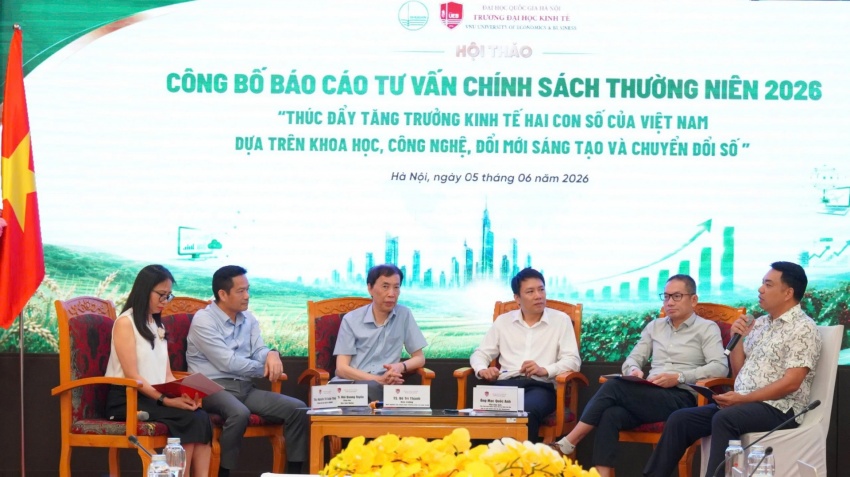 |
On June 5, the University of Economics and Business (UEB) under Vietnam National University, Hanoi announced its 2026 Annual Policy Advisory Report and held a seminar on boosting science, technology, innovation and digital transformation.
Nguyen Duc Hien, Deputy Head of the Party Central Committee’s Commission for Policies and Strategies, said Vietnam had set a high growth target of 10 per cent or more. In that context, transforming the growth model towards rapid, sustainable and knowledge-based development, driven by sci-tech, innovation and digital transformation, has been identified as a core engine for generating productivity, competitiveness and new added value.
However, he noted that this transition required urgent improvements in institutions, stronger technological absorption capacity among businesses, the development of suitable personnel and more effective implementation of public policies.
Assoc. Prof. Dr. Nguyen Truc Le, rector of the UEB, raised the question of what Vietnam should rely on to achieve economic growth of 10 per cent or higher in the coming years.
He stressed the need to turn sci-tech into a direct productive force, make innovation a source of national competitiveness, and position digital transformation as a key driver of productivity growth across the economy. Research outcomes, new technologies and innovative ideas, he said, must be translated into economic growth, jobs, higher incomes and better living standards for Vietnamese people.
 |
Luu Quoc Dat from the UEB argued that the new development model places knowledge, technology, data and innovation at the centre of growth. Under this approach, total factor productivity would increase, with growth increasingly generated by governance, technology, skills, data and continuous learning.
At the same time, a lower ICOR ratio would reflect more efficient use of capital and reduced dependence on pure investment expansion. Domestic enterprises, he added, would gain stronger control over production processes, products, data and markets.
“Transforming the growth model is not about simply adding more technology, but about reorganising the way growth is generated, with productivity and value-added serving as the central benchmarks,” Dat said.
He proposed a five-layer model linked into an integrated ecosystem in which the state serves as the foundation builder, the innovation system connects stakeholders and science, technology, innovation and digital transformation together create a continuous value cycle.
According to the proposal, the three pillars of the new economic development model would help Vietnam move away from extensive growth towards growth based on productivity, knowledge, innovation and data.
Sci-tech generates new knowledge, while technology transforms that knowledge into tools, processes and productive capacity. Innovation serves as the central mechanism for converting knowledge and technology into socioeconomic value. Meanwhile, digital transformation is not simply about digitalisation, but about restructuring governance, production and innovation based on data.
“The new development logic is no longer just about adding capital and labour, but about building the capability to create knowledge, convert knowledge into value and amplify that process through digital technologies,” Dat said. “The three pillars do not replace one another, but interact and complement each other to enhance productivity, value-added and new competitive capabilities. High and sustainable growth can only emerge when all three pillars continuously interact within the national innovation system.”
The UEB proposed that the government expand public procurement for innovation, create an institutional “green lane” and adopt KPI-based governance mechanisms.
“The focus should not be on issuing more policies, but on creating fast, measurable implementation mechanisms and building markets for innovation,” Dat said.
 |
The seminar also highlighted major obstacles to growth driven by science, technology and innovation, including limited technological absorption capacity among businesses, inconsistent digital infrastructure and institutions, gaps between research and practical application, and barriers related to capital, staff and digital transformation for small and medium-sized enterprises.
Experts called for breakthroughs in institutional reform, the development of digital infrastructure and national data systems, as well as stronger linkages among the government, universities, research institutes and businesses to encourage innovation and improve the economy’s competitiveness.
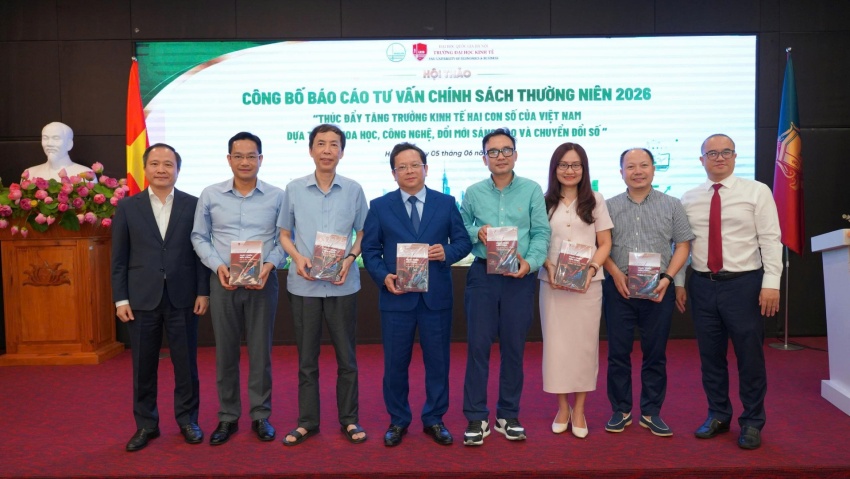
At the seminar, the UEB also launched its 2026 annual policy advisory publication series, consisting of three thematic reports: “Vietnam’s Growth Outlook and Economic Structure”; “Innovation, Digital Transformation and National Governance Capacity”; and “Sustainable Development and New Economic Models.”
The publications are the result of interdisciplinary research conducted by UEB experts, combining theoretical foundations, international experience and Vietnam’s development realities. They focus on strategic issues such as growth model reform, private sector development, institutional reform, digital transformation, and improving resource allocation efficiency.
Assoc. Prof. Le Trung Thanh, vice rector of the UEB, said science, technology, innovation and digital transformation must become the core foundation of Vietnam’s new growth model, providing momentum for rapid and green development while enhancing national competitiveness.
"Scientific research should be more closely linked with practical governance and business needs to help transform knowledge into productivity, technology and new economic value," he said.
 | World Bank projects Vietnam’s growth to moderate to 6.8 per cent in 2026 While headwinds are expected to temper the pace of expansion, World Bank's latest Vietnam Economic Update, released on May 15, projects growth will moderate to a 6.8 per cent in 2026, following an 8 per cent expansion in 2025. |
 | Vietnam’s digital growth bet As Vietnam races towards an ambitious double-digit growth target, policymakers and tech leaders are pushing to turn digital transformation, AI and regulatory sandbox reforms from long-term strategy into immediate economic momentum. |
 | ADB president backs Vietnam’s 'Era of National Rise' President of the Asian Development Bank Masato Kanda met Party General Secretary and State President To Lam on May 31, congratulating him on his historic re-election and expressing strong support for Vietnam’s new phase of high-quality, innovation-driven growth under the “Era of National Rise” agenda. |
What the stars mean:
★ Poor ★ ★ Promising ★★★ Good ★★★★ Very good ★★★★★ Exceptional
 Tag:
Tag:Related Contents









Latest News


More News
- Quandela and Quanova partner to deploy Vietnam’s first quantum computer (October 24, 2026 | 17:07)
- VinMetal Ha Tinh selected as a candidate to explore the Thach Khe mine (October 23, 2026 | 18:34)
- Japan's OC Global makes strategic investment in Vietnam's ECONUTI (October 23, 2026 | 18:18)
- Vietnam Railways seeks transfer of five stations and Dalat line (October 23, 2026 | 11:43)
- Vietnam and EU pledge deeper ties on security, trade, and resilience (October 23, 2026 | 11:30)
- South Korean firms seek predictable tax and customs policies in Vietnam (October 23, 2026 | 10:33)
- Thanh Hoa urged to remove obstacles to Cong Thanh LNG project (October 23, 2026 | 10:14)
- Vietnam pledges transparent tax and customs policies for South Korean businesses (October 23, 2026 | 10:08)
- KUKA Vietnam inaugurates new Hanoi headquarters (October 22, 2026 | 09:00)
- OJI Group invests in $110 million aseptic carton packaging plant in Vietnam (October 22, 2026 | 08:23)



Latest News





 Mobile Version