
Machine vision and 3D: How logistics and warehousing are catching up with manufacturing

 |
| Tran Thi Bao Tran, Vietnam country manager, Zebra Technologies |
In logistics, items are generally variable – individual products, parcels, packages, and pallets come in a range of shapes, sizes, and materials, and they’re usually presented to machine vision cameras in a less structured manner, with items on wide conveyor belts and loading areas in all sorts of positions and clusters. It means machine vision, 3D and industrial scanning technology needs to be able to deal with wider variations and unexpected scenes and formations.
Machine vision has been the preserve of the manufacturing industry for the past 25 years – it’s where the technology and use cases began and were hardened over decades. But over the past three to five years, the accessibility of neural processing, the development of 3D sensing, and AI algorithms have improved. Software suites and hardware platforms can apply these newer tools in manufacturing, such as more subtle defects or anomaly detection, as well as in much less structured environments like logistics.
Technical advances – Here’s the proof
Visual automation solutions generally slot into four main categories where machine vision, industrial scanning, AI, and 3D can be brought to bear on a host of applications between inbound and outbound for each of these four categories.
The first is vision-guided robotics to pick and sort items. For instance, a major industrial food manufacturer is securing lower error rates and higher throughput of goods using machine vision software guiding a robotic arm. The facility inspects its full range of packaged goods using this integrated solution. It can carry out efficient, intelligently automated picking with the robotic grip handling between 25 and 30 packages per minute, without damaging the items or packaging. It’s estimated that the solution has secured up to 75 per cent cost savings compared to traditional camera and lighting inspection approaches and eliminated the need for frontline workers to carry out repetitive, manual visual inspection and picking.
Second is inspection, for product integrity, damage detection and order completeness. For example, hyperspectral imaging can be applied to understand whether boxes have leakage, possibly signifying a damaged product, which may be seen with a colour camera but not necessarily with a normal greyscale camera.
The third is measurement, specifically dimensioning items, parcels and pallets to understand different shapes and sizes so they fit into various packages, loading areas, and vehicles. The logistics team at a leading national grocery retailer has cut workflow times by up to half with a new intelligent automation solution. It is built on a fleet of mobile devices with integrated parcel dimensioning software using modern time-of-flight sensors combined with AI algorithms. Working together, it virtually reconstructs and measures standard cuboidal parcels and irregular non-cuboidal items.
The final category is identification, which uses various methodologies such as barcode, data matrix, colour, optical character recognition, pattern, and shape. A global third-party logistics (3PL) provider receives up to 25 truckloads of goods each week at one of its major distribution sites from a leading fashion and lifestyle retail customer. The associated data is logged in the provider’s enterprise resource planning system. Each box is redistributed to its final destination, and the company has achieved over 50 per cent in time savings in inbound storage operations using fixed industrial scanners.
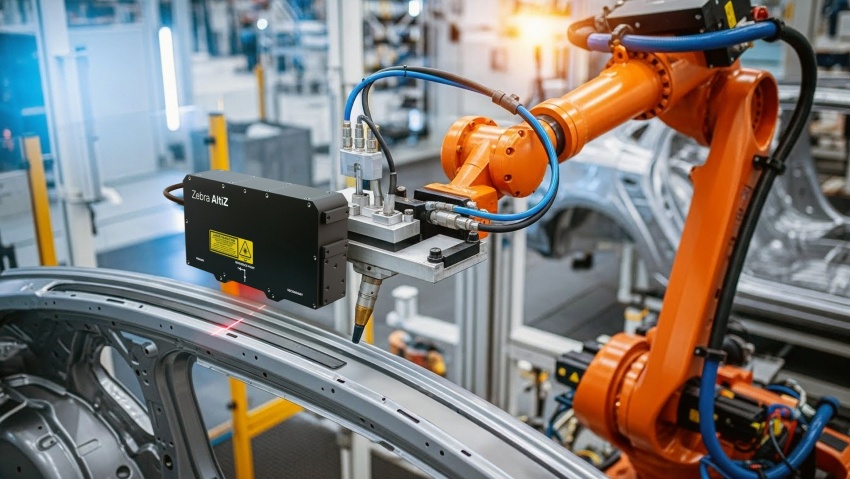 |
| Zebra Altiz 3D Profiler Inspecting Automotive Sealant Bead. Photo: Zebra Technologies |
During the first five months after its installation, the solution enabled the 3PL to intelligently automate the scanning and validation of around 700,000 packages. As the complete process time for each package has been dramatically reduced, follow-up processes have been further automated, and staff now only need to intervene with exception.
Today’s 3D casts new light
As with 2D machine vision, more structured manufacturing sectors have led the way with 3D scanning. On a global stage, automotive OEMs have utilised these advanced systems to secure a 10-15 per cent defect rate reduction for items as complex as car doors. Machine vision integrators create solutions built on dual-camera, single-laser Zebra AltiZ 3D Profile Sensors integrated with AI software. The 3D sensor scans items like car doors, capturing thousands of data points, and turns those into highly detailed point cloud and depth map representations for the AI software to interpret and inspect for defects. Thankfully, warehousing and logistics organisations are also catching up here.
In logistics, traditional structured light 3D scanners have been popular, as they provide sub-millimeter resolution and high accuracy for scanning static scenes. But if the sensor or the scene moves during the scanning process – which is always possible given the unstructured nature of logistics goods and conveyor belts – the 3D scan will be distorted. Traditional time-of-flight systems are also useful for certain use cases and offer very fast scanning speed and data acquisition, but some may compromise on resolution and noise levels.
However, newer generations of 3D sensing are delivering highly accurate scanning using unique parallel structured light technology. This allows for real-time, high-resolution 3D scanning of objects moving at speed, by constructing multiple virtual images within one exposure window. This opens new possibilities in warehousing and logistics robotic guidance, damage detection, advanced bin and conveyor belt picking, uniform and mixed palletisation and de-palletisation, and digital twinning.
As global industries continue advancing with machine vision, AI‑driven inspection and 3D sensing, Vietnam’s logistics and warehousing sector is also entering a rapid digitalisation phase. With e‑commerce growing around 25 per cent annually and the online retail market projected to reach $31 billion by 2025, demand for advanced visual automation - particularly robotic guidance, automated inspection and real‑time 3D dimensioning - is expected to accelerate significantly in the next two to three years.
This trajectory aligns with Vietnam’s Logistics Services Development Strategy for 2025–2035, with a vision to 2050, which emphasises digital transformation, automation, and the adoption of emerging technologies to build a modern, efficient and globally competitive logistics sector.
What the stars mean:
★ Poor ★ ★ Promising ★★★ Good ★★★★ Very good ★★★★★ Exceptional
 Tag:
Tag:Themes: Digital Transformation
- Vietnam transforming AI ambitions into business impact
- Work on digital technology building begins in Hanoi
- Vietnam-Australia forum boosts AI and digital technology cooperation
- Digital transformation shifts focus to added value
- Amazon Kuiper licensed for private satellite telecommunications network in Vietnam
Related Contents





Latest News



More News
- AMATA congratulates Kao Vietnam on 30 years (October 21, 2026 | 14:17)
- Deputy Minister of Finance meets Gujarat delegation in Hanoi (October 21, 2026 | 12:11)
- Vietnam and US discuss financial cooperation and preparations for APEC 2027 (October 21, 2026 | 12:07)
- Vietnam and Denmark sign MoUs to strengthen bilateral ties (October 21, 2026 | 08:00)
- Vietnam and Liechtenstein sign double taxation avoidance agreement (October 19, 2026 | 18:08)
- Creative Young Entrepreneur 2026 showcases five young businesses (October 19, 2026 | 17:59)
- IEAE Hanoi 2026 to spotlight smart electronics trends (October 19, 2026 | 17:44)
- Vietnam and EFTA member states sign free trade agreement (October 19, 2026 | 13:10)
- TC-HICT handles over 8.2 million TEUs since 2018 launch (October 17, 2026 | 16:56)
- Vietnam transforming AI ambitions into business impact (October 16, 2026 | 18:01)









 Mobile Version