
Industrial AI and Virtual Twins: Unlocking Vietnam’s next phase of industrial growth

How can AI help Vietnamese businesses improve productivity, product quality and operational efficiency while reducing costs?
Vietnam is already a manufacturing powerhouse in high stakes sectors, including electronics, automotive. In conversations with Vietnamese business leaders, we see a clear ambition to move from making products to designing and innovating them.
 |
| Samson Khaou, executive vice president, Asia-Pacific, Dassault Systèmes. Photo: Dassault Systèmes |
That is where the Virtual Twin makes the difference. A manufacturer can simulate a product, a production line or an entire factory virtually before investing in physical prototypes or equipment. This matters for Vietnamese manufacturers serving global brands. Customers expect faster launches and higher quality, and a virtual environment lets you deliver both without raising costs.
Generative capabilities push this further. Engineers can explore many more design options in much less time, and Industrial AI helps them choose the best one based on performance, cost and manufacturability.
The test is always business outcomes: shorter development cycles, less rework and lower operating costs, not technology for its own sake.
What is needed for Vietnamese manufacturers to move from initial digitalisation projects to company-wide digital transformation?
Many Vietnamese companies have made a good start with individual tools and systems. The real step forward comes when these stop being silo-ed projects and work as one connected system.
It begins with leadership. Digital transformation has to be owned by the top and senior management team as a business strategy, in line with Vietnam’s national push for digital transformation.
Vietnam’s industrial base includes many small and medium-sized enterprises, so the path has to be practical. Start with one high-value use case, prove the results, then scale across the organisation.
People are as important as technology. Vietnam has a young, talented and fast-learning workforce, and investing in digital skills will determine how quickly companies can move.
No one should do this alone. Companies, universities, government and technology partners need to work together, which is why we are bringing the community together at the 3DEXPERIENCE Forum Vietnam.
How can technology contribute to Vietnam’s sustainable economic growth and industrial competitiveness?
Digital technologies, AI and Virtual Twins help Vietnamese businesses raise productivity and strengthen operational resilience. This helps companies compete globally, and move towards higher-value activities rather than competing only on cost.
Virtual Twins let companies assess environmental impact and optimise resource use at the design stage, so sustainability is built in from the start. Sustainable products and operations are increasingly what global customers and export markets expect, so they are also a competitive advantage.
Growth that combines human expertise with AI is more durable, because it builds capability that stays in the country.
What are Vietnam’s key strengths and capability gaps in the semiconductor supply chain, and which segments should the country prioritise over the next five years?
Vietnam’s strengths are real: a strong electronics manufacturing base, growing assembly, testing and packaging activity, and a young, technically capable workforce. The gaps are in the more specialised upstream areas, such as advanced design capability, materials, equipment and deep engineering talent. Vietnam does not need to be everywhere in the value chain. Focus matters more than breadth.
Priorities should build on existing strengths and move up the value chain, including chip design, advanced packaging and testing, and supporting industries. Whatever the choice, a skilled workforce is the foundation, and it takes years to build, so it needs to start now.
As industrial AI and virtual twin technologies become part of everyday engineering and production work, what skills will Vietnam’s workforce need, and how can companies, universities and technology providers build that talent pipeline?
Digital fluency becomes a baseline for every engineer: working with data, simulation and AI as everyday tools. Collaboration across disciplines matters just as much. Design, production and sustainability are now one conversation.
Universities should teach with industrial tools on real problems, so graduates are productive from day one. Companies add internships and projects, and technology providers supply the platforms and certification. Learning also has to continue through a career. Many of the people who will use these technologies are already in the workforce.
What changes are needed in Vietnam to attract international corporations to develop technology and conduct R&D locally, rather than simply deploy solutions developed overseas?
Global companies look for three things: talent, predictability and an active ecosystem. Vietnam is moving in the right direction on all three.
The government has signalled openness. It wants foreign partners to take part in building technology infrastructure, including R&D centres, incubators and shared laboratories. That is key.
To turn openness into long-term commitment, companies need confidence that the policy environment will stay stable and supportive of R&D. Research and development is a multi-year investment, so predictability matters as much as incentive.
Closer ties between companies and universities help too, because local R&D pays off when talent and research are connected to industry.
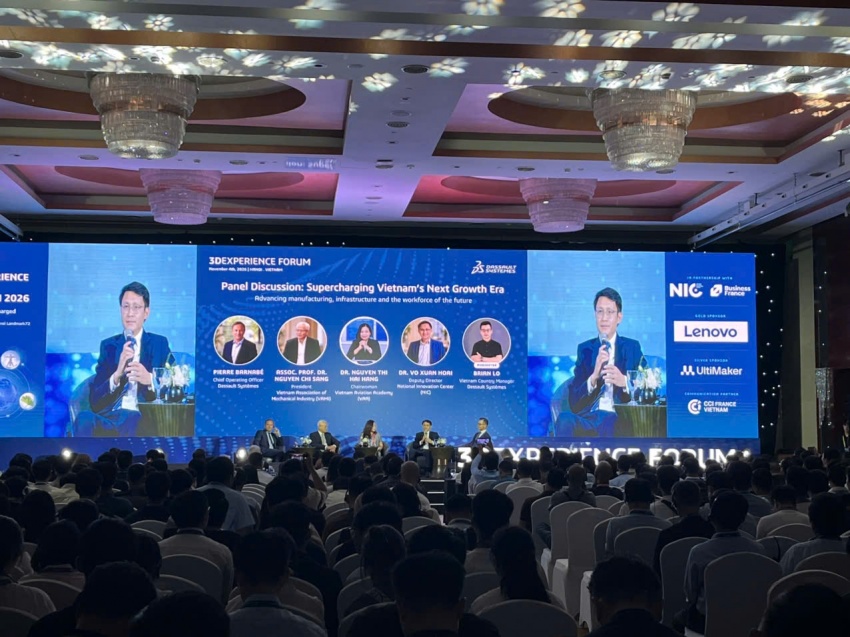 |
| The first 3DEXPERIENCE Forum Vietnam. Photo: Dassault Systèmes |
How can Dassault Systèmes support Vietnam’s innovation and industrial transformation beyond providing technology solutions?
Our role goes beyond software. We want to be a long-term partner in building Vietnam’s industrial capability. That includes talent - working with universities and industry to develop the digital skills Vietnam will need as AI becomes part of everyday work.
It also includes innovation capacity, such as the R&D and COE Centre we are establishing with the Vietnam Innovation Centre, which supports local technology development.
We chose Vietnam for the first 3DEXPERIENCE Forum Vietnam because of its momentum in manufacturing, its ambition for innovation and its growing role in global supply chains. Hosting the forum here, under the theme “Vietnam Supercharged,” reflects our commitment to Vietnam’s long-term industrial transformation, not a one-off event.
What the stars mean:
★ Poor ★ ★ Promising ★★★ Good ★★★★ Very good ★★★★★ Exceptional
 Tag:
Themes: Digital Transformation
- Industrial AI and Virtual Twins: Unlocking Vietnam’s next phase of industrial growth
- Building Vietnam’s digital future: Trustworthy agentic AI in 2026
- Dassault Systèmes advances industrial AI at 3DEXPERIENCE FORUM Vietnam 2026
- Vietnam accelerates 5G utilisation and prepares for 6G
- Vietnam strengthens inter-regional cooperation on enhancing AI capabilities
Related Contents





Latest News
More News
- Unlocking investment potential of TOD in Vietnam (November 05, 2026 | 09:00)
- TCP empowers young people to spread positive energy in the community (November 04, 2026 | 16:57)
- Roche Pharma Vietnam turns economic ties into patient impact (October 20, 2026 | 14:14)
- Ford innovations continue towards sustainable growth (October 19, 2026 | 09:40)
- Preparing professionals for a new business environment (October 19, 2026 | 09:13)
- From investment to impact: How Nestlé contributes to Vietnam’s growth (October 13, 2026 | 11:02)
- NSRP navigates global energy supply volatility (October 08, 2026 | 16:59)
- AI agents reshape Vietnam’s social commerce landscape (September 28, 2026 | 11:39)
- DKSH's blueprint for resilient supply chains (September 14, 2026 | 14:00)
- Vietnam’s challenge to turn market reform into long-term capital (September 08, 2026 | 09:16)







 Mobile Version