
Vietnam and EU pursue new value chains

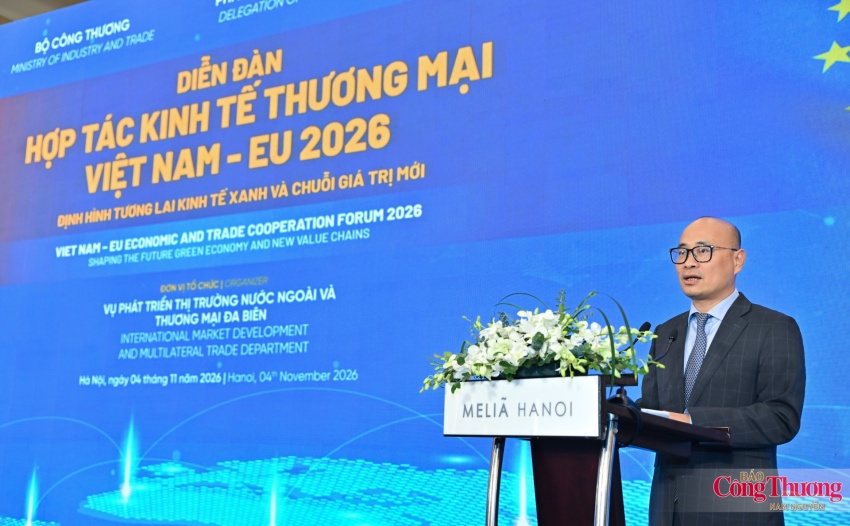 |
| Luong Hoang Thai, Deputy Minister of Industry and Trade. Photo: congthuong.vn |
Speaking at the Vietnam-EU Economic and Trade Cooperation Forum 2026, held in Hanoi on November 4, Luong Hoang Thai, Deputy Minister of Industry and Trade, highlighted the EU's importance as one of Vietnam's leading strategic partners, given its market size, technological capabilities, and complementary economic and trade structures.
The year 2026 marks a new chapter in Vietnam-EU relations, with the elevation of bilateral ties to a Comprehensive Strategic Partnership, building on the foundation established by the EU-Vietnam Free Trade Agreement (EVFTA).
After more than six years of implementation, the EVFTA has continued to support robust growth in bilateral trade, while expanding market opportunities and strengthening connections between businesses and supply chains on both sides.
Two-way trade between Vietnam and the EU reached $65.48 billion in the first nine months of 2026, up nearly 20 per cent on-year. The EU is currently Vietnam's fourth-largest trading partner, third-largest export market, and sixth-largest import market. Meanwhile, Vietnam is the EU's largest trading partner within ASEAN and its ninth-largest goods supplier globally.
"The EVFTA has delivered significant benefits beyond tariff reductions, helping businesses on both sides gain better market access while facilitating the flow of capital, technology, expertise, and supply-chain connections," Thai said.
"Looking ahead, we expect the EU not only to remain a key market for Vietnamese goods, but also to become a strategic and top-priority partner in upgrading trade, developing comprehensive and autonomous supply chains, and enhancing sustainability and Vietnam's position in global value chains," he added.
Vietnam aims to increase the proportion of exports to Europe comprising technology-intensive, deeply processed, and higher value-added products. At the same time, the country has substantial demand for European machinery, equipment, materials, advanced technologies, and green and circular solutions.
 |
| Photo: congthuong.vn |
Beyond trade, Vietnam is seeking to attract greater European participation in green and digital transformation, energy transition, and the circular economy.
Thai called on European partners to provide technical assistance, facilitate technology transfer, and invest in specific projects supporting these priorities, which align with the development objectives of both sides.
Energy cooperation is a particularly important area. Vietnam recognises the EU's contributions to the country's energy development and transition, notably through the Vietnam-EU Sustainable Energy Transition Programme and the Just Energy Transition Partnership (JETP).
Vietnam hopes the EU, as a key member and coordinator of the International Partners Group, will continue to translate its commitments into concrete financial support and technology transfers.
In particular, JETP should be further developed into a channel for mobilising long-term investment on commercially attractive terms, with participation from a wider range of stakeholders, Thai said.
However, he also noted that significant challenges remain despite the strong foundations provided by bilateral relations and existing trade agreements, including the EVFTA and the forthcoming EU-Vietnam Investment Protection Agreement.
Global economic uncertainty, intensifying trade competition, rising protectionism, and increasingly demanding non-tariff barriers are creating additional pressures for businesses. Meanwhile, the EU's expanding network of free trade agreements with other partners means that Vietnam can no longer rely solely on tariff advantages to maintain its competitiveness.
Instead, higher value-added production, compliance with standards, sustainability, and adaptability will increasingly determine how effectively Vietnamese businesses can capitalise on opportunities in the European market.
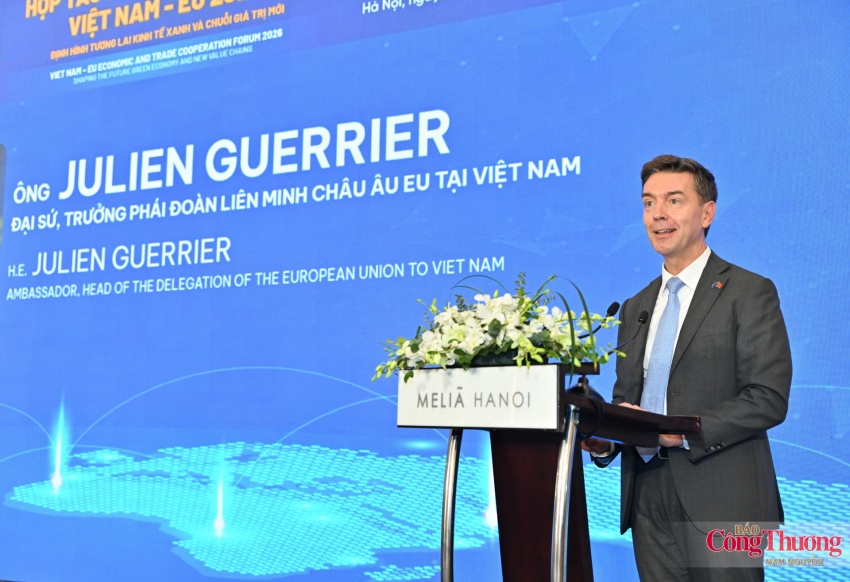 |
| Julien Guerrier, EU Ambassador to Vietnam. Photo: congthuong.vn |
Julien Guerrier, EU Ambassador to Vietnam and Head of the EU Delegation to Vietnam, emphasised that stronger economic relations would depend on businesses translating political commitments into actual investment and commercial projects.
"Governments can create the conditions, set the policy direction, and establish the rules. But at the end of the day, it is businesses that make investment decisions, build partnerships, transfer technology, train workers, and turn this ambition into reality," he said. "The priority was to ensure that shared ambitions were translated into concrete projects and tangible benefits for businesses and people on both sides."
Guerrier described the EVFTA as the cornerstone of bilateral economic cooperation, noting that it had already contributed to deeper trade and investment ties.
Vietnam is now the EU's largest trading partner in ASEAN and its 16th-largest trading partner globally, he said, describing this as a remarkable achievement given the relative size of Vietnam's economy and the geographical distance between the two regions.
Nevertheless, he argued that the full and effective implementation of the agreement would be essential to unlocking further growth potential. "Predictability, transparency, and consistency will be crucial. Investors need a business environment where rules are clear, implementation is reliable, and procedures are efficient," he said.
The EU supports Vietnam's efforts to improve law enforcement and implementation, shift from pre-approval controls towards risk-based management, and ensure more consistent application of regulations across provinces.
According to Guerrier, these reforms would strengthen investor confidence, reduce business costs, shorten project timelines, and create favourable conditions for attracting a new generation of high-quality European investors, particularly in the green economy and emerging industries.
He also explained the importance of ensuring that investment opportunities are accessible not only to large corporations and major projects, but also to small and medium-sized enterprises (SMEs), which form the backbone of both economies.
"The EU sees Vietnam as a strategic and trusted partner and wants to turn the current political momentum into practical business opportunities," he said.
With a dynamic Vietnamese economy, an ambitious reform agenda, a comprehensive free trade agreement, and growing political trust, the two sides have a solid foundation for further cooperation.
"If we continue to improve implementation, guarantee fair market access, and maintain a predictable and transparent investment climate, then I am very convinced that the next chapter of EU-Vietnam economic cooperation can be even more ambitious than the last," Guerrier said.
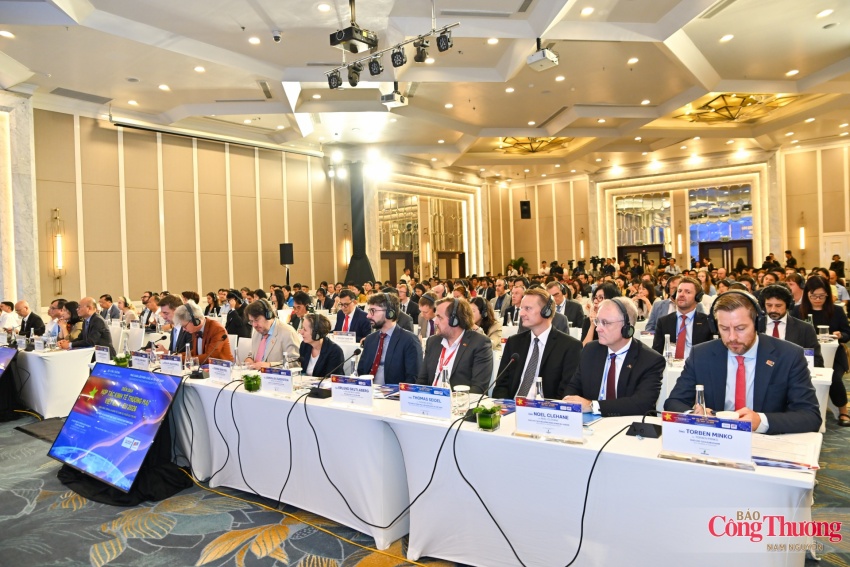
The forum provided a platform for policymakers, business associations, and companies from Vietnam and the EU to exchange views on market developments, address obstacles to trade and investment, and identify opportunities in energy, industry, green finance, and emerging economic sectors.
It also offered businesses an opportunity to share practical experience and explore partnerships to strengthen supply chains and capture new opportunities arising from the green transition.
 | Vietnam and EFTA member states sign free trade agreement Vietnam and representatives of the member states of the European Free Trade Association have signed a free trade agreement in Hanoi. |
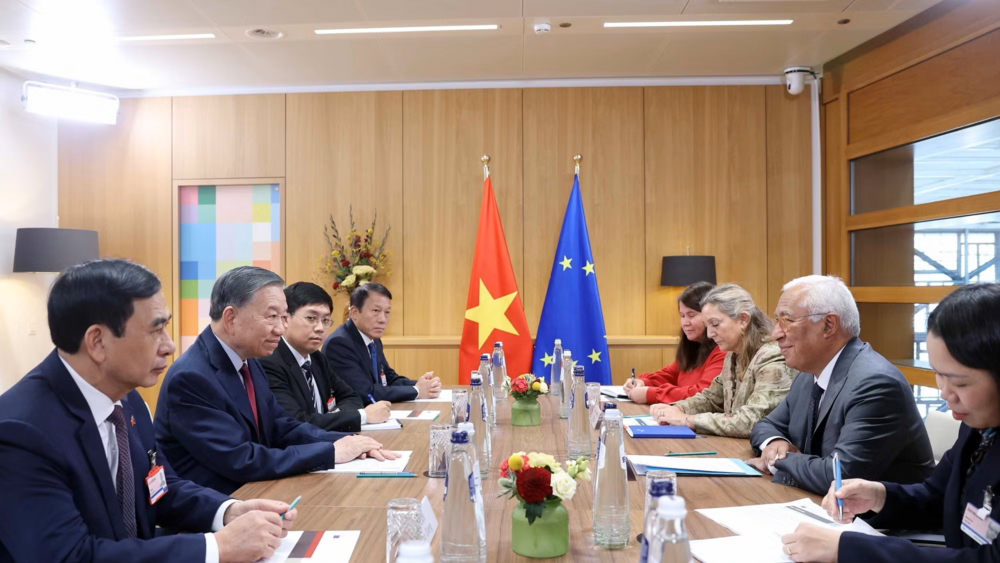 | Vietnam and EU pledge deeper ties on security, trade, and resilience Party General Secretary and State President To Lam has held talks in Brussels with European Council President António Costa and European Commission President Ursula von der Leyen on bilateral cooperation, regional security, and global challenges. |
What the stars mean:
★ Poor ★ ★ Promising ★★★ Good ★★★★ Very good ★★★★★ Exceptional
 Tag:
Related Contents






Latest News
More News
- Vietnam emerges as Southeast Asia’s fastest-growing digital economy (November 05, 2026 | 11:53)
- Vietnam accelerates 5G utilisation and prepares for 6G (October 30, 2026 | 18:28)
- Vietnam and Cambodia customs agree 2027–2028 cooperation plan (October 30, 2026 | 13:46)
- Vietnam strengthens inter-regional cooperation on enhancing AI capabilities (October 29, 2026 | 15:32)
- First zero-direct-emission electric barge operates in Vietnam (October 29, 2026 | 14:41)
- Deputy Finance Minister meets Chinese State Council research delegation (October 29, 2026 | 14:25)
- Vietnam and Denmark hold sixth intergovernmental committee session (October 28, 2026 | 12:35)
- Ho Chi Minh City announces first 10 official members of VIFC-HCMC (October 28, 2026 | 12:27)
- Science and tech funding disbursement set to accelerate (October 28, 2026 | 12:23)
- Geleximco and Chery forge strategic partnership to advance high-tech industrial development (October 28, 2026 | 10:00)




 Mobile Version