
Vietnam and Japan step up agricultural market access

The agreement followed talks on November 6 in Japan between Vietnamese Minister of Agriculture and Environment Trinh Viet Hung and Japanese Minister of Agriculture, Forestry and Fisheries Takebe Arata.
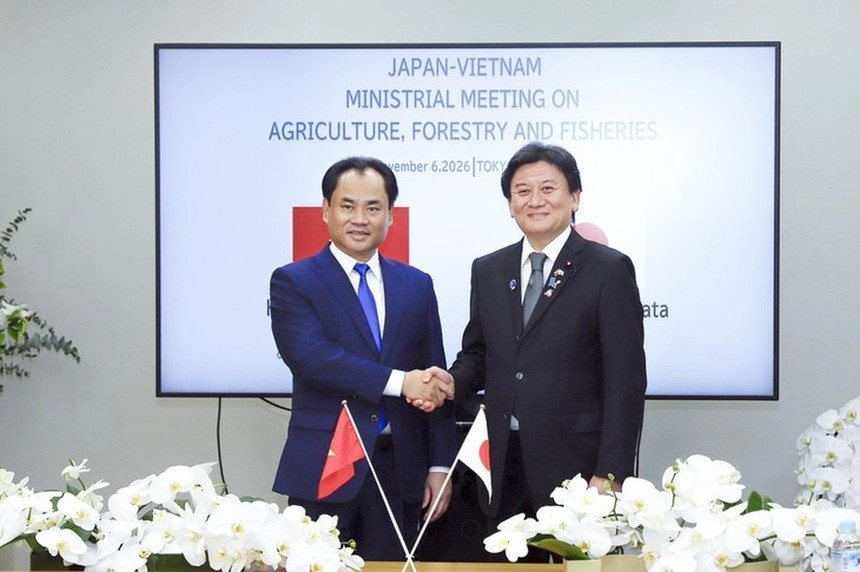 |
| Vietnamese Minister of Agriculture and Environment Trinh Viet Hung (left) and Japanese Minister of Agriculture, Forestry and Fisheries Takebe Arata. Photo: Khuong Trung |
During the meeting, the two sides discussed measures to strengthen cooperation in agriculture, forestry, and fisheries, focusing on market access, technology transfer, and the development of sustainable value chains.
Minister Arata proposed that the two countries accelerate market-opening procedures for pomelos, grapes, peaches, and passion fruit, while also considering proposals concerning pufferfish, pork, beef, and chicken.
Following their discussions, the two sides agreed to prioritise completing the necessary procedures for Vietnamese pomelos and Japanese grapes, with a view to introducing the two products into each other's markets during the 2027 harvest season.
Subsequently, Vietnam and Japan will continue efforts to open their markets to Vietnamese passion fruit, Japanese peaches, Vietnamese pet food containing poultry meat, and Japanese puffer fish.
Regarding pork, beef, chicken, and puffer fish, Minister Trinh Viet Hung agreed to consider Japan's proposals on a reciprocal, product-by-product basis.
Japan also proposed that Vietnam shorten the time required to assess registration applications from Japanese businesses seeking to export seafood to the Vietnamese market. Minister Trinh Viet Hung said he would instruct relevant agencies to accelerate the review process and strengthen exchanges to address related issues.
Nguyen Dinh Tung, vice chairman of Vietnam Fruit and Vegetable Association, said the delegation was encouraging two-way fruit trade in Japan, and hoped the market would soon open to Vietnamese pomelos.
“With the recent market-opening agreements, pomelos and fresh coconuts have the potential to become two standout export products for Vietnam's fruit and vegetable sector in the coming years.
However, export opportunities can only translate into actual orders once market-opening procedures are completed and the products fully meet import requirements.
Businesses need to focus on quality control, food safety, traceability and the development of stable growing areas to meet Japanese market standards,” said Tung.
Vietnam also called on Japan to strengthen cooperation in green agriculture, circular agriculture, emissions reduction, and climate change adaptation.
Minister Hung noted the need to effectively implement the Medium- and Long-term Vision for Vietnam-Japan Agricultural Cooperation for 2025-2030, signed by the two countries in September 2025.
He noted that priority areas of cooperation include digital transformation, smart agriculture, crop variety research, post-harvest preservation technologies, processing and product quality improvement.
Vietnam also encouraged Japanese businesses to step up investment and technology transfer, participate in developing agricultural, forestry and fisheries value chains, and expand cooperation in workforce training and management experience sharing.
According to the Ministry of Agriculture and Environment, Vietnam's exports of agricultural, forestry and fishery products reached approximately $63.02 billion in the first 10 months of 2026, up 8 per cent on-year.
Japan accounted for 7.3 per cent of Vietnam's agricultural, forestry, and fishery export market share, with export value to the market increasing 4.8 per cent on-year.
In 2025, several Vietnamese agricultural products recorded positive export performance in the Japanese market. Coffee exports reached nearly $600 million, while fruit and vegetable exports totalled approximately $237 million.
Products such as mangoes, mung beans, acerola cherries, pineapples, lychees, and coconuts also posted growth, although export volumes remained relatively modest. By contrast, exports of several products, including yams, potatoes, maize, chillies, dragon fruit, and ginger, declined compared with the previous year.
These results highlight the growth potential of Vietnamese agricultural products in Japan, while also revealing uneven competitiveness across different product categories.
Therefore, alongside efforts to boost market access, businesses need to focus on improving product quality, investing in post-harvest technologies, and building stable supply chains to capitalise effectively on export opportunities.
If the procedures are completed as planned, Vietnamese pomelos could enter the Japanese market from the 2027 harvest season. Further market openings for agricultural products, coupled with cooperation in technology and investment, are expected to help increase export value, and boost market expansion for Vietnamese agricultural produce.
 | US and Vietnam agree on framework to boost trade and market access The United States and Vietnam have agreed on a framework for a new trade deal designed to boost bilateral commerce and market access. |
 | Australia seeks market access for kangaroo meat and lychees in Vietnam Australia is seeking market access for kangaroo meat and lychees in Vietnam, with Australian Ambassador to Vietnam Gillian Bird calling on the Ministry of Agriculture and Environment to complete its assessment process. |
 | Vietnam, New Zealand to expand agricultural market access and digital trade Vietnam and New Zealand are looking to deepen economic and trade ties, with a focus on expanding agricultural market access, boosting two-way investment, and broadening cooperation in digital trade and cross-border e-commerce. |
 | Foreign investors to be widened for market access Vietnam is moving to widen market access, improve investment incentives, and streamline procedures, with greater support tied to investors’ actual commitments and results, as part of the law on amending and supplementing a number of articles of the Law on Investment. |
What the stars mean:
★ Poor ★ ★ Promising ★★★ Good ★★★★ Very good ★★★★★ Exceptional
 Tag:
Related Contents


More News
- European firms push for stronger Vietnam trade ties (November 06, 2026 | 12:19)
- IEAE Hanoi 2026 connects global supply chains (November 05, 2026 | 17:32)
- Vietnam and EU pursue new value chains (November 05, 2026 | 12:02)
- Vietnam emerges as Southeast Asia’s fastest-growing digital economy (November 05, 2026 | 11:53)
- EU-ABC delegation visits Vietnam to deepen trade and investment ties (November 04, 2026 | 08:00)
- Vietnam accelerates 5G utilisation and prepares for 6G (October 30, 2026 | 18:28)
- Vietnam and Cambodia customs agree 2027–2028 cooperation plan (October 30, 2026 | 13:46)
- Vietnam strengthens inter-regional cooperation on enhancing AI capabilities (October 29, 2026 | 15:32)
- First zero-direct-emission electric barge operates in Vietnam (October 29, 2026 | 14:41)
- Deputy Finance Minister meets Chinese State Council research delegation (October 29, 2026 | 14:25)







 Mobile Version