
Hanoi launches low emission zones

This provides an immediate solution to improve air quality and opens the way for a transformation of urban transportation models towards green, modern, and sustainable practices.
For many years, air pollution has been one of the major challenges facing Hanoi. Periods of poor air quality are no longer isolated incidents but occurring with increasing frequency, especially during transitional seasons. This directly impacts public health, the quality of life of residents, and affects tourism as well as the image of a city striving for green development.
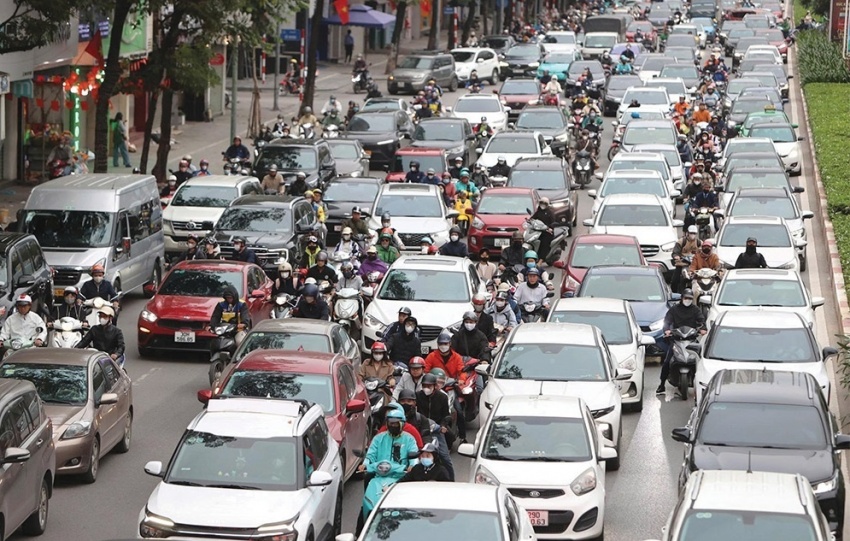 |
| Illustration photo: Duc Thanh |
Traffic is one of the largest sources of emissions in urban areas. According to Hanoi People's Committee, during 2023-2025, traffic accounted for approximately 25 per cent of the total PM2.5 fine particulate matter emissions across the city.
Without controlling emissions from vehicles, it is highly difficult to improve air quality. Therefore, implementing the LEZ is an essential step. This is a model that has been adopted by many cities around the world to limit high-emission vehicles, encourage the use of clean vehicles, and gradually build a sustainable transportation system.
To achieve this, Hanoi has chosen a cautious approach. The city does not aim to ban fossil fuel vehicles immediately, but rather builds a multi-stage roadmap, starting from the central area, implementing and evaluating the plan as needed for adjustments. The LEZ is part of a process of changing traffic management methods and travel behaviour towards a more environmentally friendly direction.
The 2026 Law on the Capital City creates a legal framework for the implementation of low-emission zones. On June 15, the Hanoi City People's Council approved the LEZ project within Ring Road 1, clearly defining the scope, roadmap, and responsibilities for implementation.
Based on this, the municipal People's Committee developed a implementation plan, ensuring it aligns with the conditions of the capital. Simultaneously, the city is preparing conditions to provide residents with more options when changing their mode of transport.
Accordingly, within the Ring Road 1 area, there are currently 45 bus routes in operation; from July 1, 2026 to June 30, 2027, passengers using subsidised bus routes within this area will be exempt from fares.
In addition, Hanoi has arranged 220 parking areas, developed 44 public bicycle stations with hundreds of bicycles, and is researching the construction of transfer parking areas (Park and Ride) to connect with buses and urban rail.
The city is also gradually improving its surveillance camera system, vehicle identification, and expanding the network of charging stations and battery swapping points to serve clean energy vehicles.
More broadly, the LEZ is not a single policy. It is a link in a chain of solutions that Hanoi is implementing to build a green transportation system, from converting fossil fuel-powered buses to electric buses, accelerating urban rail lines, developing the Transit-Oriented Development model, to investing in underground parking, transfer car parks, and infrastructure serving green vehicles. When these links are connected, the LEZ will have a foundation to be effective.
 | VinFast record sales day demonstrates EV mainstream adoption The Vietnamese automaker's single-day delivery achievement reflected electric vehicles becoming practical transportation choices for consumers. |
 | Tax incentives set to accelerate EV adoption and curb pollution Vietnam is moving to extend tax breaks for electric vehicles, aiming to accelerate adoption, cut emissions and support industry growth as the country pushes forward with its green transition agenda. |
 | VCCI agrees with proposal to extend tax incentives for EVs The Vietnam Chamber of Commerce and Industry agrees with the Ministry of Finance's proposal to extend the special consumption tax on motor vehicles under 24 seats powered by batteries. |
What the stars mean:
★ Poor ★ ★ Promising ★★★ Good ★★★★ Very good ★★★★★ Exceptional
 Tag:
Tag:Themes: Towards Sustainability
- Hanoi launches low emission zones
- Skellefteå: epicentre of an extraordinary societal transformation
- Decree 112 sets legal framework for Vietnam's carbon market participation
- BII launches British Climate Partners to accelerate energy transition in Asian developing economies
- Ministry of Construction drafts criteria to assess urban climate resilience
Related Contents





Latest News


More News
- GreenYellow and Vina Paper partner on rooftop solar project (October 05, 2026 | 09:00)
- Consultation workshop refines Vietnam's clean hydrogen strategy (October 04, 2026 | 08:00)
- JBIC considers new financing options for Vietnam’s energy projects (October 03, 2026 | 08:00)
- Vestas to supply 16 turbines for two new Vietnam wind farms (October 01, 2026 | 07:00)
- Inter-sectoral cooperation on Montreal protocol (September 30, 2026 | 17:20)
- EV battery recycling rate proposed at 8 per cent from 2029 (September 29, 2026 | 16:00)
- Bankability remains hurdle for Vietnam's JETP projects (September 29, 2026 | 12:08)
- Binh Minh Plastics extends clean water project to border communities (September 29, 2026 | 10:57)
- Coca-Cola Vietnam expands packaging collection programme (September 25, 2026 | 08:15)
- Pacifico Energy secures sea survey licence for offshore wind project in Lam Dong (September 24, 2026 | 18:02)










 Mobile Version