
Investment boom expected for EU-compliant plastic recycling plants

Speaking at the seminar "Packaging Transition: Ready for EU Regulations (PPWR) Effective August 2026 and the EPR Mechanism," held at VSIP Bac Ninh I Industrial Park on August 5, Nguyen Thi, senior lecturer at Hanoi University of Natural Resources and Environment, said Vietnam's exporters would need to make substantial changes to comply with the EU's new packaging regulations, while the transition opens up major opportunities for investment in advanced recycling.
The PPWR, which took effect in August, is a comprehensive 120-page framework governing the entire life cycle of packaging, including plastic, paper, glass and wood, from design and production to recycling and disposal. The EU regulation aims to minimise the environmental and health impacts of packaging waste while ensuring the smooth functioning of the EU single market.
The regulation applies to all economic operators, including manufacturers, suppliers, importers, distributors and consumers. Producers placing packaging on an EU member state's market for the first time are responsible for meeting Extended Producer Responsibility (EPR) obligations and paying recycling fees.
|
|
Tougher recycling requirements
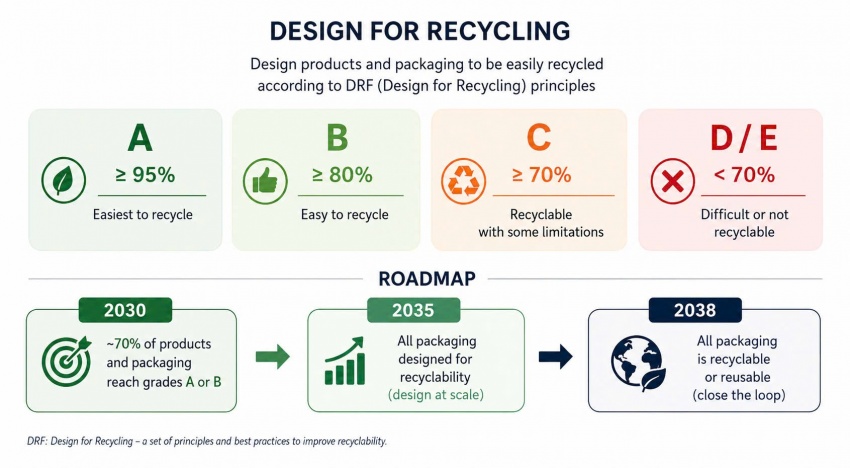
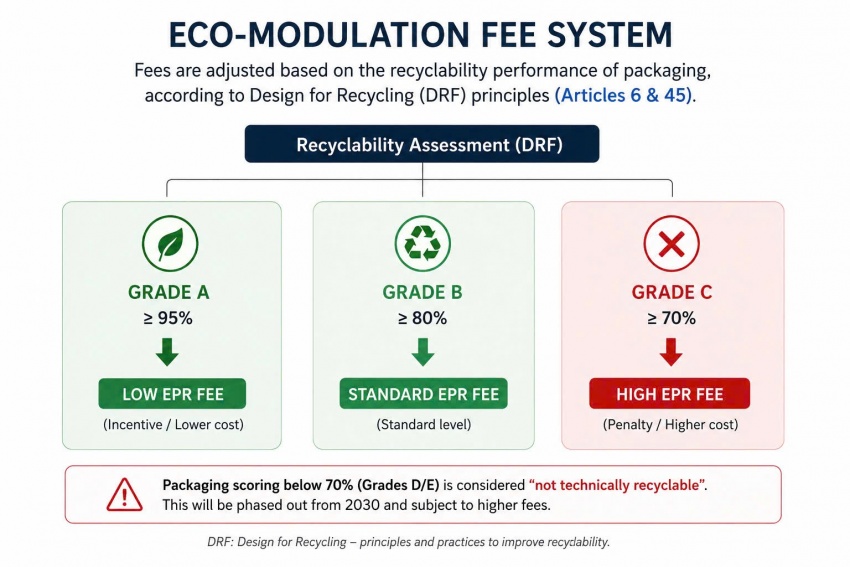
Under the PPWR's Design for Recycling (DfR) requirements, all packaging placed on the EU market must be recyclable and classified under a recycling performance grading system.
By 2030, packaging must achieve at least Grade A (95 per cent recyclability), Grade B (80 per cent), or Grade C (70 per cent). By 2035, packaging must be "recycled at scale", while from 2038 only packaging with more than 80 per cent recyclability will be permitted on the EU market.
The regulation also introduces several product-specific requirements. From August 12, 2026, the EU will prohibit PFAS (per- and polyfluoroalkyl substances) in paper trays, paper boxes and wrapping materials. Food and seafood processors will therefore need to eliminate PFAS coatings and prepare technical documentation and Declarations of Conformity (DoC).
Single-use plastic packaging will be progressively phased out, with many applications banned from 2030, requiring agricultural exporters to switch to alternatives such as mesh bags, paper packaging or certified compostable materials.
PPWR also sets mandatory minimum recycled-content targets. Single-use PET beverage bottles and sensitive food-contact PET packaging must increase recycled content from 30 per cent in 2030 to 65 per cent in 2040. Other sensitive plastic packaging must contain at least 10 per cent recycled material, while other plastic packaging will see requirements rise from 35 per cent to 65 per cent over the same period.
From February 12, 2028, tea bags, coffee pods and beverage filter bags, along with stickers attached directly to fruit and vegetables, must be industrially compostable across the EU.
"The food and beverage sector will be among the industries most directly affected because it relies heavily on food-contact packaging and single-use plastics," Thi said.
For alcoholic beverages, glass bottles and aluminium cans can more easily achieve the highest recyclability grades. However, labels, shrink sleeves and adhesives will need to be redesigned to avoid contaminating recycling streams. Under reuse targets and the EU's Deposit Return System (DRS), at least 10 per cent of beverage products must be sold in reusable packaging by 2030, making participation in collection and bottle-return systems increasingly important for exporters targeting European retailers.
Cosmetics and household cleaning products, which commonly use HDPE, PP and PET packaging, will also face stricter rules. From 2030, non-food-contact plastic packaging must contain at least 35 per cent post-consumer recycled (PCR) plastic, while miniature hotel toiletries will be banned in favour of refillable dispensers.
 |
New investment opportunities but heavy compliance
Thi said the combination of the EU's PPWR and Vietnam's EPR framework would accelerate four major industry transformations.
Manufacturers will need to redesign packaging around DfR principles and mono-material structures, invest in food-grade recycling technologies and PCR production, expand the use of paper-based and biodegradable packaging, and strengthen data transparency through technical documentation, DoC and traceability systems.
One of the most significant changes will be the shift away from difficult-to-recycle multilayer packaging, such as PET/aluminium/polyethylene laminates, towards mono-material packaging made entirely from polyethylene or polypropylene.
"The biggest challenge is securing certified recycled plastics. Vietnamese exporters will increasingly need to prove the origin and quality of food-grade recycled PET, PE and PP used in their packaging," Thi said. Most recycling facilities in Vietnam remain small-scale and rely on outdated technologies, producing recycled plastic that often fails to meet European food-contact standards certified by European Food Safety Authority (EFSA) or the US Food and Drug Administration (FDA).
"At the same time, this presents enormous investment potential. Vietnam has significant room to develop modern recycling plants using bottle-to-bottle technology capable of producing high-quality food-grade recycled plastic," he said.
Paper packaging, corrugated cardboard and wood-based packaging are also expected to benefit because of their strong circularity credentials. Vietnamese paper packaging manufacturers could gain a competitive advantage by demonstrating legal timber sourcing through FSC certification and eliminating PFAS from production.
Industrially compostable bioplastics are expected to become mandatory solutions for specific product categories, including tea bags, coffee filters, fruit labels and ultra-light plastic bags.
Thi said compliance would involve changes in packaging design, as well as significantly greater administrative and technical documentation. From August 12, 2026, Vietnamese packaging manufacturers will effectively need to supply compliance data alongside their products, including laboratory test results for heavy metals and PFAS, packaging void-space measurements and documentation verifying the origin of recycled plastics so that European customers can prepare DoC.
Preparing for adaption
Thi recommended a three-stage roadmap for businesses. In the short term, during 2026, companies should eliminate PFAS and heavy metals from packaging, prepare technical documentation under Annex VII, complete Declarations of Conformity for EU-bound shipments and ensure packaging void space remains below 50 per cent.
Between 2027 and 2029, businesses should redesign multilayer packaging into mono-material alternatives, test recycled resin blends and ensure bottles and cans are compatible with DRS requirements.
From 2030 onwards, companies should fully comply with circular economy requirements by incorporating at least 30-35 per cent recycled plastic in packaging, achieving Grade A or Grade B recyclability under DfR standards, and integrating QR codes or other digital data carriers to support traceability and recycling instructions.
"Understanding both domestic and international regulatory frameworks is the foundation for helping Vietnamese businesses integrate into global standards such as the EU's PPWR and ESPR," Thi said.
Thi also called on policymakers to accelerate institutional reforms and harmonise Vietnam's regulations with the EU framework. He recommended developing national standards on DfR, minimum recycled-content requirements and mono-material packaging, while introducing food-contact safety standards for recycled plastics similar to those administered by EFSA and FDA.
He also urged greater investment in waste collection, sorting and recycling infrastructure, including pilot nationwide Deposit Return Systems for PET bottles and aluminium cans in Hanoi, Ho Chi Minh City and Danang, following successful European models.
Developing modern recycling industrial parks, relocating informal recycling villages into regulated industrial zones equipped with wastewater and emissions treatment systems, and supporting bottle-to-bottle recycling projects through tax incentives, preferential credit and government subsidies would help Vietnam build internationally competitive recycling capacity.
Thi also proposed a package of financial incentives, including corporate income tax reductions for green businesses, import duty exemptions on advanced recycling equipment, VAT incentives for products using certified recycled plastics or compostable packaging, preferential green credit for research and development projects, and green public procurement policies prioritising products using recycled or reusable packaging.
What the stars mean:
★ Poor ★ ★ Promising ★★★ Good ★★★★ Very good ★★★★★ Exceptional
 Tag:
Tag:Related Contents





Latest News


More News
- Vietnam’s registered FDI surpasses $50 billion in nine months (October 07, 2026 | 10:30)
- Samsung Electro-Mechanics to add $1.85 billion semiconductor investment in Thai Nguyen (October 06, 2026 | 18:23)
- Electronics funding will be won via a capable ecosystem: SGS (October 06, 2026 | 09:00)
- LNG power plant projects risk falling behind schedule (October 03, 2026 | 09:00)
- Pandora opens world’s largest fine jewellery crafting facility (October 02, 2026 | 22:21)
- An Phat 5 Industrial Park positions for new wave of investment in northern Vietnam (October 02, 2026 | 09:00)
- Hanoi to launch portal to ease hurdles for tech businesses (October 01, 2026 | 09:00)
- Foreign investors to be widened for market access (September 30, 2026 | 17:54)
- Phu Quoc Airport planning adjusted to serve APEC 2027 (September 30, 2026 | 17:35)
- Nearly 200 foreign-invested enterprises in Vietnam to pay global minimum tax (September 30, 2026 | 17:26)


Latest News




 Mobile Version