
Hanoi, Bac Ninh and Hung Yen seek closer regional integration to attract investment in smart agriculture

 |
| Photo: Doan Thanh (hanoimoi.vn) |
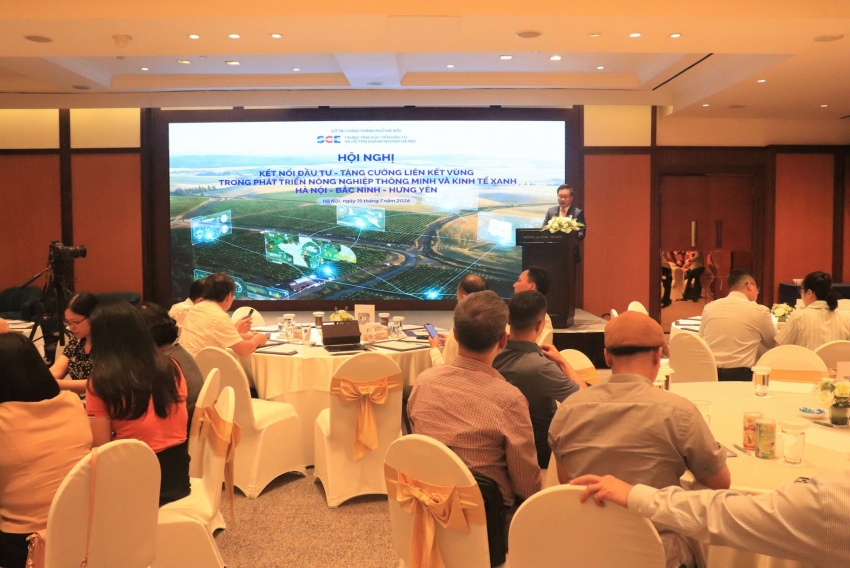
The vision was outlined at the Investment Connectivity – Strengthening Regional Linkages for Smart Agriculture and Green Economy Development conference on July 15, where representatives from the three localities proposed deeper cooperation in technology, logistics, research, investment promotion, and supply chain development.
Local officials said closer regional integration has become increasingly important as agriculture undergoes rapid transformation driven by digital technologies, AI, biotechnology, big data and low-emission production models. At the same time, food security, climate resilience, emissions reduction, and rising quality standards are reshaping agricultural production and investment priorities.
Speaking at the event, Le Trung Hieu, deputy director of Hanoi Department of Finance, said regional cooperation should become a key driver for creating new development space, mobilising investment, and raising the value of agricultural production across northern Vietnam.
He said the three localities each possess complementary strengths that could be combined into a single investment ecosystem. Hanoi serves as the region's centre for science, technology, innovation, finance, trade, and consumption, while Bac Ninh has developed into a major hub for high-tech manufacturing, smart production, and foreign investment. Hung Yen, meanwhile, has strong potential in high-quality agricultural production, raw material development, and food processing.
"When these advantages are effectively connected, they can create a modern agricultural ecosystem covering research, production, processing, logistics, trade, and exports," Hieu said, adding that such integration would generate more opportunities for businesses, investors, and farmers.
He also called for a new approach to investment promotion, moving away from promoting individual provinces towards presenting investors with an integrated regional development space that offers a complete value chain.
According to Hieu, Hanoi will continue working closely with neighbouring localities and investment promotion agencies to improve information sharing, introduce investment opportunities, connect businesses with partners, and facilitate projects in high-tech agriculture, logistics, digital transformation, and the green economy.
He encouraged investors to view Hanoi, Bac Ninh and Hung Yen as a single interconnected investment destination capable of attracting high-quality foreign direct investment, advanced technologies, and sustainable development projects.
Representing Bac Ninh, Nguyen Manh Cuong said agriculture must evolve from traditional production towards an agricultural economy based on value chains, market demand, digital technologies, and green production standards.
He said regional cooperation would improve the utilisation of land, infrastructure, technology, and markets while strengthening the competitiveness of agricultural products.
Cuong described the three localities as playing distinct but complementary roles. Hanoi acts as the region's research, technology, finance, distribution, and consumer centre, supported by universities, research institutes, technology companies, and a large retail market. Hung Yen contributes strengths in commercial agriculture, fruit cultivation, livestock production, food processing, and transport connectivity.
Bac Ninh combines high-tech industrial capabilities with extensive agricultural production areas. The province recorded agricultural, forestry and fishery production valued at approximately VND16.8 trillion ($650 million) in 2025, with more than 35,000 hectares of vegetable cultivation and nearly 30,000ha of lychee plantations. More than 17,000ha of lychee are produced under VietGAP standards, while over 1,300 ha meet export requirements. High-tech agriculture now accounts for more than 35 per cent of the province's agricultural production value.
Under its provincial master plan, Bac Ninh aims to expand concentrated farming areas meeting VietGAP and GlobalGAP standards while boosting Agriculture 4.0 through AI, big data, and smart farming technologies. The province also plans to develop an ecological agricultural zone focused on fruit production, forestry products, medicinal plants, deep processing, cold-chain logistics, e-commerce, and carbon credit development.
To strengthen regional integration, Bac Ninh proposed five priority areas for cooperation. The first is developing a shared database and digital map of regional production areas, including crop zones, production volumes, quality standards, packing facilities, processing plants, cold storage, and distribution networks.
The second focuses on creating a joint network for agricultural research, technology transfer, and demonstration projects. Hanoi's research institutions and technology companies would work more closely with agricultural enterprises and cooperatives in Bac Ninh and Hung Yen to accelerate the commercial application of innovations in crop breeding, pest management, automation, precision irrigation, and post-harvest processing.
The third priority is building an integrated regional system for processing, cold-chain logistics, and green distribution. Officials said the three localities should coordinate the development of cold storage facilities, logistics centres, wholesale markets, and retail distribution, with Hanoi serving as the main consumption and distribution hub while Bac Ninh and Hung Yen expand processing and preservation capacity near production areas.
The fourth proposal involves establishing common standards and branding for safe, green agricultural products across the region. The region should create a 'Green Agricultural Products of the Capital Region' certification framework that builds upon existing VietGAP, GlobalGAP and organic standards while incorporating requirements on water efficiency, emissions reduction, waste management, environmentally friendly packaging, and product traceability.
Finally, Bac Ninh called for coordinated investment promotion targeting projects in high-tech agricultural infrastructure, seed research, food processing, cold-chain logistics, traceability platforms, e-commerce, and circular economy solutions for agricultural by-products.
Cuong stressed that regional cooperation should move beyond memoranda of understanding towards practical action plans with clearly defined objectives, responsibilities, and implementation timelines.
Rather than encouraging every locality to produce the same products, he said development should be based on comparative advantages, while high-tech agricultural zones should be closely connected with production areas, businesses, cooperatives, and farmers.
At the conference, Dang Thai Son, deputy director of Hung Yen Investment Promotion Centre, said the province's location on the doorstep of Hanoi positions it as a major supplier of fresh and processed agricultural products to the capital and the wider Northern Key Economic Region.
Hung Yen has developed more than 1,000 VietGAP and VietGAHP-certified production models applying modern farming technologies, covering products including longan, lychee, rice, vegetables, and ornamental plants.
However, Son said regional agricultural development continues to face several major issues, including planning and land availability, logistics infrastructure, inconsistent certification standards, and weak value-chain linkages.
To address these challenges, Hung Yen proposed establishing a 'Hanoi Technology Centre - Hung Yen Smart Farming' model, under which Hanoi would focus on research, biotechnology, seed development, and processing technologies, while Hung Yen would provide large-scale production areas for commercial deployment.
The province also proposed joint investment in specialised cold-chain logistics centres along Ring Road No.4 and major expressways to improve the movement of fresh agricultural products to Hanoi's wholesale markets, supermarkets, and Noi Bai International Airport for export.
A third proposal calls for harmonising technical standards across the region under a 'one certification, multiple acceptance' approach, allowing products certified in one locality to gain easier access to distribution channels throughout the region. Officials also advocated wider adoption of blockchain technology to improve traceability and strengthen consumer confidence.
The conference concluded with a shared commitment from the three localities to deepen regional cooperation and create an integrated smart agriculture ecosystem capable of attracting quality investment, accelerating technological innovation, and supporting the transition towards a greener, more competitive agricultural sector.
What the stars mean:
★ Poor ★ ★ Promising ★★★ Good ★★★★ Very good ★★★★★ Exceptional
 Tag:
Tag:Related Contents



Latest News



More News
- Tien Phong Plastics wins two awards at Green Future Awards 2026 (October 06, 2026 | 11:51)
- Energy transition task force meets to advance Vietnam's grid and storage (October 05, 2026 | 18:59)
- GreenYellow and Vina Paper partner on rooftop solar project (October 05, 2026 | 09:00)
- Consultation workshop refines Vietnam's clean hydrogen strategy (October 04, 2026 | 08:00)
- JBIC considers new financing options for Vietnam’s energy projects (October 03, 2026 | 08:00)
- Vestas to supply 16 turbines for two new Vietnam wind farms (October 01, 2026 | 07:00)
- Inter-sectoral cooperation on Montreal protocol (September 30, 2026 | 17:20)
- EV battery recycling rate proposed at 8 per cent from 2029 (September 29, 2026 | 16:00)
- Bankability remains hurdle for Vietnam's JETP projects (September 29, 2026 | 12:08)
- Binh Minh Plastics extends clean water project to border communities (September 29, 2026 | 10:57)






 Mobile Version