
Ministry of Construction drafts criteria to assess urban climate resilience

Nguyen Cao Vien, deputy director of the Ministry of Construction's (MoC) Department of Urban Development, said the government issued Decree No.35/2026/ND-CP in January, detailing provisions on urban classification. The decree assigned the ministry to develop and implement the resilience criteria nationwide.
The Department of Urban Development has advised leaders of the MoC to issue a plan to draft a circular, and to coordinate with a group of experts to support the development of a set of indicators to assess the resilience of urban areas to climate change.
The department and a team of experts reviewed the Party's policies and guidelines; several legal documents and standards in climate change response and resilience; and international experiences.
Vien explained that the resilience assessment criteria comprise five groups covering urban development management policies, key urban infrastructure, ecological environment, social capacity, and economic and financial capacity.
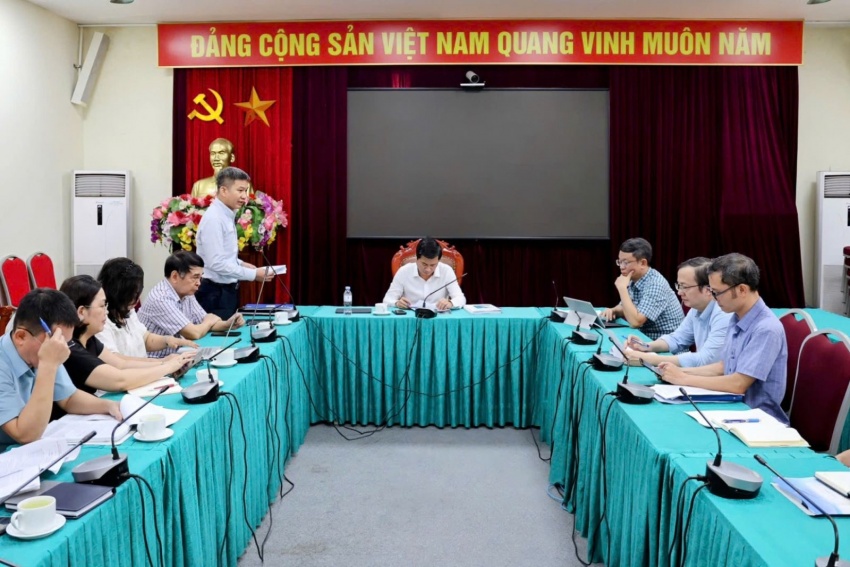 |
| Deputy Minister of Construction Nguyen Tuong Van chaired the meeting. Photo: the MoC |
The evaluation criteria ensure alignment with international trends, suitability to the realities of Vietnam, regional conditions, and urban types. The assessment of urban resilience to climate change is categorised into weak, medium, fair, and good levels.
Local people's committees organise the assessment for Type I, Type II, and Type III urban areas subject to assessment within their jurisdiction. The MoC publishes the assessment results of these urban areas on the ministry's database information system.
At a meeting to discuss the development of the draft circular on April 10, Deputy Minister of Construction Nguyen Tuong Van asked the drafting unit and research team to thoroughly review the current system of legal regulations, clarify the legal basis, and ensure that the implementation roadmap is consistent with reality.
The criteria should be developed based on the actual characteristics of Vietnam's urban system, with similarity with other relevant indicator sets.
The assessment content must focus in depth on the practical conditions of various types of natural disasters in Vietnam, such as flooding and landslides, tailored to each type of urban area and regional characteristics.
The deputy minister also requested the drafting unit to study the feasibility of piloting in several localities, from the plains and mountainous areas to coastal regions, to ensure the feasibility and effectiveness of the circular when put into practice.
Urban areas contribute more than 70 per cent of GDP and 90 per cent of new non-agricultural jobs in Vietnam, but are also the most vulnerable areas to natural disasters. Each year, the damage caused by climate risks is estimated at up to $3.75 billion. From the experience of climate-resilient urban projects in Can Tho, flooding time has been reduced by 60 per cent thanks to the application of climate-smart infrastructure.
According to experts, developing climate-resilient urban areas is an urgent and long-term task, requiring synchronous coordination between policies, finance, planning and science and technology. Putting people at the centre, strengthening governance, ensuring social equity and promoting international cooperation will be the foundation for creating safer, greener and more liveable Vietnamese cities in the future.
 | Takeda supports health resilience amid climate change challenges With world leaders having gathered at COP30 in Brazil in November, health was one of the central themes in the global climate dialogue. |
 | Swedfund invests in MSME growth and climate action in Vietnam Swedfund announced on December 18 an investment in Vietnamese EVF General Finance JSC (EVF) through a loan of up to $20 million. |
 | Australia contributing to Vietnam’s climate change responses Australia is balancing innovation, digital transformation, and economic development while ensuring green growth. Australian Ambassador to Vietnam GILLIAN BIRD talked to DUC HANH about the efforts of the Australian government in supporting Vietnam to implement sustainable development in key industries. |
 | Insurance protection for climate-resilient progress The World Bank has estimated that about $300 billion of the country’s commercial and industrial assets are vulnerable to climate-related disasters. Patrick Lenain, senior associate at the Council on Economic Policies, looks at the gaps in insurance protection and how solutions for such gaps can be crafted. |
What the stars mean:
★ Poor ★ ★ Promising ★★★ Good ★★★★ Very good ★★★★★ Exceptional
 Tag:
Tag:Themes: Towards Sustainability
- Hanoi launches low emission zones
- Skellefteå: epicentre of an extraordinary societal transformation
- Decree 112 sets legal framework for Vietnam's carbon market participation
- BII launches British Climate Partners to accelerate energy transition in Asian developing economies
- Ministry of Construction drafts criteria to assess urban climate resilience
Related Contents







Latest News



More News
- Lotte Properties and Phat Dat develop Thu Thiem Eco Smart City (May 27, 2026 | 22:18)
- Greening construction material market: the time is now (May 22, 2026 | 09:37)
- Last opportunity to own real estate in heart of Thao Dien (May 06, 2026 | 09:35)
- IOM and partners launch new SMEs guidance for construction and materials industry in Vietnam (April 24, 2026 | 17:25)
- Workshop guides construction firms on carbon rules (April 24, 2026 | 12:28)
- Malaysian tycoon SkyWorld brings sustainable homes to Vietnam (April 23, 2026 | 08:00)
- Green real estate labels mask deeper capital market divides (April 20, 2026 | 08:00)
- Hyundai HT to expand smart home and building in Vietnam (April 01, 2026 | 13:20)
- New urbanisation cycle set to define Vietnam's next decade of growth (March 17, 2026 | 21:00)
- Vietnam enters global Top 10 markets for LEED-certified buildings (March 09, 2026 | 13:45)


Latest News




 Mobile Version