
Retail sector urged to accelerate circular economy

The workshop, Promoting Circular Economy Practices in the Private Sector: Reducing Single-Use Products in the Retail Sector, was jointly organised in Hanoi on July 24 by the Institute of Strategy and Policy on Agriculture and Environment (ISPAE) and the Hanns Seidel Foundation (HSF) in Vietnam.
The event brought together policymakers, businesses, and industry representatives to discuss solutions for reducing plastic waste in the retail sector.
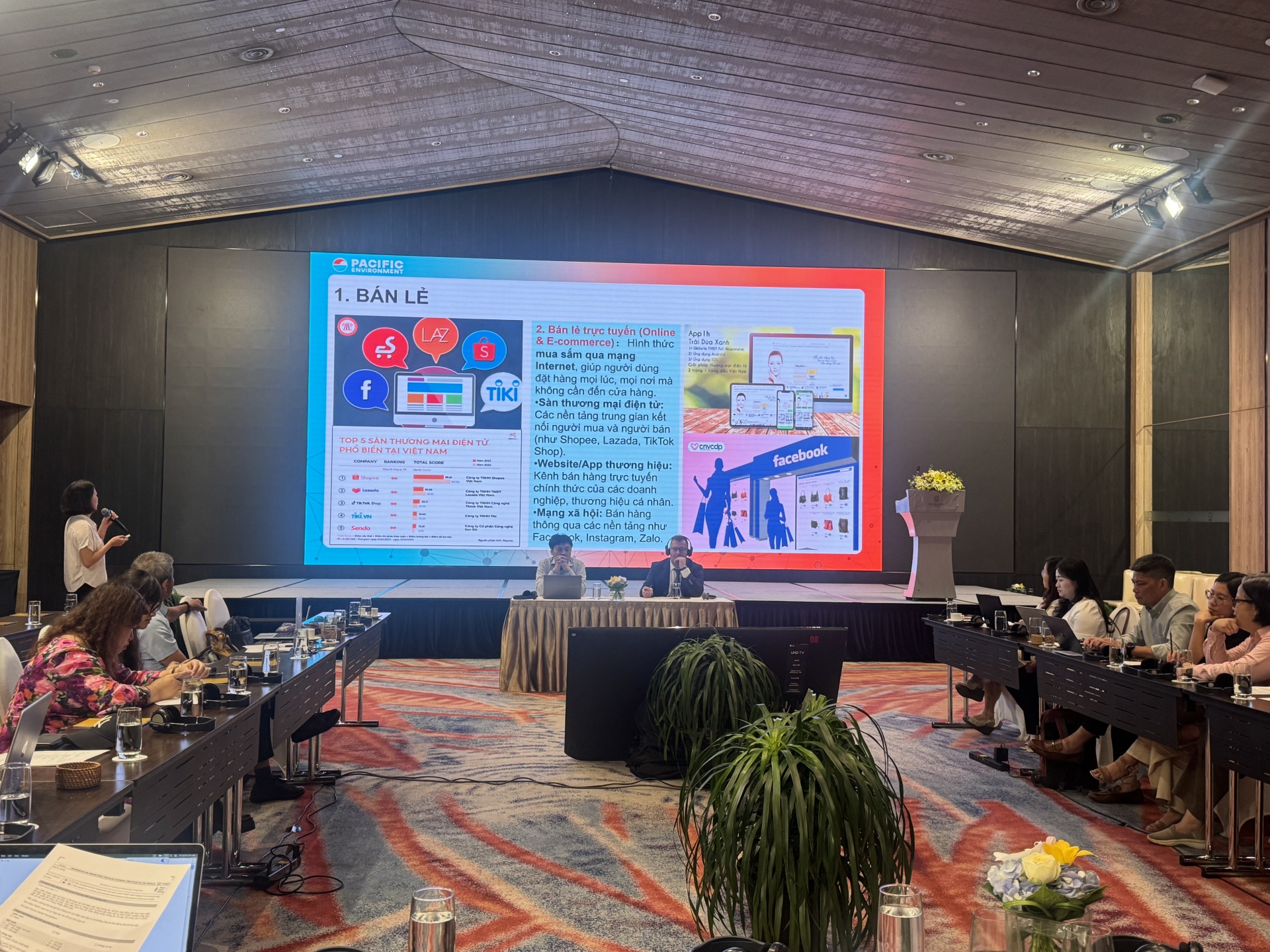 |
Nguyen Trung Thang, deputy director of ISPAE, said the event aimed to update stakeholders on policies related to the circular economy and plastic pollution reduction.
"The workshop also provides an opportunity to share successful models for reducing single-use plastics while strengthening connections between regulators, businesses, manufacturers, development organisations, and consumers to promote sustainable production and consumption," Thang said.
Plastic pollution remains a major global environmental challenge. According to the United Nations Environment Programme, between 19 and 23 million tonnes of plastic waste enter aquatic ecosystems each year, damaging ecosystems, reducing their resilience to climate change, and threatening livelihoods, food security, and human wellbeing.
Vietnam has introduced a number of policy frameworks to strengthen plastic waste management and promote sustainable consumption, including the National Strategy on Integrated Solid Waste Management to 2025 with a vision to 2050, the National Action Plan on Sustainable Production and Consumption for 2021-2030, Prime Minister's Directive No.33/CT-TTg, and Decision No.1316/QD-TTg on plastic waste management.
Under these policies, Vietnam aims to ensure that plastic bags and packaging used in shopping centres and supermarkets are environmentally friendly, while gradually phasing out non-biodegradable plastic bags and single-use plastic products.
Quach Thi Xuan, representative of Pacific Environment, said reducing single-use plastics in retail requires more than replacing conventional materials with greener alternatives.
"For these models to be effective in Vietnam, close coordination is needed between the government, businesses, and consumers to improve policies, invest in reuse infrastructure, standardise packaging, and raise public awareness," Xuan said.
She noted that many countries are shifting from waste management towards waste prevention through product and packaging redesign. Measures increasingly adopted include restrictions on single-use plastics, extended producer responsibility schemes, deposit-return systems, and reusable packaging networks.
Retailers worldwide have introduced refill stations, encouraged customers to use reusable bags and containers, replaced plastic packaging with sustainable materials, and offered incentives to encourage greener consumption habits.
The European Union has banned a range of single-use plastic products and tightened packaging requirements, while France has introduced strict rules limiting disposable plastic packaging. China has also implemented nationwide restrictions on non-biodegradable plastic bags and packaging.
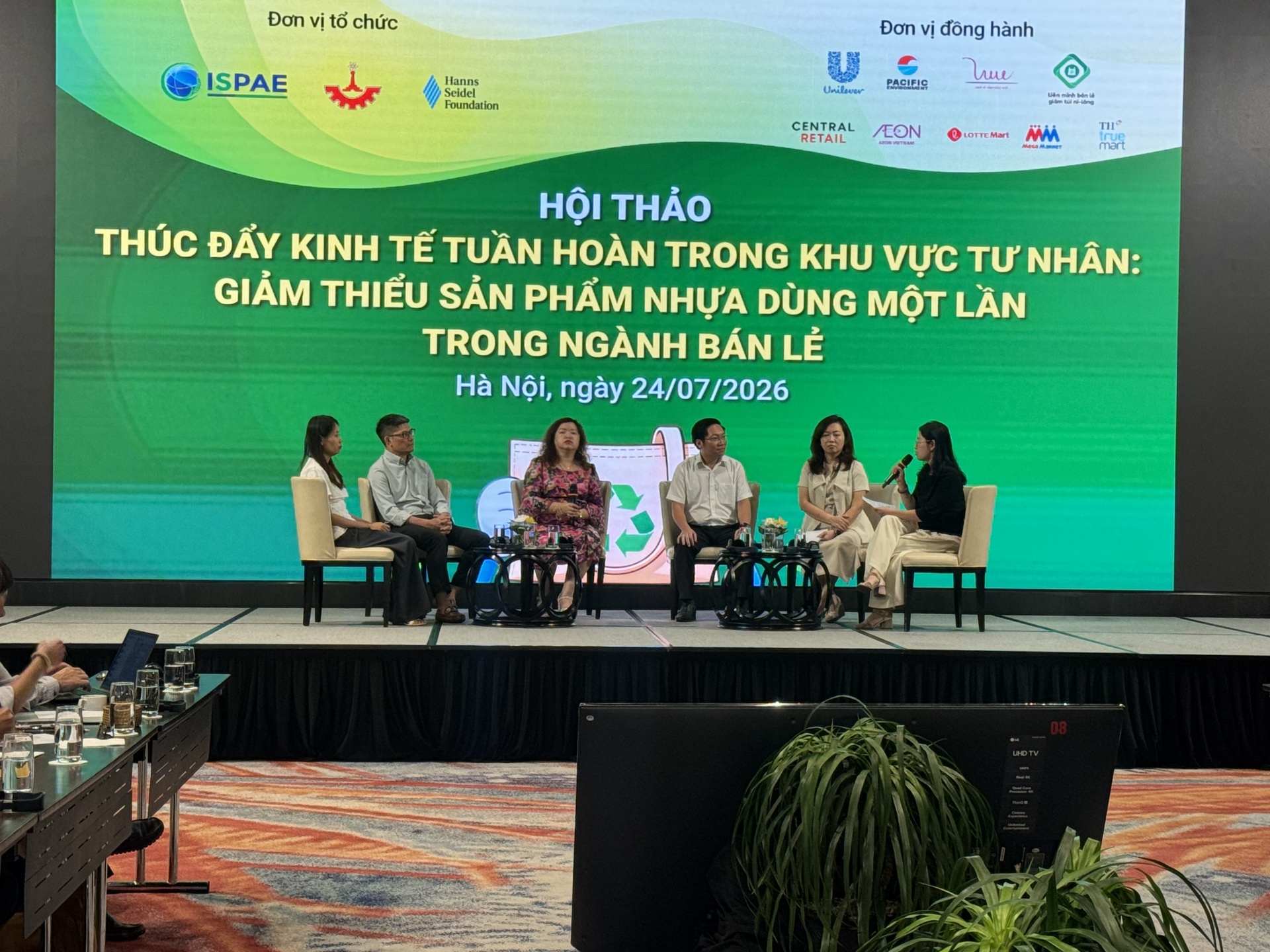 |
According to Dr. Kim Thi Thuy Ngoc of ISPAE, reducing plastic consumption in supermarkets should be a starting point for promoting the circular economy in retail.
Research by the institute shows that each supermarket distributes an average of 1,454 plastic bags per day, equivalent to around 1.6 bags per customer transaction. In Hanoi alone, supermarkets provide approximately 200,000 plastic bags daily, or nearly one tonne of plastic.
"To reduce plastic waste generation, 16 major retailers have joined the Retailers Alliance for Plastic Bag Reduction, committing to replace non-biodegradable plastic bags with environmentally friendly alternatives while encouraging customers to limit single-use plastics. Businesses are also increasing the use of recycled paper and sustainable packaging across their supply chains," Ngoc said.
From a business perspective, Le Thi Hong Nhi, deputy general director of Communications, External Affairs and Sustainability at Unilever Vietnam, outlined the company’s proposed 4C framework for accelerating the circular economy.
The framework comprises Collaboration, fostering shared responsibility across the value chain; Connection, strengthening data sharing and stakeholder coordination; Circulation, creating closed-loop systems spanning product design, waste collection, recycling, and the use of recycled materials; and Change, encouraging more sustainable consumer choices.
“Policies should also support the wider adoption of eco-labels for environmentally friendly products and packaging, helping consumers identify and prioritise green products while encouraging businesses to invest in sustainable development," Nhi said.
 | Circular economy becoming architectural foundation The circular economy is increasingly becoming a driving force and playing a central role in Vietnam’s dual transition towards digitalisation and green transformation, serving as an essential pathway to achieving sustainability goals. |
 | Driving double-digit growth through green and circular transformation in Vietnam The circular economy has been identified as a strategic pillar of Vietnam's new green growth model. At the same time, it is considered as a strategic key enabling Vietnam to seize opportunities for breakthrough development. |
 | Green finance and circular economy as drivers of growth As low-cost, sustainability-driven green capital increasingly flows into circular business models, the circular economy is set to evolve into a new driver of Vietnam’s economic growth. Long Viet Nguyen, partner in Consulting for EY Vietnam, spoke to VIR about unlocking green finance for such business models. |
 | 200 participants trained on circular economy Over 200 attendees, including managers and specialists from ministries, departments, localities, and businesses, attended a training course about circular economy and sustainable production and consumption in Hanoi on March 10. |
 | Milk cartons and the circular economy: when schools become agents of change Billions of beverage cartons are consumed every year – a vast, underutilised source of recyclable material waiting to be properly harnessed. |
 | Advancing the circular economy: opportunities for Germany-Vietnam cooperation The circular economy, sustainable manufacturing, and industrial competitiveness were at the centre of discussions at the Germany-Vietnam Business Forum 2026 held in Ho Chi Minh City on June 11. |
 | Mondelez Kinh Do continues to win accolades with two sustainability awards Driven by its commitment to responsible growth and circular economy leadership, Mondelez Kinh Do Vietnam continues to earn recognition for its sustainability initiatives and community contributions. |
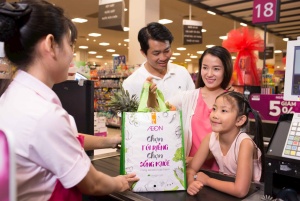 | Retailers step up circular economy efforts to curb plastic waste Vietnam’s leading retailers are accelerating efforts to reduce single-use plastic bags and promote circular economy practices, as businesses increasingly position sustainable consumption as a key component of their long-term growth. |
What the stars mean:
★ Poor ★ ★ Promising ★★★ Good ★★★★ Very good ★★★★★ Exceptional
 Tag:
Tag:
Related Contents


Latest News


More News
- Consultation workshop refines Vietnam's clean hydrogen strategy (October 04, 2026 | 08:00)
- JBIC considers new financing options for Vietnam’s energy projects (October 03, 2026 | 08:00)
- Vestas to supply 16 turbines for two new Vietnam wind farms (October 01, 2026 | 07:00)
- Inter-sectoral cooperation on Montreal protocol (September 30, 2026 | 17:20)
- EV battery recycling rate proposed at 8 per cent from 2029 (September 29, 2026 | 16:00)
- Bankability remains hurdle for Vietnam's JETP projects (September 29, 2026 | 12:08)
- Binh Minh Plastics extends clean water project to border communities (September 29, 2026 | 10:57)
- Coca-Cola Vietnam expands packaging collection programme (September 25, 2026 | 08:15)
- Pacifico Energy secures sea survey licence for offshore wind project in Lam Dong (September 24, 2026 | 18:02)
- Vietnam secures $221 million in UN development programmes for 2027-2031 (September 23, 2026 | 17:39)








 Mobile Version