
Bayer Vietnam launches Centre of Excellence for durian and coffee farming

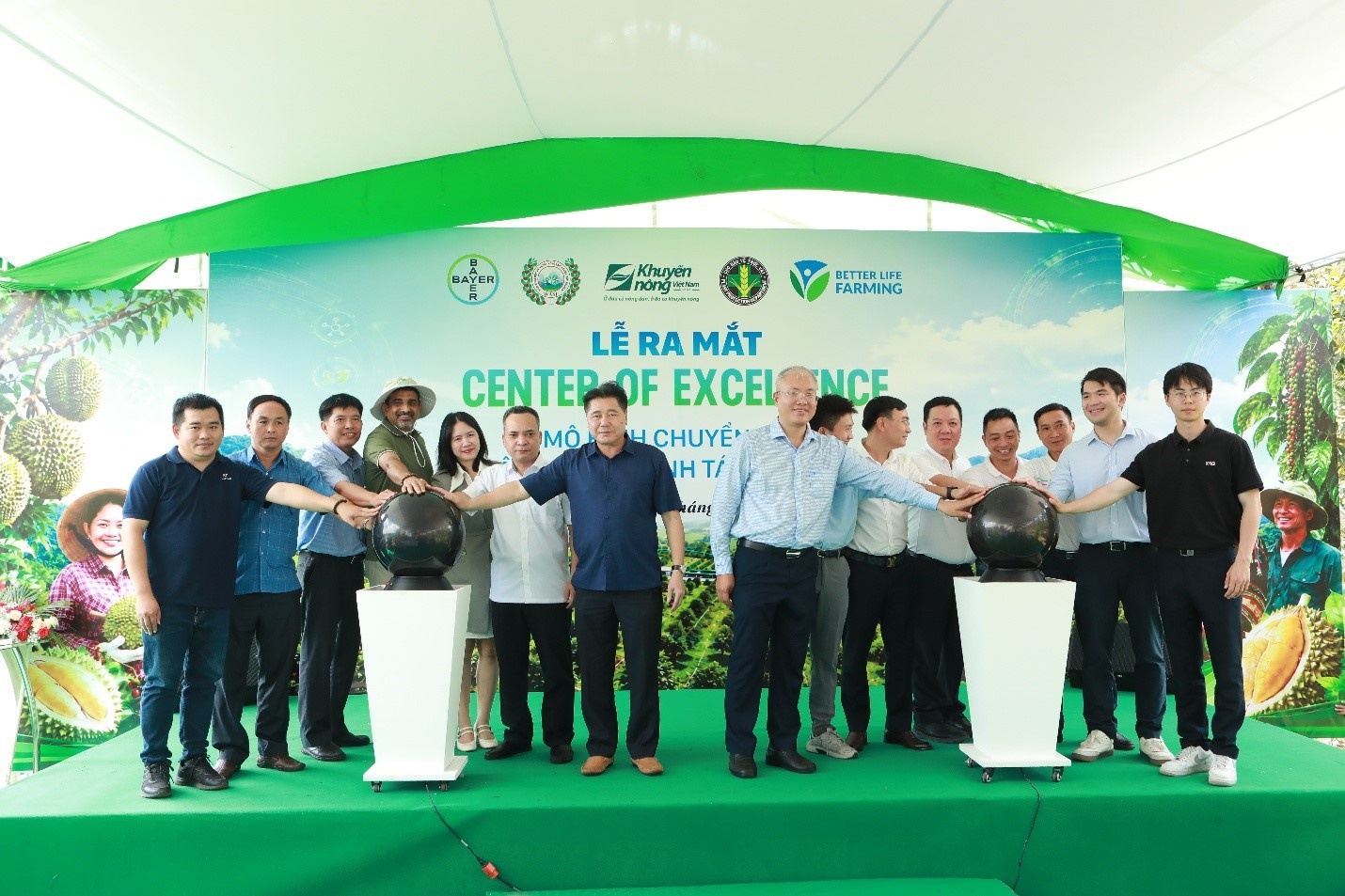 |
The initiative was announced on June 6, with the multi-stakeholder public-private partnership aiming to improve yield, quality, and sustainability for key agricultural products in a challenging global environment.
Durian and coffee cultivation in the Central Highlands is facing rising pressure from climate change, pests, fragmented technical processes, residue control, and a lack of strong links between farmers and consumption markets. The Centre of Excellence (CoE) initiative aims to transfer know-how and best practices.
The CoE model features a comprehensive set of solutions. Notably, the Integrated Plant Health Management (IPHM) helps control maximum residue limits to meet export standards.
The CoE also boasts advanced digital tools like microclimate forecasting systems, smart irrigation systems, and automated spraying technologies. This is coupled with building a value chain ecosystem that connects farmers with financial support solutions, microcredit, and export purchasing enterprises.
The launch of the model marks a strategic milestone based on the success of the Better Life Farming initiative. While the Better Life Farming initiative focuses on supporting and enhancing capabilities for smallholder farmers, the CoE is a strategic leap forward to target mega-farms, production zones, and export cooperatives, connecting with processing companies.
To operate such a large-scale and modern agricultural ecosystem, the CoE is designed as a multi-stakeholder public-private partnership platform where each partner has their own role and coordinates effectively.
At the event, the partners reaffirmed commitments to jointly developing, operating, and replicating the CoE model across the Central Highlands.
In the ecosystem, Bayer Vietnam is responsible for formulating an action plan, developing optimal farming practices, and compiling in-depth training materials for the technical team. Other private sector partners also provide water management solutions, microclimate forecasting stations, automated spraying equipment, and sustainable linkages to output markets.
The public sector, including the Plant Protection Department, the National Agriculture Extension Centre, and the Western Highlands Agriculture and Forestry Science Institute, will guide and direct the initiative. This sector will establish standard guidelines for IPHM processes, control residues to meet MRL standards, support the issuance of Production Unit Codes, and implement pilot programmes and field training.
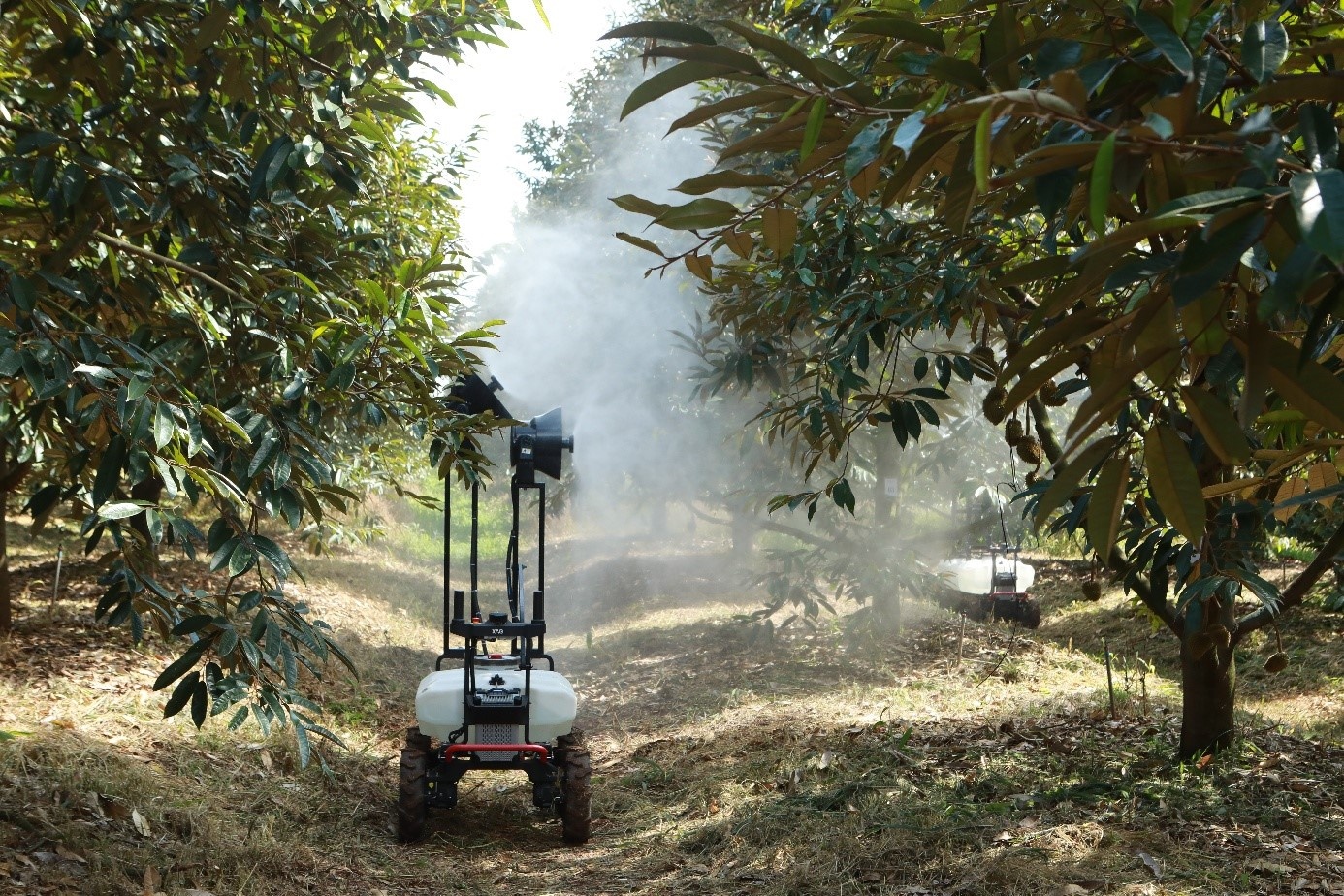 |
| Autonomous sprayer demonstration on durian trees, showcasing technology-driven solutions for modern orchard management |
Speaking at the event, Kg Krishnamurthy, country head of Crop Science at Bayer Vietnam, said, “Farmers are at the heart of everything we do. At Bayer, we believe that sustainable agriculture is not measured solely by yield or revenue, but by the long-term value it creates for farmers, the environment, and communities. The CoE model reflects our long-term commitment, alongside our public and private partners, to advancing sustainable agriculture in the Central Highlands and across Vietnam.”
“We envision this model as a dynamic knowledge ecosystem, delivering comprehensive support that connects farmers, cooperatives, and processing enterprises, enabling them to adopt technologies, adapt to climate and market changes, and ultimately enhance the global standing of Central Highlands agricultural products, contributing to a more prosperous and sustainable future,” he added.
Le Quoc Thanh, director of the National Agriculture Extension Centre, said he appreciated the CoE approach that replaces individual products with a comprehensive support ecosystem for farmers.
"This approach is in line with the Ministry of Agriculture’s direction of developing ecological agriculture, green agriculture, circular agriculture, and green development," he said. "The success of the CoE model will not be measured by the number of workshops or training courses but by the tangible changes in the fields. Through the initiative, farmers can increase yield, reduce costs, improve product quality, meet market standards, and sustainably increase their income."
Bayer also kicked off The International Year of Women Farmers 2026 in Vietnam on June 6 in response to the initiative of the Food and Agriculture Organisation of the United Nations.
The programme will focus on three areas. First, Bayer will utilise technical training courses to improve sustainable farming capacity for 2,000 female farmers in the Central Highlands. Second, it will also launch a video creation contest on digital platforms to honour the contributions of women. Third, it will continue integrating public health content into training programmes to provide comprehensive healthcare for rural families.
 | Bayer Vietnam opens new healthcare warehouse in Tay Ninh Bayer in collaboration with PhytoPharma inaugurated a new healthcare warehouse at Long Hau Industrial Park in Tay Ninh on January 27. |
 | Bayer outlines growth path to 2030 driven by AI and pharma innovation Bayer has reaffirmed its growth ambitions, underpinned by a strengthened pharmaceutical portfolio, advanced research pipeline, and increasing integration of AI. |
 | Bayer and the National Hospital of Obstetrics and Gynaecology sign deal to improve women's healthcare Bayer Vietnam has signed a strategic partnership with the National Hospital of Obstetrics and Gynaecology to expand access to advanced therapeutic solutions for women. |
What the stars mean:
★ Poor ★ ★ Promising ★★★ Good ★★★★ Very good ★★★★★ Exceptional
 Tag:
Tag:Related Contents


Latest News





More News
- French business delegation meets MoF to discuss investment cooperation (October 14, 2026 | 11:37)
- Friso promotes global scientific collaboration on children’s gut health in Vietnam (October 13, 2026 | 16:18)
- Germany and Vietnam look to expand strategic cooperation and investment (October 13, 2026 | 16:14)
- Vietnam-Australia forum boosts AI and digital technology cooperation (October 13, 2026 | 11:30)
- Digital transformation shifts focus to added value (October 09, 2026 | 18:00)
- Melatec Dental Clinic - accompanying international clients on their smile care journey (October 09, 2026 | 17:25)
- 12 localities achieve double-digit growth in first nine months (October 09, 2026 | 17:00)
- CYE 2026 announces top 5 finalists (October 09, 2026 | 16:55)
- Robotics inspires Vietnam’s next generation of engineers (October 08, 2026 | 15:18)
- Vietnam among fastest AI adopters, Pearson-AWS study finds (October 07, 2026 | 12:26)








 Mobile Version