
HER2+ breast cancer carries $3.71 billion productivity burden in Vietnam

 |
The report details the substantial socioeconomic impact of HER2-positive (HER2+) breast cancer, framing the disease as a clinical challenge and significant macroeconomic constraint.
The analysis, which forms part of a broader study across 11 Asia-Pacific economies by the WifOR Institute and supported by Roche, suggests that evaluating healthcare funding presents an opportunity to transition from managing short-term costs to investing strategically in national resilience.
According to the report, across the 11 analysed Asia-Pacific economies, HER2+ breast cancer and retinal diseases (diabetic macular edema and neovascular age-related macular degeneration) combined are projected to generate an estimated $180 billion in cumulative productivity losses between 2017 and 2027.
This systemic burden is driven by the loss of approximately seven million Disability-Adjusted Life Years (DALYs) – a measure of the number of healthy life-years lost to illness, disability or early death. The trajectory is steepening: in 2023, HER2+ breast cancer alone cost these eleven economies $10 billion in lost productivity, a figure the report projects will reach approximately $13 billion by 2027 – a 30 per cent increase in just four years.
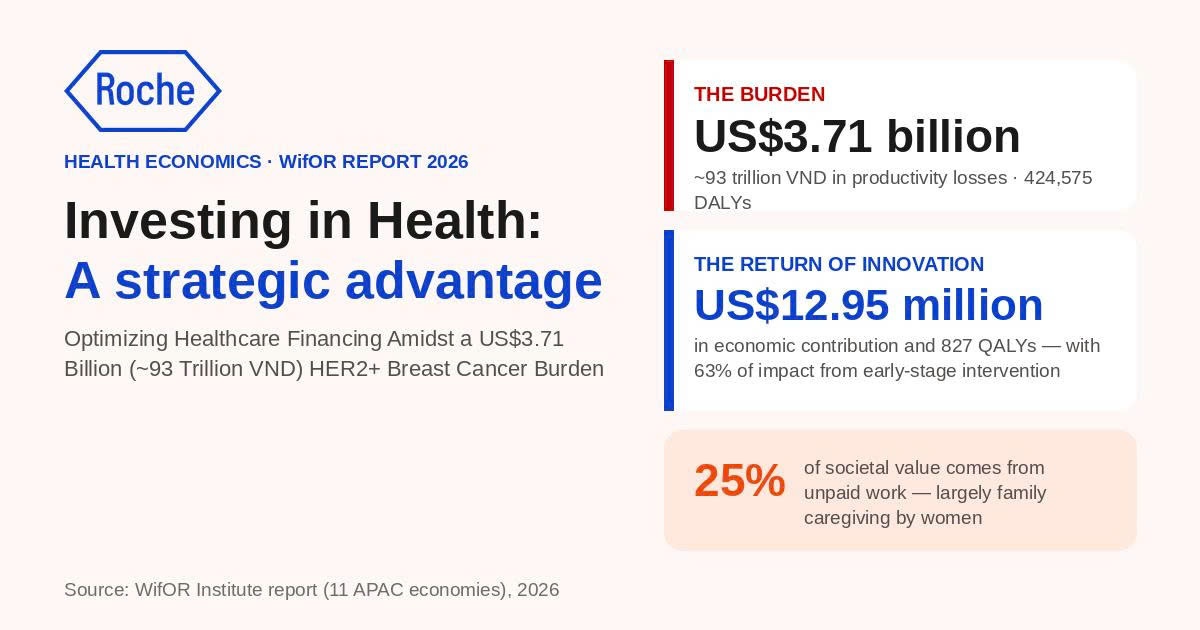
The report quantifies the specific burdens in Vietnam. The data indicates that HER2+ breast cancer alone is projected to cost the Vietnamese economy an estimated $3.71 billion in cumulative lifetime productivity losses during 2017-2027, correlating to the loss of approximately 424,575 DALYs. This represents a continuous constraint on workforce productivity, particularly concerning as Vietnam seeks to avoid the "middle-income trap."
Behind these figures are women in the middle of their working lives – often building careers, raising children and caring for ageing parents at the same time. For them, a late diagnosis is not measured in billions but in months away from work, income a household cannot easily replace, and time with family that cannot be recovered.
Earlier detection and timely treatment change that arithmetic. It is why the report argues that the value of care should be judged not only by what it costs a health system, but by what it allows people to keep doing – including the caregiving and household work that economic models have traditionally left out.
Conversely, the study provides empirical evidence of the economic returns generated when patients gain access to medical innovation. In Vietnam, Roche’s innovative therapeutic interventions for HER2+ breast cancer are estimated to contribute $12.95 million to economic growth and generate 827 Quality-Adjusted Life Years gained for patients over the decade.
The report cautions that these two figures are not directly comparable: the burden estimate covers lifetime productivity losses across the entire patient population, whereas the social impact estimate captures value only for the years patients are actively on treatment – a deliberately conservative snapshot rather than an offset to the total burden.
Notably, social impact grew from $1.6 million in 2017–2023 to $11.3 million in 2024–2027 – a more than 600 per cent increase that underscores the transformative power of access to innovation. Furthermore, the WifOR methodology captures a metric often excluded from standard economic evaluations: productivity gains from unpaid work. The report notes that activities such as domestic labour and family caregiving–predominantly managed by women–account for approximately 25 per cent of the total social impact of these treatments.
Burak Pekmezci, general manager of Roche Pharma Vietnam, said, "Vietnam has set ambitious goals for its development, and a healthy population is one of the strongest foundations for reaching them. To achieve sustainable, long-term growth, understanding the full socioeconomic impact of disease is crucial."
"By supporting this research, we hope to contribute to a comprehensive framework where the value of medical innovation is evaluated not just by the immediate cost, but by its broader societal returns, such as keeping individuals in the workforce and reducing the caregiving burden on families," Pekmezci said.
These findings arrive at a pivotal moment in regional dialogues regarding health financing. As Health Technology Assessment models evolve, there is a growing consensus among economists that traditional models may underrepresent the true value of an intervention.
The data supports an ongoing structural shift towards integrating long-term societal and economic value– including restored workforce productivity and reduced caregiving burdens– into budget guidelines and assessment frameworks, empowering policymakers to make holistic decisions.
On a macro level, the report aligns with global projections, which suggest that strategic investments in health and innovation could save 60 million lives and add $12 trillion to the global economy by 2040. For rapidly developing economies such as Vietnam, the report posits that sustained economic expansion remains closely tied to the continuous development of robust, value-based healthcare infrastructure.
 | Significant progress has been made in Vietnam's breast cancer fight The Vietnam Medical Association (VMA) and Roche Pharma Vietnam held a meeting on March 5 to review the first three years of a five-year partnership aimed at improving access to innovative therapies for high-risk breast cancer patients in Vietnam. |
 | New partnership targets improved cancer care for Vietnamese women Vietnam is ramping up efforts to tackle breast and cervical cancer – two major health challenges that continue to weigh heavily on women and society. |
 | Roche Pharma Vietnam and Bright Future Fund launch Joining Hands for Her campaign Roche Pharma Vietnam and the Bright Future Fund (BFF) launched the 2025 Joining Hands for Her campaign on October 14. |
What the stars mean:
★ Poor ★ ★ Promising ★★★ Good ★★★★ Very good ★★★★★ Exceptional
 Tag:
Tag:Related Contents






Latest News



More News
- Party Resolution charts Vietnam’s development model through 2045 and beyond (July 30, 2026 | 12:29)
- STEM education evolves for AI era (July 21, 2026 | 09:38)
- Vietnam’s workforce ready for AI era (June 26, 2026 | 16:04)
- Why child online safety is now a business imperative (June 24, 2026 | 11:00)
- Hybrid work is reshaping Vietnam’s labour market (June 17, 2026 | 16:24)
- World's children exposed to at least three overlapping climate threats (June 17, 2026 | 15:54)
- Thai Nguyen event promotes safer food systems for World Food Safety Day (June 11, 2026 | 14:08)
- Vietnam emerges as rising hub for wealth creation (June 02, 2026 | 18:31)
- Danang launches DIFF 2026 with world-class performances (May 31, 2026 | 08:00)
- Ministry of Finance contest aims to turn Party resolutions into action (May 30, 2026 | 09:00)










 Mobile Version