

IOM and partners launch new SMEs guidance for construction and materials industry in Vietnam

Vietnam’s manufacturing and construction sector is characterised by a highly mobile workforce, with internal migrant workers accounting for 46 per cent of the workforce, according to the National Statistics Office.
The International Organization for Migration (IOM) assessments in Vietnam’s natural stone industry provide insight on the realities on the ground; 44 per cent of surveyed businesses employed internal migrants and 17 per cent employed ethnic minority workers.
At the same time, four in ten reported challenges in ensuring compliance, particularly when it came to occupational health and safety, wages and benefits, working hours, grievance mechanisms, worker accommodation and support for women workers.
 |
| Photo: IOM |
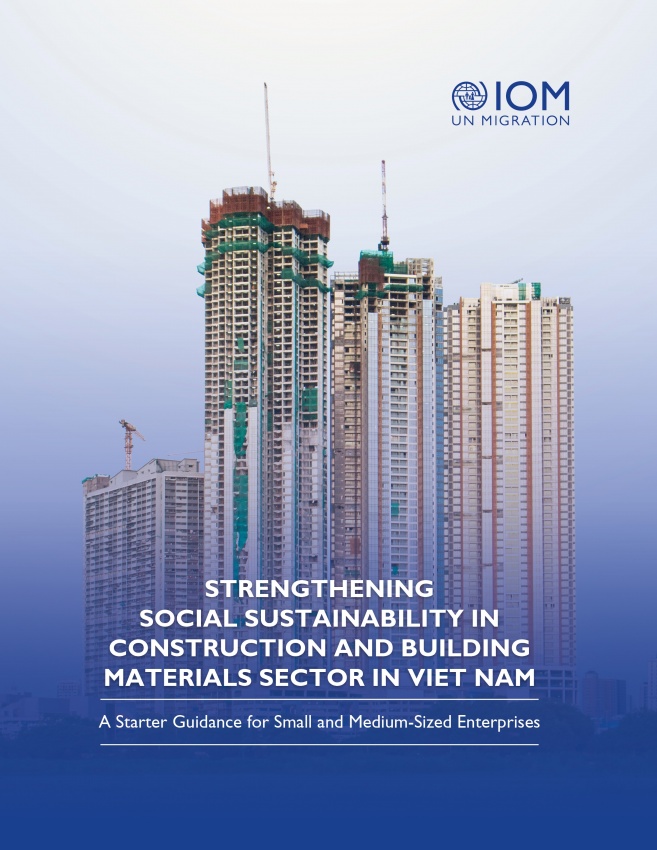
Developed in direct response to these challenges, IOM’s new Starter Guidance on Strengthening Social Sustainability for small- and medium-sized enterprises (SMEs) is tailored to the operational realities of Vietnamese businesses, by translating Environmental, Social and Governance (ESG) expectations and national legal requirements into clear, actionable steps.
Developed with direct input from Vietnamese enterprises and sector experts from the construction and materials industry, the freely available guidance offers a phased, step-by-step approach, supporting companies in the industry to gradually understand, develop and implement social sustainability practices, and extend responsible business conduct across their supply chains.
It enables SMEs to identify social sustainability risks in their own operations as well as those of their suppliers and subcontractors; know how to prioritise risks and take practical actions; maintain essential documentation systems that demonstrate compliance to clients, lenders and regulators; and strengthen workforce management practices.
To support implementation, the guidance includes two practical tools: a social risk self assessment to help companies identify their gaps and strengths in social compliance and generate reports with suggested action plans; and a workforce registry to help teams manage records of all workers on their site.
Elodie Jacoby, IOM Vietnam’s programme lead for Corporate Responsibility and Labour Migration said “For SMEs in the construction sector, improving recruitment and employment practices, particularly of internal migrant workers, can feel complex or resource intensive. In practice, it starts with achievable steps that are already required under Vietnamese law. IOM's Starter Guidance walks businesses through these steps using real industry case studies, showing how even small companies can put steps in place to support their workforce to keep projects on track and open doors to international markets.”
Julien Guerrier, head of the EU Delegation to Vietnam said, “IOM and the private sector are indispensable partners for the EU as we work together to uphold human & labour rights, conduct responsible business and ensure decent employment for the most vulnerable, notably the internal migrant workers. This is not only vital for the Vietnamese SMEs competitiveness in European, international markets, but also essential in promoting the dignity and wellbeing of all workers across our global supply chains”.
As Vietnam deepens its integration into regional and global supply chains, sustainability and responsible business conduct are increasingly central to market access and long-term resilience. Companies face growing expectations from investors, buyers and regulators to demonstrate performance across ESG standards, particularly in workforce management and supply chain practices.
This initiative also aligns with the Vietnamese government's own commitments to the sector. In December 2025, the Ministry of Construction issued its 2026 Legal Support Plan for SMEs, specifically designed to help construction businesses better understand and comply with their legal obligations.
“At the centre of every infrastructure project are the people who make it possible. Sweden’s partnership in this initiative is rooted in our firm belief that a company’s strongest competitive advantage is a protected and respected workforce. We are committed to sharing our long-standing experience in social sustainability to ensure that internal migrant workers and ethnic minority communities are met with fair recruitment and safe conditions.” said Johan Ndisi, Ambassador of Sweden to Vietnam. “By providing SMEs with the tools to translate legal requirements into real-world dignity, we aren't just supporting compliance. We are contributing to a modern, resilient construction sector where business excellence and human rights go hand in hand."
 | Ministry of Construction drafts criteria to assess urban climate resilience The Ministry of Construction is drafting a circular to guide criteria for assessing climate change resilience in cities, as part of efforts to boost urban sustainable development. |
 | 200 firms from 17 countries to join Mining and Construction Vietnam 2026 Mining and Construction Vietnam 2026 is taking place from April 21-23 at the Vietnam Exposition Center in Hanoi, bringing together businesses, experts, and organisations from the mining and construction sectors across Vietnam and the wider region. |
 | Workshop guides construction firms on carbon rules A workshop on carbon governance and emissions trading has provided legal updates and practical guidance for Vietnam's construction sector as the country accelerates its transition to a low-carbon economy. |
What the stars mean:
★ Poor ★ ★ Promising ★★★ Good ★★★★ Very good ★★★★★ Exceptional
 Tag:
Tag:
Related Contents



Latest News



More News
- Lotte Properties and Phat Dat develop Thu Thiem Eco Smart City (May 27, 2026 | 22:18)
- Greening construction material market: the time is now (May 22, 2026 | 09:37)
- Last opportunity to own real estate in heart of Thao Dien (May 06, 2026 | 09:35)
- Workshop guides construction firms on carbon rules (April 24, 2026 | 12:28)
- Malaysian tycoon SkyWorld brings sustainable homes to Vietnam (April 23, 2026 | 08:00)
- Green real estate labels mask deeper capital market divides (April 20, 2026 | 08:00)
- Ministry of Construction drafts criteria to assess urban climate resilience (April 14, 2026 | 17:05)
- Hyundai HT to expand smart home and building in Vietnam (April 01, 2026 | 13:20)
- New urbanisation cycle set to define Vietnam's next decade of growth (March 17, 2026 | 21:00)
- Vietnam enters global Top 10 markets for LEED-certified buildings (March 09, 2026 | 13:45)


Latest News




 Mobile Version