
New urbanisation cycle set to define Vietnam's next decade of growth

At an event on March 17 discussing Vietnam's urban transformation towards 2035, Cushman & Wakefield released data showing GDP growth of 8.02 per cent in 2025. Over the past decade, including the pandemic period, the economy has averaged annual growth of 6.2 per cent – the highest among major economies in the region.
Foreign investment inflows reached more than $38.4 billion last year, while total trade turnover exceeded $930 billion – a new record that placed Vietnam among the world's top 25 largest trading economies. China and the United States remained its key partners.
GDP per person nearly doubled, rising from $2,290 to $5,026. The population also reached 102.3 million, with a rapidly expanding middle-class driving domestic consumption and urban demand. Together, the indicators reflect an economy that has strengthened both its external competitiveness and internal resilience.
 |
| Source: GSO, Ministry of Finance of Vietnam, Cushman & Wakefield Vietnam |
Hoang Nguyet Minh, country head of Cushman & Wakefield Vietnam, described the country's development as a deep structural transformation from rapid expansion to more sustainable, higher-quality growth.
"From the early years of market formation and policy reform, through global integration, to today's push towards higher-value growth, Vietnam has steadily evolved into one of Southeast Asia's most dynamic economies," Minh said. "The country is now entering a more mature phase of development, where growth is increasingly defined by scale, productivity, innovation, infrastructure readiness, and the quality of investment."
Cushman & Wakefield noted that Vietnam's economic transformation over the past 30 years has unfolded through clearly defined stages: market-opening reforms and private land-use rights in the 1990s, acceleration after accession to the World Trade Organization, a post-2014 diversification phase, and a recent period of market recalibration and institutional refinement.
"The next cycle, towards 2030 and beyond, will be driven by greater legal transparency, more strategic infrastructure development, and the national ambition to become Southeast Asia's third-largest economy before 2030 and a developed, high-income country by 2045," Minh added.
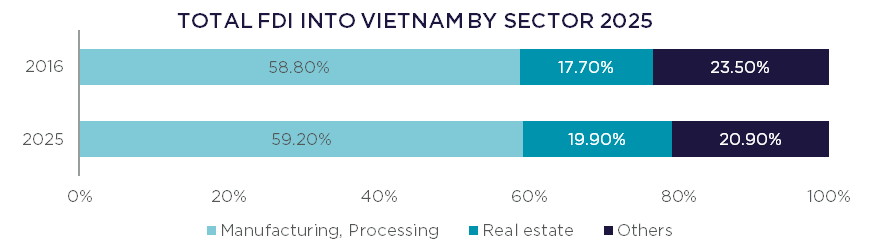
The briefing also noted that Vietnam’s foreign direct investment (FDI) attraction strategy has remained broadly consistent over the past decade, with manufacturing and processing continuing to account for nearly 60 per cent of total FDI, followed by real estate at close to 20 per cent. However, the country’s export structure has undergone a major transformation.
From an economy once concentrated on phone assembly and garment manufacturing, Vietnam has expanded its export value by 166 per cent, driven by the growth of electronics, computers, machinery and mechanical equipment, mobile phones, and related industries.
In the next phase of economic development, with a stronger focus on improving the quality of FDI, Vietnam is placing greater priority on strategic sectors such as semiconductors and chip manufacturing, AI, robotics, biotechnology, and nuclear energy. In doing so, the country aims to strengthen its competitive advantage and reposition itself from a low-cost labour and manufacturing destination into a high-tech investment hub.
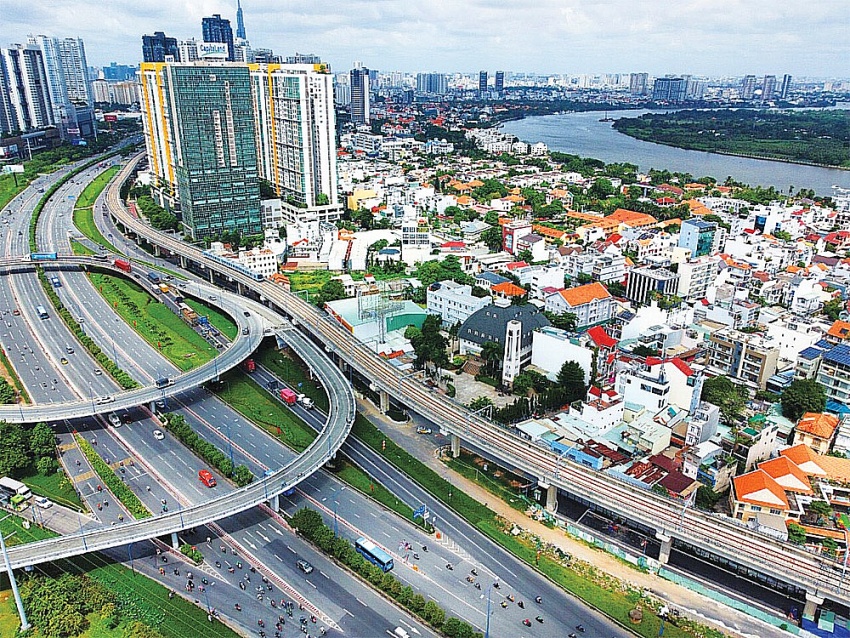
Against this backdrop, a central theme throughout the briefing was that urban planning and infrastructure development must move in parallel with economic transformation. As Vietnam evolves into a more complex, higher value-added economy, its cities can no longer continue expanding in a fragmented manner.
Instead, planning must support integrated urban areas, stronger infrastructure connectivity, the formation of employment clusters, education and healthcare ecosystems, and the creation of a higher-quality living environment.
 |
Ngoc Le, senior director of Strategic Consulting at Cushman & Wakefield Vietnam, said the strongest lesson from their urban planning case studies is that successful urbanisation is never just about adding housing stock.
"It is about creating a complete urban logic, where infrastructure, jobs, education, healthcare, public amenities, and quality of life evolve together," Le said. "Vietnam's larger planning footprint gives it a real opportunity to develop integrated mega-townships more effectively, but this requires long-term discipline and a planning mindset that builds districts, not just buildings."
Through the case studies presented at the briefing, Cushman & Wakefield identified several recurring principles for Vietnam's urban future: infrastructure connectivity must come early; planning discipline creates long-term commercial value; and mixed-use ecosystems incorporating schools, healthcare, offices, retail, and public spaces are more resilient over time. Examples from China and Vietnam show how coordinated planning can support both population growth and price resilience while enhancing urban quality of life.
Looking ahead, Anshul Jain, chief executive for India, Southeast Asia, the Middle East, and Africa at Cushman & Wakefield, said Vietnam remains one of the region's most compelling long-term growth markets because its story is no longer just about speed of expansion, but about the quality of that expansion.
"From a regional perspective, the direction is increasingly clear: urban planning, infrastructure investment, and economic strategy must become more closely aligned," Jain said. "If this alignment continues, Vietnam will be exceptionally well positioned to create more competitive cities, more investable urban corridors, and a stronger platform for long-term real estate growth."
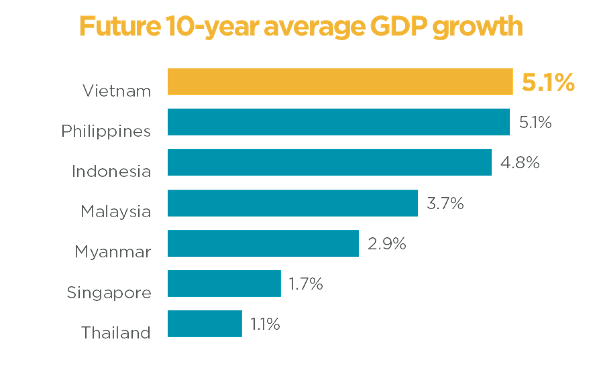 |
| The 2026 forecasted GDP Growth of Vietnam, Indonesia, Philippines and Thailand were adjusted based on the government’s target. Source: Moody’s Analytics, Cushman & Wakefield Research, Vietnam |
Cushman & Wakefield believes Vietnam is entering a pivotal period in which economic fundamentals and urban planning are becoming more closely interconnected. With stronger infrastructure ambitions, a broader domestic market, continued foreign investment interest, and an increasing focus on integrated urban development, the country is well positioned to shape the next generation of metropolitan growth in a more strategic and sustainable way.
 | Hanoi strives to raise urbanisation rate to 75 pc by 2030 The capital city of Hanoi is striving to increase its urbanisation rate to 60-62 per cent by 2025 and around 65-75 per cent by 2030. |
 | Tall building forum held in Ho Chi Minh City Ho Chi Minh City is one of the fastest growing spots for urbanisation and tall buildings in Southeast Asia, and there is great potential to develop this segment further, according to experts at the Tall Buiding Forum held in Ho Chi Minh City on May 28. |
 | Affordable housing emerges as driver of Vietnam’s urban growth As Vietnam's urban population grows, affordable housing is emerging as a key driver of sustainable development, according to Dr. Jerry Nguyen, deputy general director of Investment and International Business Development at Hoa Binh Construction Group. |
What the stars mean:
★ Poor ★ ★ Promising ★★★ Good ★★★★ Very good ★★★★★ Exceptional
 Tag:
Tag:
Latest News



More News
- Lotte Properties and Phat Dat develop Thu Thiem Eco Smart City (May 27, 2026 | 22:18)
- Greening construction material market: the time is now (May 22, 2026 | 09:37)
- Last opportunity to own real estate in heart of Thao Dien (May 06, 2026 | 09:35)
- IOM and partners launch new SMEs guidance for construction and materials industry in Vietnam (April 24, 2026 | 17:25)
- Workshop guides construction firms on carbon rules (April 24, 2026 | 12:28)
- Malaysian tycoon SkyWorld brings sustainable homes to Vietnam (April 23, 2026 | 08:00)
- Green real estate labels mask deeper capital market divides (April 20, 2026 | 08:00)
- Ministry of Construction drafts criteria to assess urban climate resilience (April 14, 2026 | 17:05)
- Hyundai HT to expand smart home and building in Vietnam (April 01, 2026 | 13:20)
- Vietnam enters global Top 10 markets for LEED-certified buildings (March 09, 2026 | 13:45)


Latest News




 Mobile Version