
Hanoi plans congestion charges within Ring Road 1 from 2028

 |
| Photo: baodautu.vn |
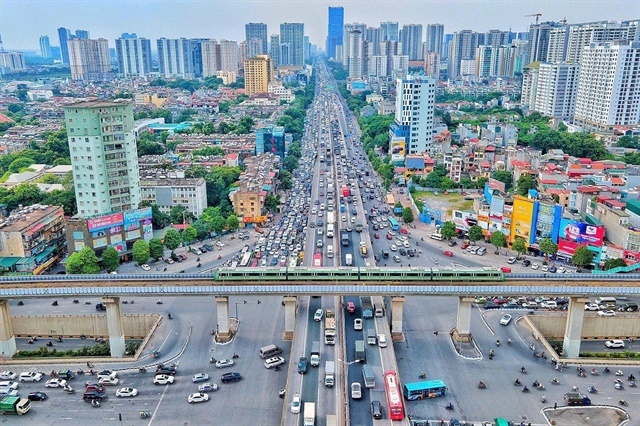
Hanoi People’s Committee is seeking public feedback on a draft resolution covering transport development policies, the application of advanced technologies in transport management and operations, and measures to restrict private vehicle use in central areas of the capital.
A dedicated chapter of the draft focuses on limiting private vehicles and introducing congestion charging. Under the proposed roadmap, road motor vehicles entering areas within Ring Road 1 would be subject to charges from January 1, 2028. The policy would then be extended to Ring Road 2 from January 1, 2030, and Ring Road 3 from January 1, 2032.
According to an explanatory report prepared by Hanoi Department of Construction, Hanoi’s inner-city areas are facing mounting traffic pressure due to the rapid growth in private vehicle ownership, while land allocated for transport infrastructure remains limited. Traffic congestion frequently occurs on major roads and in central districts, increasing travel times, social costs, and pollutant emissions.
“The application of economic measures through congestion charging is therefore a necessary solution to regulate demand for private vehicle use, reduce traffic volumes, and encourage greater use of public transport,” the report said.
The department noted that the phased implementation by ring road was intended to ensure feasibility and align with the development of transport infrastructure, public transport services, and the city’s socioeconomic conditions. The timeline is also expected to provide residents and businesses with sufficient time to adapt to the new policy.
Ring Road 1 has been prioritised for the first phase because it experiences the highest population density, vehicle concentration, and traffic pressure. Following an assessment of the scheme’s effectiveness, the city plans to extend the charging zone to ring roads 2 and 3 as part of a broader urban traffic management strategy.
The policy of charging vehicles entering central Hanoi has been under consideration for more than a decade. In 2017, Hanoi People’s Council approved a plan to strengthen private vehicle management through 2020 with a vision to 2030, identifying congestion charging in traffic hotspots as one of the measures to curb private vehicle use and reduce environmental pollution.
A proposal to introduce the fee was included in the city council’s legislative agenda in late 2021 but was subsequently withdrawn amid concerns over its feasibility.
Hanoi currently has around 8.1 million road vehicles, including 1.1 million cars, accounting for 13.6 per cent of the total, and approximately seven million motorcycles and scooters, representing 86.7 per cent.
The figure does not include around 1.2 million vehicles from other cities and provinces that regularly travel within the capital. About 95 per cent of the city’s motorcycles and scooters are petrol-powered.
The city’s public transport network currently comprises 1,946 buses operating on 129 routes, alongside more than 14,370 taxis.







What the stars mean:
★ Poor ★ ★ Promising ★★★ Good ★★★★ Very good ★★★★★ Exceptional
 Tag:
Tag:
Related Contents






Latest News




More News
- Financing options for shock-responsive social protection in Vietnam (July 30, 2026 | 14:59)
- HER2+ breast cancer carries $3.71 billion productivity burden in Vietnam (July 30, 2026 | 14:32)
- Party Resolution charts Vietnam’s development model through 2045 and beyond (July 30, 2026 | 12:29)
- STEM education evolves for AI era (July 21, 2026 | 09:38)
- Vietnam’s workforce ready for AI era (June 26, 2026 | 16:04)
- Why child online safety is now a business imperative (June 24, 2026 | 11:00)
- Hybrid work is reshaping Vietnam’s labour market (June 17, 2026 | 16:24)
- World's children exposed to at least three overlapping climate threats (June 17, 2026 | 15:54)
- Thai Nguyen event promotes safer food systems for World Food Safety Day (June 11, 2026 | 14:08)
- Vietnam emerges as rising hub for wealth creation (June 02, 2026 | 18:31)



Latest News





 Mobile Version