
Vietnam ranks among top 10 most improved global real estate markets

According to the Global Real Estate Transparency Index (GRETI) 2026 report released by JLL on September 15, Vietnam currently ranks 50th out of 88 countries and territories surveyed, with a transparency score of 3.15, remaining in the "Semi-Transparent" category.
Notably, Vietnam is one of 10 markets with the strongest score improvements globally during the 2024-2026 survey, alongside Poland, Thailand, Australia, Qatar, South Korea, India, Saudi Arabia, Dubai, and Abu Dhabi.
The index evaluates 88 markets globally based on 256 criteria across six categories: Performance Measurement (25 per cent), Regulatory and Legal (23.5 per cent), Market Fundamentals (16.5 per cent), Transaction Process (15 per cent), Listed Vehicle Governance (10 per cent), and Sustainability (10 per cent). It serves as a key reference for investors, lenders, and corporate occupiers worldwide, as market transparency directly impacts investment risk and opportunity.
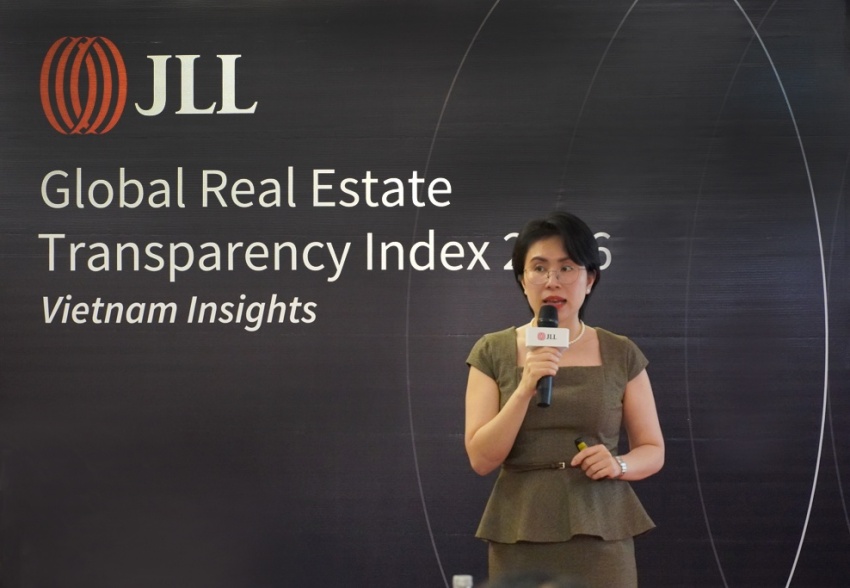 |
| Trang Le, country head and head of Research and Advisory for Vietnam, JLL |
The Asia-Pacific region recorded the strongest improvement in this year's survey, accounting for half of the top 10 most improved markets globally, led by India, Vietnam, South Korea, Australia, and Thailand. Following these improvements, cross-border investment flows into the region have recovered strongly over the past 12 months, with direct transaction volumes in several markets, including Vietnam, reaching record highs.
Globally, two-thirds of the 88 markets surveyed recorded transparency score increases over the past two years. However, the gap between leading and other markets continues to widen: the "Highly Transparent" and "Transparent" groups now attract over 98 per cent of total global commercial real estate investment, with the "Highly Transparent" group accounting for approximately 81 per cent. In contrast, the "Semi-Transparent" group, where Vietnam currently sits, accounts for only about 1.3 per cent of global capital flows, indicating significant potential to attract more investment as the market continues to enhance transparency.
Before 2020, Vietnam was in the "Low Transparency" group, with typical challenges such as limited market data and a complex legal framework, particularly for foreign investors on property ownership matters. In 2016, Vietnam's accession to the Trans-Pacific Partnership and the proposal to build a national real estate database marked the first major step, demonstrating commitment to international standards and reforms.
From 2020 to present, Vietnam has moved into the "Semi-Transparent" group, with 2024 serving as a critical year for legal framework development: the amended Land Law, Housing Law, and Real Estate Business Law all took effect; the new Price Law requires appraisers to hold professional certificates and maintain verifiable valuation records; and real estate transactions must be conducted through the banking system.
In 2026, Decree No. 357 came into effect, with the goal of completing the national land database by end of 2026. Vietnam has also seen increasing adoption of sustainable development practices in the real estate sector.
"Vietnam's inclusion in the top 10 most improved transparency markets globally in the 2026 GRETI reflects years of consistent effort. From 2012 to now, we have seen the market evolve from its early stages to establish a much stronger foundation, due to ongoing legal reforms. The comprehensive changes from 2025, from improving the legal framework and streamlining administrative procedures to economic policy reforms, have delivered initial positive results, evidenced by continuously increasing total registered foreign direct investment figures," said Trang Le, country head and head of Research and Advisory for Vietnam, JLL.
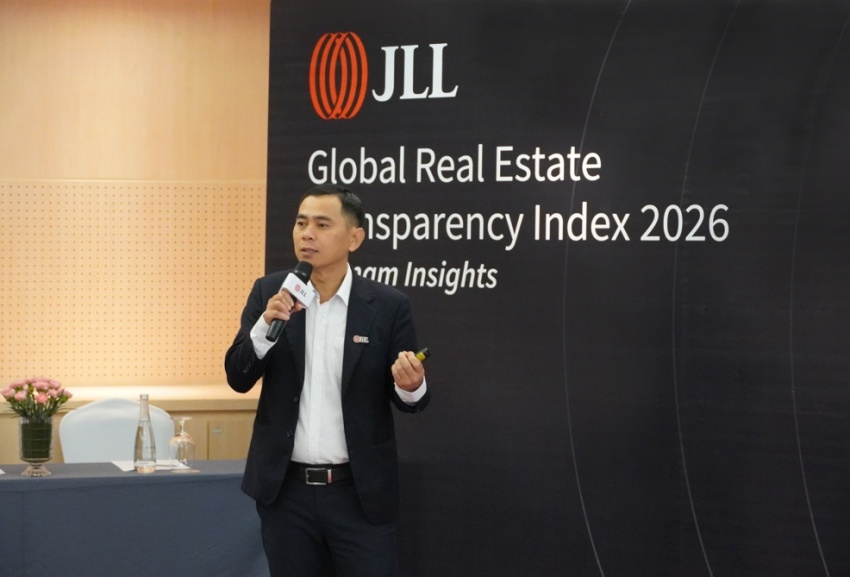 |
| Phuoc Vo, head of Valuation and Risk Advisory for Vietnam, JLL |
JLL's report also highlights a clear link between transparency levels and accuracy in real estate valuation. In "Highly Transparent" markets, with publicly available and comprehensive transaction data, valuation accuracy reaches 85-95 per cent, average valuation time is only 5-10 days, with an estimated 70 per cent of input information coming from public data, 20 per cent from market surveys, and only 10 per cent based on expert judgment.
In contrast, in "Semi-Transparent" markets like Vietnam today, data remains fragmented and limited, resulting in valuation accuracy of only 60-75 per cent and valuation time extending to 10–20 days. The information source structure is also reversed: expert judgment accounts for up to 40 per cent, market surveys 40 per cent, while public data accounts for only about 20 per cent. This means higher information gathering costs, more difficult verification, and higher legal risk compared to highly transparent markets.
"When markets rely heavily on experience and surveys rather than public data, information gathering costs, valuation time, and legal risks are all significantly higher compared to highly transparent markets. Vietnam's ongoing digitisation of land records, establishment of a unified nationwide real estate registration system, and adoption of international valuation standards such as IPMS will be key factors in closing this gap, improving the reliability of valuation results, and strengthening international investor confidence in the market," said Phuoc Vo, head of Valuation and Risk Advisory for Vietnam, JLL.
| Criteria | Highly Transparent Market | Vietnam (Semi-Transparent) |
| Valuation Accuracy | 85 - 95 per cent | 60 - 75 per cent |
| Valuation Time | 5 - 10 days | 10 - 20 days |
| Public Data | 70 per cent | 20 per cent |
| Market Surveys | 20 per cent | 40 per cent |
| Expert Judgment | 10 per cent | 40 per cent |
Source: JLL, 2026
JLL believes the roadmap to bring Vietnam closer to transparent market status will focus on six key areas: completing land record digitisation; establishing a unified nationwide real estate registration system; adopting international valuation standards; publishing data on the commercial real estate credit market; boosting green building certification linked to master planning; and strengthening disclosure requirements for listed companies.
JLL notes that amid increasing global economic and geopolitical uncertainty, real estate market transparency has become more important than ever for investors, especially as factors such as AI applications, capital reallocation into structural growth segments, energy security, and credit market transparency are reshaping investment decision-making globally.
 | Vietnam navigates complex landscape to accelerate strategic FDI Vietnam is targeting to become a top destination for strategic foreign direct investment (FDI) by reforming its policies and legal framework and enhancing the quality of its workforce and infrastructure. |
 | JLL tops Vietnam real estate advisory with 94 per cent market share JLL has been ranked as the top real estate investment advisor in Vietnam for 2025, capturing 94 per cent market share based on sell-side sales volume. |
What the stars mean:
★ Poor ★ ★ Promising ★★★ Good ★★★★ Very good ★★★★★ Exceptional
 Tag:
Tag:Related Contents







Latest News


More News
- Huong Viet Properties breaks ground on Palm City riverside park (October 09, 2026 | 15:35)
- HoREA proposes new framework for affordable commercial housing (October 08, 2026 | 17:01)
- Hong Hac City event to explore Bac Ninh's urban transformation (October 08, 2026 | 15:27)
- Onsen in the heart of the city: a new experience at the shopping mall (October 08, 2026 | 08:00)
- Enterprises honoured as Outstanding Provider of Green Industrial Solutions (October 06, 2026 | 18:03)
- MIK Group launches House of MIK in Ho Chi Minh City (October 03, 2026 | 17:00)
- Vietnam hospitality shifts towards integrated mixed-use developments (October 03, 2026 | 10:00)
- Stavian IP accelerates its modern expansion (October 02, 2026 | 14:00)
- ESG for future-ready industrial success (October 02, 2026 | 09:00)
- Green Future Awards honour five leading industrial park developers (October 01, 2026 | 22:20)



Latest News





 Mobile Version