
Why logistics will define the next phase of growth

Today, a new transformation is underway. Global supply chains are being fundamentally restructured. Businesses are no longer focused solely on minimising cost. They are redesigning supply chains to improve resilience, diversify sourcing, increase visibility, and meet growing sustainability requirements. This shift represents a major opportunity for Vietnam – not only as a manufacturing base, but as a strategic supply chain and logistics hub for the region.
 |
| Remco Enders, managing director, DSV Contract Logistics |
Efficiency and cost were key evaluation factors for production and supply chain setup decisions, and it was concentrated in a small number of locations, inventory levels were minimised, and logistics networks were optimised for lowest cost. Various disruptions have exposed the risks of this approach, and we’ve seen this by various causes in the last six or so years.
As a result, companies are increasingly adopting multi-country sourcing strategies and regional manufacturing networks that reduce dependence on any single location. Last year at the Vietnam Industrial Property Forum, the presentations taught us that besides Vietnam, also Indonesia and Thailand are key beneficiaries of this shift in Asia.
Vietnam is particularly well positioned to further benefit from this trend. The country sits at the centre of Southeast Asia, close to many of the world’s largest manufacturing and consumer markets. Its expanding industrial base, growing export capabilities, and strong trade connectivity make it an attractive location for companies looking to build more diversified supply chains.
However, attracting factories alone will not be enough. The next phase will be determined by supply chain capability. When multinational companies evaluate where to invest, they increasingly consider factors such as transportation reliability, warehouse capacity, supply chain visibility, customs efficiency, sustainability readiness, and overall logistics performance.
Logistics capability has become a competitive advantage rather than simply a support function. At DSV, we have these discussions on a daily basis with our global client base, whenever they evaluate alongside Vietnam with Thailand, Malaysia, or Singapore.
The interest creates significant opportunities for Vietnam’s logistics sector, but challenges as well. This shift is creating demand for higher-value logistics services and more skilled supply chain expertise. Sectors such as electronics, healthcare, advanced manufacturing, and technology require specialised logistics capabilities, including security, traceability, and compliance management. As Vietnam continues to attract more of these industries, the logistics sector will keep moving further up the value chain.
Sustainability is another important driver of change. Global customers increasingly evaluate environmental performance alongside cost and service quality. Carbon reporting, emissions reduction, renewable energy, and transportation solutions are becoming core business requirements rather than optional initiatives.
This is also a topic we actively engage in across the industry, including through contributions from our Asia-Pacific leadership at forums such as the Vietnam Industrial Property Forum.
To fully capture the opportunities created by global supply chain restructuring, continued investment will be essential across three key areas. First, infrastructure connectivity must continue to improve further. Ports, airports, industrial zones, free trade areas, and transport corridors need to function as integrated networks.
Secondly, digitalisation across the logistics ecosystem must continue to accelerate, as we’ve seen the government investing in various areas already.
And thirdly, as supply chains become more technology-driven and operationally sophisticated, stronger collaboration between industry and educational institutions is needed to develop future-ready talent. We are contributing to this effort through partnerships with colleges and universities that connect classroom learning with practical industry experience.
Vietnam’s manufacturing success story is already well established. The next chapter will be determined by its ability to build a world-class supply chain ecosystem around that manufacturing base.
The country has all the foundations needed to strengthen its position as one of Asia’s leading logistics and supply chain hubs. As global supply chains continue to evolve, this may prove to be the Vietnam’s most important competitive advantage in the decade ahead, when comparing to the regional competition.
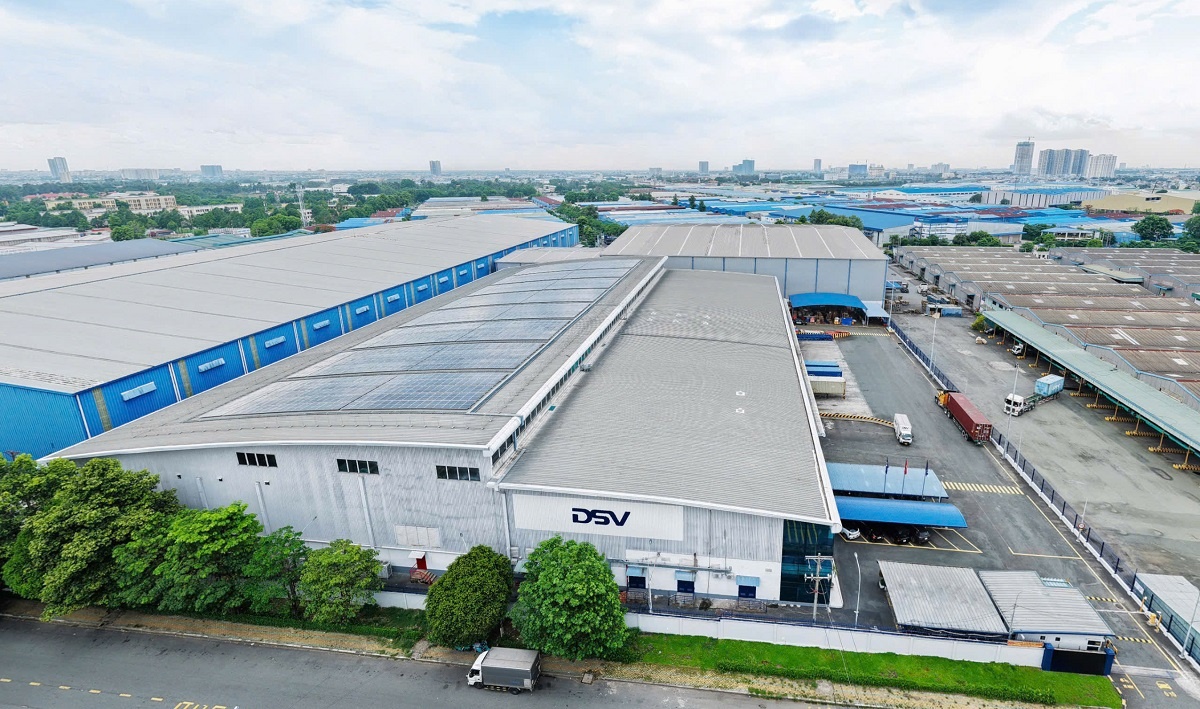 |
| The rooftop solar power system at DSV's warehouse contributes to promoting a sustainable supply chain and carbon emissions reduction. |
DSV’s purpose is to keep customers’ supply chains flowing, moving millions of shipments annually by air, sea, road, and rail around a world in constant change. Its vision is to create long-term, sustainable growth and value for customers, employees, shareholders, and society.
Visit dsv.com
Head office in Vietnam: 8th Floor, E.Town 6 Building, 364 Cong Hoa Street, Tan Binh Ward, Ho Chi Minh City
Phone number: +8428 3948 7800
Email: info@vn.dsv.com
What the stars mean:
★ Poor ★ ★ Promising ★★★ Good ★★★★ Very good ★★★★★ Exceptional
 Tag:
Tag:Related Contents

Latest News
More News
- Enterprises honoured for sustainability in industrial parks (October 06, 2026 | 11:49)
- Honouring businesses in Vietnam’s industrial property development (October 05, 2026 | 18:31)
- Soilbuild wins three awards at Green Future Awards 2026 (October 05, 2026 | 18:23)
- Vietnam emerging as an industrial location of choice (October 05, 2026 | 16:21)
- Investors interest amid ongoing reshuffling of global manufacturing (October 02, 2026 | 22:10)
- LŌ-GOI Group sets up industrial estate venture with three Asia-based institutional investors (October 02, 2026 | 16:00)
- Stavian IP accelerates its modern expansion (October 02, 2026 | 14:00)
- ESG for future-ready industrial success (October 02, 2026 | 09:00)
- Green Future Awards honour five leading industrial park developers (October 01, 2026 | 22:20)
- Green transition leaders honoured at Green Future Awards 2026 (October 01, 2026 | 22:10)







 Mobile Version