
coLoan to empower women through inclusive green finance

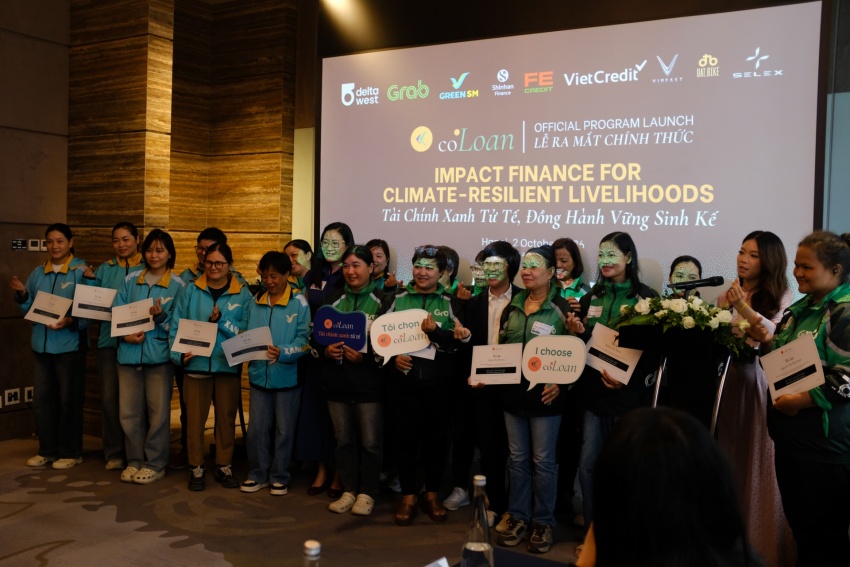 |
| Women ride-hailing and delivery workers are beneficiaries from the platform. Photo: Delta West |
In its first phase, coLoan will support women ride-hailing and delivery workers in Hanoi and Ho Chi Minh City to access and own electric vehicles, with an ambition to scale the model nationwide and, over time, beyond Vietnam.
The programme brings together financial institutions (Shinhan Finance , FE Credit, VietCredit), electric vehicle makers (VinFast, Selex Motors, Dat Bike) and mobility platforms (Grab, Green SM) to address different barriers that have historically limited women's access to productive assets and formal finance. Lenders share credit risk, EV manufacturers make vehicles more accessible, while mobility platforms provide income-generating opportunities and operating data that can support repayment and credit-building.
Together, the partnership creates a connected pathway from daily work to ownership of the vehicle that powers it.
According to Park Jeong Song, sales director, Shinhan Finance, women who power Vietnam's mobility economy every day have too often been invisible to the financial system.
“This coalition changes that, giving them a fair tool to earn on their own terms, build credit, and drive the green transition,” Song said.
Lan Anh Ha, principal, Delta West Group said that coLoan turns a multi-partner financing structure into something women drivers can clearly understand and act on, offering structured guidance and empowering women’s decision-making process from their first inquiry to full vehicle ownership.
Every day, millions of Vietnamese women earn a living through ride-hailing and delivery. Many face unpredictable fuel costs, tightening restrictions on petrol motorbikes in major cities, and limited formal credit history to secure affordable financing.
coLoan puts an electric vehicle, a work tool that earns income every day within reach with zero down payment and repayments from about VND 40,000 ($1.54) a day over terms of up to 24 months.
Based on coLoan programme’s partner estimates, switching from petrol to electric can cut energy costs by more than 60 per cent and increase net income by about 8 per cent. Every on-time payment also helps drivers build a credit history and move towards a greener, more secure livelihood.
The financing challenge sits within a broader gender gap in entrepreneurship. A UN Women study found that 93.2 per cent of women-owned enterprises in Vietnam were micro or small enterprises, with 79.2 per cent operating in the service sector. The study also identified limited access to resources among the barriers facing women-owned SMEs.
In its first phase, coLoan aims to mobilise approximately $2 million in impact financing across Hanoi and Ho Chi Minh City, while targeting an estimated 5,000 tonnes of CO₂ emissions reduction annually.
The ambition extends well beyond the pilot. Vietnam has around 80 million motorcycles in circulation, with electric motorcycles accounting for only about 4 per cent of the fleet, approximately 3.2 million electric motorcycles in 2025.
This creates a significant opportunity for financing solutions that can accelerate the transition from petrol-powered to electric mobility.
The climate challenge makes that transition increasingly important. In its 2025 Economic and Social Survey of Asia and the Pacific, ESCAP identified Vietnam as one of 11 of 30 economies analysed that were more exposed to climate risks from a macroeconomic perspective.
Vietnam's national green transport roadmap sets a pathway towards net-zero greenhouse gas emissions by 2050, including the transition of road motor vehicles toward electricity and green energy.
 | How can private investments unlock Vietnam’s healthcare? Vietnam’s healthcare sector has made remarkable strides over the past few decades, shaped by government reforms and increasing private sector involvement. Social health insurance, established in the early 1990s, now covers about 93 per cent of the population, with an annual government budget over $5 billion. |
What the stars mean:
★ Poor ★ ★ Promising ★★★ Good ★★★★ Very good ★★★★★ Exceptional
 Tag:
Tag:Related Contents





Latest News




More News
- Vietnam and Switzerland to deepen financial cooperation (October 19, 2026 | 13:24)
- Carbon finance hinges on viable ventures (October 19, 2026 | 09:59)
- AI to transform the future of finance (October 19, 2026 | 09:04)
- Government proposes relaxing IPO conditions (October 19, 2026 | 08:00)
- Citi warns of intensifying competition for capital amid higher rates (October 16, 2026 | 16:54)
- Banks poised for Q3 profit growth amid margin pressure (October 16, 2026 | 16:51)
- Eximbank to strengthen corporate governance structure (October 16, 2026 | 11:32)
- Citi honours 13 banks with 2025 STP Awards (October 15, 2026 | 16:01)
- Green transition requires realistic roadmap (October 14, 2026 | 17:31)
- VIR workshop explores credit policy and carbon market development (October 14, 2026 | 11:22)








 Mobile Version