
ESG for future-ready industrial success

Vietnam’s industrial sector stands at a transformative juncture. As one of Southeast Asia’s fastest-growing manufacturing hubs, the country continues to attract substantial foreign investment. At the same time, success in an increasingly competitive landscape depends on a forward-looking approach to environmental, social, and governance (ESG) principles.
 |
With 50 years of real estate expertise, Soilbuild International has observed how global standards are reshaping investor and occupier expectations across Vietnam. Multinational corporations and institutional investors increasingly prioritise developments that align with international benchmarks, not only to support compliance but also to enhance operational efficiency, manage risks, and strengthen supply chain credentials. In this context, ESG integration from the earliest planning stages represents a strategic advantage.
A key consideration is future-proof design. Industrial facilities must be able to accommodate evolving technologies, regulatory requirements, and climate considerations. Developments that incorporate flexibility, such as modular layouts, renewable energy readiness, and efficient resource systems, are better positioned to maintain relevance and asset value over the long term.
This adaptability is critical in Vietnam, where rapid infrastructure expansion and shifting global trade patterns demand agile responses.
Taking a role as an environmental leader via practical innovation, Soilbuild notes that practical environmental measures deliver tangible benefits. LEED-certified industrial facilities, for example, integrate energy-efficient technologies and solar power capabilities. These features help reduce carbon footprints and operational expenses while enabling tenants to meet their own ESG reporting obligations more effectively.
Flagship projects such as Spectrum Nghe An in Nghe An province and Spectrum Hung Yen in Vietnam’s northern economic corridor exemplify this approach. Located within established industrial zones with excellent connectivity to ports and airports, these developments pair premium specifications with strong sustainability elements, including green spaces and electric vehicle-supportive infrastructure.
Spectrum Bac Ninh, set to launch soon, will further expand these offerings in a key manufacturing hub, providing flexible ready-built and build-to-suit solutions that support scalable, responsible operations.
In Vietnam’s context, where rapid industrialisation coincides with ambitious climate targets, such features are particularly relevant. Developers who prioritise green building practices help bridge economic expansion and environmental responsibility.
Additionally, Soilbuild also boasts social dimensions and governance excellence. The social pillar of ESG emphasises creating workplaces and ecosystems that foster wellbeing, safety, and inclusive growth. Modern industrial parks must prioritise occupational health, skills development, and community connectivity.
Professional estate management also plays an important role in maintaining consistent standards, allowing businesses to focus on core operations while benefiting from supportive environments.
Strong governance underpins these efforts. Transparent decision-making, robust risk management, and ethical standards build trust with investors, regulators, and partners. This is important in Vietnam’s dynamic market, where long-term partnerships define success.
Furthermore, Soilbuild International also uses adaptability as the key to resilience. Vietnam’s industrial sector faces a complex interplay of opportunities and challenges: infrastructure improvements, technological advancements, shifting trade dynamics, and climate vulnerabilities. A rigid approach risks obsolescence. Instead, future-ready strategies emphasise modularity, scalability, and integration with broader economic corridors.
Soilbuild International’s Spectrum portfolio demonstrates how strategic location, LEED-certified design, and end-to-end capabilities can create resilient platforms for tenant success. These projects reflect a commitment to delivering adaptable industrial solutions that evolve alongside industrial maturation.
Vietnam has demonstrated commitment to balancing growth with sustainability through policy initiatives that encourage green investment. For industrial real estate, this creates fertile ground for innovation.
International experience shows that early adopters of comprehensive ESG practices often achieve superior risk-adjusted returns, stronger tenant relationships, and enhanced reputation in global markets.
Staying ahead requires continuous learning and evolution. ESG is a fundamental shift in how value is created and preserved; it demands ongoing assessment of material issues, stakeholder engagement, and willingness to invest in solutions that secure enduring competitiveness.
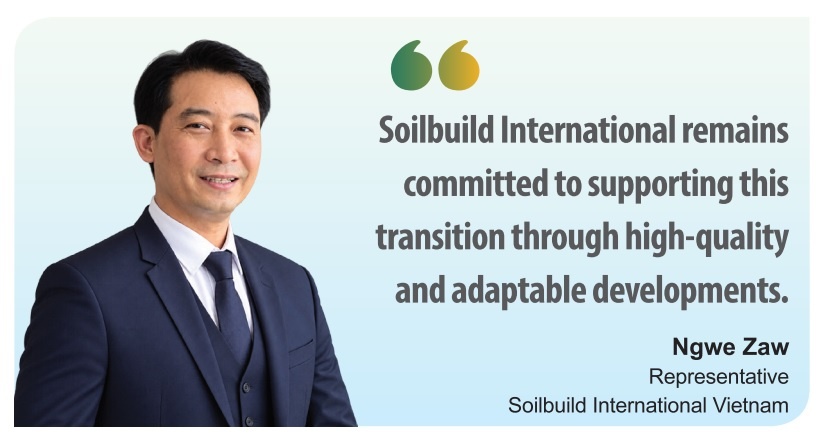
Soilbuild International remains committed to supporting this transition through high-quality, adaptable developments that combine international expertise with local market understanding. The Spectrum projects in Nghe An, Hung Yen, and Bac Ninh illustrate how thoughtful integration of ESG principles can empower businesses to thrive up and down Vietnam.
What the stars mean:
★ Poor ★ ★ Promising ★★★ Good ★★★★ Very good ★★★★★ Exceptional
 Tag:
Tag:Related Contents
Latest News
More News
- Enterprises honoured for sustainability in industrial parks (October 06, 2026 | 11:49)
- Honouring businesses in Vietnam’s industrial property development (October 05, 2026 | 18:31)
- Soilbuild wins three awards at Green Future Awards 2026 (October 05, 2026 | 18:23)
- Vietnam emerging as an industrial location of choice (October 05, 2026 | 16:21)
- Investors interest amid ongoing reshuffling of global manufacturing (October 02, 2026 | 22:10)
- LŌ-GOI Group sets up industrial estate venture with three Asia-based institutional investors (October 02, 2026 | 16:00)
- Stavian IP accelerates its modern expansion (October 02, 2026 | 14:00)
- Green Future Awards honour five leading industrial park developers (October 01, 2026 | 22:20)
- Green transition leaders honoured at Green Future Awards 2026 (October 01, 2026 | 22:10)
- Six developers honoured as Emerging Green Industrial Property Developers (October 01, 2026 | 22:00)








 Mobile Version