
Japan commits $1.5 million to support flood recovery in Vietnam

 |
| Ito Naoki, Japanese Ambassador, together with his spouse and Silvia Danailov, UNICEF representative in Vietnam, visited water, sanitation, and hygiene (WASH) activities at Kim Cuc Primary School in Cao Bang province. Photo: IOM |
Announced on December 15, the contribution aims to address immediate humanitarian needs while strengthening community resilience in some of the country's most heavily affected areas after a succession of extreme weather events throughout 2025.
Of the total funding, $1 million will be channelled through IOM Vietnam to provide non-food item assistance to more than 32,000 people in Daklak, Gia Lai, Khanh Hoa, and Lam Dong provinces.
The support will include essential household items and shelter repair kits, while also strengthening search and rescue capacity for 20 community-based response teams, benefiting an estimated 4,000 people.
The remaining $500,000 will be allocated to UNICEF Vietnam to improve access to water, sanitation, and hygiene (WASH) services, repair damaged sanitation facilities, enhance lighting in schools, and strengthen protection measures for women and girls. The programme is expected to benefit approximately 20,000 people, including 14,000 children.
Japanese ambassador to Vietnam Ito Naoki said the assistance reflected Japan's commitment to standing alongside Vietnam during times of crisis.
“We sincerely hope that this emergency support from the Japanese people and government will quickly reach those affected, ease the burden caused by the storms, and help disaster-hit communities recover as soon as possible,” he said.
He added that Japan is also considering longer-term technical cooperation through the Japan International Cooperation Agency, with a focus on water management and infrastructure development in Vietnam's central regions to mitigate future disaster risks.
 |
| A family in Kim Cuc commune, Cao Bang province has access to clean water thanks to the support of the Japanese government through UNICEF. Photo: UNICEF |
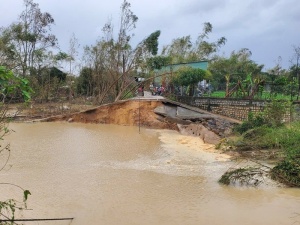
Vietnam has experienced an unprecedented sequence of extreme weather events in 2025, with 15 typhoons recorded and flooding of exceptional intensity, frequency, and geographic spread.
Major storms, including typhoons Bualoi and Matmo in late September and early October, caused record flooding across seven major river systems, severely affecting northern provinces. Subsequent storms, such as Fengshen and Kalmaegi, further compounded damage in central regions, while Storm Koto at the end of November brought additional heavy rainfall.
According to the government's latest report dated November 26, the south-central region is facing its worst flooding in 50 years.
Floods and landslides have resulted in accumulated economic losses estimated at $3.6 billion, while 409 people have been reported dead or missing since the start of the storm season. More than 337,000 homes have been destroyed or damaged nationwide.
At the height of Typhoon Kalmaegi, more than 500,000 people were temporarily displaced. Across nine provinces, an estimated 1.9 million people are currently lacking access to safe water and sanitation, raising concerns about public health risks, particularly for children.
The Japanese funding is expected to play a catalytic role in strengthening multi-sector coordination across health, education, nutrition, and protection services. As part of the United Nations' joint response plan, IOM and UNICEF are prioritising support for the most vulnerable groups, including displaced families, women, children, and people with disabilities.
UNICEF representative in Vietnam Silvia Danailov said children are among those most affected by climate-related disasters.
“Children have done nothing to cause climate change, yet they bear its heaviest burden,” she said. “Japan's timely support enables UNICEF and partners to restore safe water and sanitation, protect children from disease, and help communities build resilience against future climate shocks.”
Similarly, IOM chief of mission in Vietnam Kendra Rinas highlighted the importance of addressing immediate shelter and household needs for displaced families.
“With Japan's generous support, IOM will deliver shelter repair kits and essential non-food items to families affected by recent disasters in south-central Vietnam, helping them stabilise living conditions and accelerate recovery,” she said.
Japan and Vietnam have a long-standing development and humanitarian partnership. In 2024, with funding from the Japanese government, UNICEF supported WASH and child protection efforts for families affected by Typhoon Yagi in Cao Bang, Dien Bien, Lao Cai, and Yen Bai provinces, benefiting nearly 35,000 people.
Meanwhile, IOM Vietnam has previously delivered life-saving assistance to more than 17,000 vulnerable individuals and rehabilitated evacuation centres in flood- and landslide-prone areas.


What the stars mean:
★ Poor ★ ★ Promising ★★★ Good ★★★★ Very good ★★★★★ Exceptional
 Tag:
Tag:Related Contents



Latest News




More News
- Keppel expands Bytes for Future programme to Hanoi (September 15, 2026 | 14:59)
- TCP and Central Committee of the Vietnam Youth Federation empower youth through community sport yards (August 26, 2026 | 15:13)
- SABECO strengthens community ties through Bia Saigon partnership (August 24, 2026 | 15:29)
- Government launches child protection programme for 2026–2030 (August 06, 2026 | 11:33)
- TMIV, Tohe host autism art event in Hanoi (July 13, 2026 | 17:06)
- TUI Academy Hanoi opens to bridge tourism skills gap (July 10, 2026 | 15:05)
- Panasonic to donate 1,000 flashlights to residents in Nghe An and Ha Tinh ahead of storm season (July 02, 2026 | 09:00)
- Viatris collaborates with medical community to enhance management of non-communicable diseases in Vietnam (June 29, 2026 | 17:20)
- Save Turtles Run returns to Con Dao for fifth anniversary (June 18, 2026 | 15:58)
- Citi Vietnam hosts annual blood donation as part of Global Community Day (June 09, 2026 | 08:53)







 Mobile Version