
Closing workshop highlights five-year impact of Fair for All project

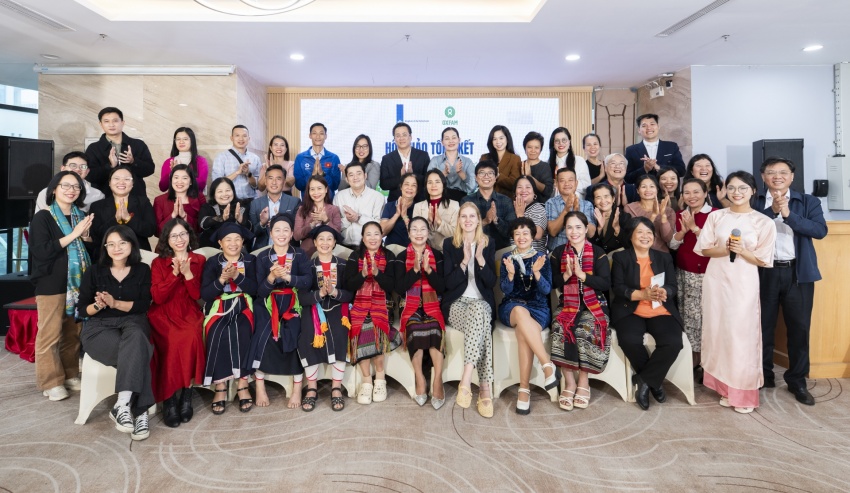 |
At the closing workshop held in Hanoi on December 12, Pham Quang Tu, deputy country director of Oxfam in Vietnam, said the Fair for All (F4A) project – funded by the Ministry of Foreign Affairs of the Netherlands and implemented by Oxfam in 2021 – aims to help vulnerable groups engage more effectively in agricultural value chains, encourage sustainable production models, and place people and the planet at the centre of development.
“Over the last five years, F4A has shown that when vulnerable communities have a voice in value chains, they can shape development that truly serves their needs,” said Tu. "Strengthening women’s economic autonomy remains essential because inclusive growth is impossible if half the population is left behind."
F4A was implemented across multiple provinces with the participation of political-social organisations, and research institutes, focusing on three key areas: capacity-building for social organisations; promoting green livelihoods and circular economy models; and enhancing the role of women and ethnic minorities in agricultural value chains.
Thanks to strong collaboration among stakeholders, the initiative helped shift development mindsets and improved organisational capacity at the local level. “These outcomes provide a solid foundation for scaling up the models and sustaining long-term impact beyond the project’s completion,” Tu said.
In Thai Nguyen province, F4A supported many women from the San Chay ethnic group to strengthen their economic autonomy and preserve indigenous knowledge. Members of the Dong Tien Cooperative in Phu Luong Commune, such as Hoang Thi Hang, successfully transformed herbs grown around their homes into herbal pillow products recognised as three-star OCOP items.
"I had to rehabilitate the soil around my house to plant herbs," said Hang. "The process was very hard, but fortunately, my husband supported me and helped clear the land. After that, I combined our family’s traditional oriental medicine practice to create the herbal pillow. I gathered women who shared the same passion, and together we established a cooperative."
During product testing, she became even more confident. “When we had the product inspected for food safety, there were no chemicals or harmful substances at all,” she said. The success of the herbal pillow opened new economic opportunities for the community. Hang also restored her stilt house to receive visitors seeking herbal treatments.
Cooperative member Hoang Thi Trinh expressed the community’s aspirations, “Our village will become a community-based tourism area to create livelihoods and increase income for local people.”
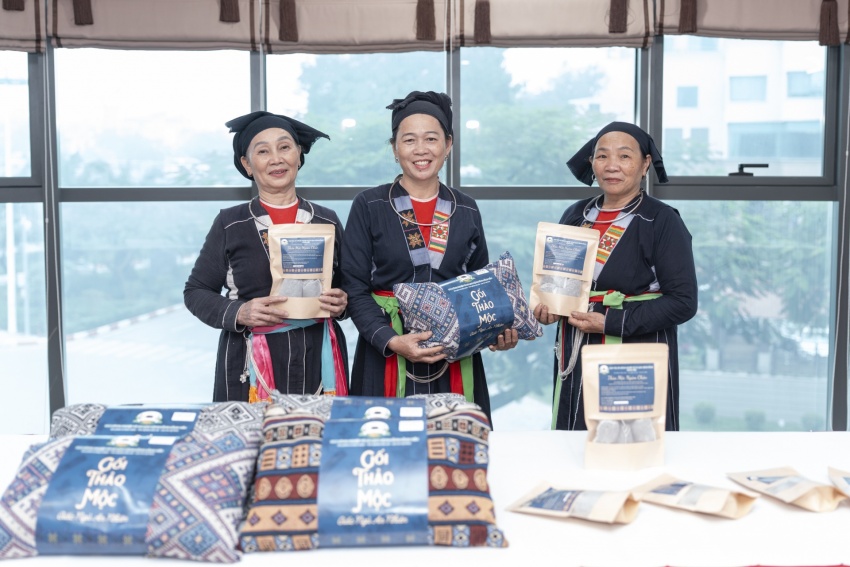 |
| Women-made products from the Dong Tien Cooperative in Phu Luong commune, Thai Nguyen province |
In Quang Tri province, F4A supported the Bru Van Kieu community in shifting from traditional farming to high-tech bamboo shoot cultivation, a model that fits local conditions and generates stable income and protects the environment.
Ho Thi Tuong, a member of the Giang Truong Xuan Bamboo Shoot Cooperative in Truong Son Commune, said, “Local people here really enjoy this bamboo shoot scheme. It provides income while helping protect the land and prevent erosion.”
Explaining why the model is sustainable, researchers said the mountainous terrain and cool, humid climate make the area ideal for bamboo growth. In villages blanketed by dust from stone mines, where vegetables cannot grow and citrus trees fail to bear fruit, bamboo still thrives, stabilises the soil, and reduces dust. This makes bamboo shoot cultivation a practical and climate-resilient solution.
The scheme also extended its impact to Ca Mau province, where F4A promoted circular economy practices and strengthened legal capacity for communities in Song Doc and Dat Mui communes, helping residents become more resilient to climate change and safeguard long-term livelihoods.
Gribnau Fleur, first secretary at the Embassy of the Netherlands in Vietnam, said Vietnam is “at a critical turning point” as it moves towards a greener, more circular economy. “The Netherlands is proud to support this transition not only through technical expertise and investment, but also through partnerships that bring together government, businesses, social organisations and researchers,” she said.
She added that “all changes must consider community wellbeing and environmental integrity – only then can growth be genuinely sustainable.”
According to Fleur, F4A reflects this multidimensional approach by enabling women, ethnic minorities and other vulnerable groups to strengthen their capabilities, access sustainable livelihoods and participate more fully in value chains rooted in traditional knowledge.
Over its five years, F4A delivered a series of notable outcomes: 10 social-organisation initiatives promoting green livelihoods and circular-economy models; 16 partner organisations engaged as advisors and collaborators; and 54 organisations and research units that strengthened their capacity.
The project supported 92 livelihood models across livestock and crop production, developed five alternative business models aligned with green and circular principles, and reached more than 380,000 people – including nearly 156,000 women. It also implemented four community-monitoring initiatives involving 70 residents, most of them women.
 | Hanoi symposium highlights gender equality research and policy An international scientific conference on gender equality and female empowerment was held in Hanoi, bringing together Vietnamese and international experts. |
 | Experts highlight unpaid care work as key barrier to gender equality Vietnam’s push for gender equality is hindered by a persistent blind spot: unpaid care work, which limits women’s participation in the workforce. |
 | Maternal job loss may affect children’s mental health, research shows Job losses affect more than workers themselves, with new research showing that children can suffer emotional and behavioural challenges when mothers lose employment. |
What the stars mean:
★ Poor ★ ★ Promising ★★★ Good ★★★★ Very good ★★★★★ Exceptional
 Tag:
Tag:Related Contents





Latest News




More News
- Keppel expands Bytes for Future programme to Hanoi (September 15, 2026 | 14:59)
- TCP and Central Committee of the Vietnam Youth Federation empower youth through community sport yards (August 26, 2026 | 15:13)
- SABECO strengthens community ties through Bia Saigon partnership (August 24, 2026 | 15:29)
- Government launches child protection programme for 2026–2030 (August 06, 2026 | 11:33)
- TMIV, Tohe host autism art event in Hanoi (July 13, 2026 | 17:06)
- TUI Academy Hanoi opens to bridge tourism skills gap (July 10, 2026 | 15:05)
- Panasonic to donate 1,000 flashlights to residents in Nghe An and Ha Tinh ahead of storm season (July 02, 2026 | 09:00)
- Viatris collaborates with medical community to enhance management of non-communicable diseases in Vietnam (June 29, 2026 | 17:20)
- Save Turtles Run returns to Con Dao for fifth anniversary (June 18, 2026 | 15:58)
- Citi Vietnam hosts annual blood donation as part of Global Community Day (June 09, 2026 | 08:53)



Latest News





 Mobile Version