
Hi-Tech Vietnam 2026 takes flight

Hi-Tech Vietnam 2026 opened on September 9 at the Vietnam Exhibition Centre in Hanoi, bringing together technology companies, manufacturers, research institutions and domestic and international organisations active in Vietnam’s unmanned aerial vehicles (UAVs) sector. The event will run through September 11.
Alongside three specialised exhibitions, the event series brings together organisations and businesses from Vietnam, China and South Korea, with a focus on high technology, UAVs, AI, robotics, semiconductors and the digital economy.
According to the organisers, bringing together interconnected technology sectors is intended to create a platform for businesses to showcase products, seek partners, boost technology transfer and expand into new markets, while strengthening links among technology, investment and research.
UAV Vietnam 2026 focuses on UAVs, drones and the low-altitude economy, showcasing technologies and solutions for smart agriculture, logistics, surveying and mapping, infrastructure inspection, smart urban development and AI-integrated applications. Exhibits include agricultural drones, gimbals, electro-optical/infra-red payloads, integrated cameras, “Make in Vietnam” UAVs, dual-use UAVs, drone-in-a-box systems, autonomous mobile robots and automated patrol solutions.
In related fields, AI & DIG SHOW 2026 showcases solutions in AI, robotics, big data, cloud computing, data centres, smart devices and platforms supporting digital transformation. VISOTECH 2026, the second international exhibition on semiconductor integrated circuits, optoelectronics and smart technologies, focuses on IC design, electronic components, semiconductor materials, sensors, lasers, LiDAR, measurement equipment and other foundational technologies for the digital economy.
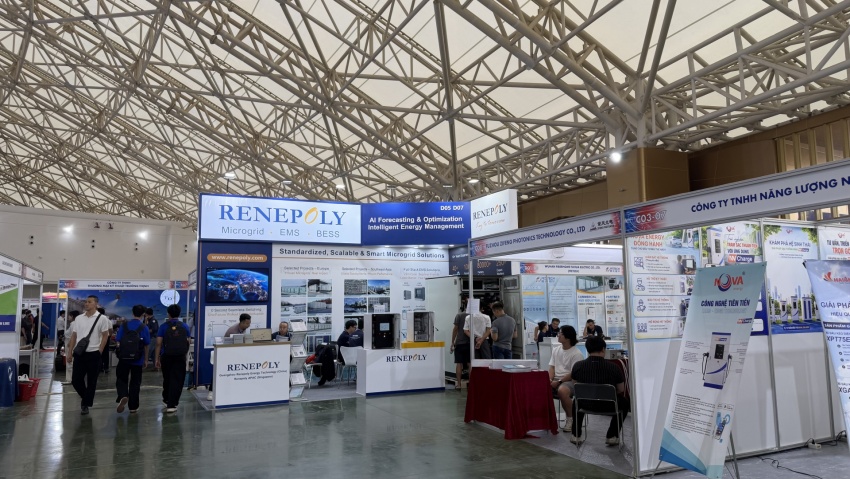 |
| Hi-Tech Vietnam 2026 at the Vietnam Exposition Centre. Photo: Ha Vy |
Holding the four exhibitions concurrently at the same venue is expected to give businesses and visitors access to a relatively comprehensive technology value chain, spanning core technologies and practical solutions for manufacturing, commerce and everyday life.
Behind the development of UAV technology lies a broader question: whether Vietnam can build a low-altitude economy.
According to Bui Hoang Phuong, deputy minister of Science and Technology, UAVs are already being deployed in many areas, meaning the focus of the initiative should go beyond testing the technology itself to developing specific application models and assessing their effectiveness when UAVs are integrated into economic activities, production and everyday life.
“If these models demonstrate their effectiveness, UAVs could become infrastructure for a broader market, with a single platform capable of being configured for different tasks, from crop spraying and terrain surveying to resource monitoring and goods delivery, depending on the configuration and associated services,” said Phuong.
“Beyond their ability to transport goods or perform aerial tasks, data collected from flights can also support digital mapping, production management and operations. This forms the basis of the low-altitude economy, where economic activities take place in low-altitude airspace with the participation of UAVs and related technologies and services.”
However, turning individual applications into a market at scale will require more than technology alone.
Nguyen Van Thuat, deputy director general of the Department of Digital Economy and Digital Society under the Ministry of Science and Technology, said the biggest challenge facing the low-altitude economy was currently not technology but the regulatory framework.
“UAVs are subject to multiple areas of regulation, including airspace, national defence, security, flight safety, radio frequency management and data, while commercial applications are expanding into a wide range of economic activities,” he said.
According to Thuat, this is also why a sandbox mechanism is being used to allow new models to operate within a controlled environment, generating real-world data before policies are finalised.
“This approach places the emphasis on controlled experimentation rather than waiting for a complete regulatory framework before deployment. Data and operational results will provide a basis for assessing effectiveness, identifying risks and gradually refining the regulatory framework,” he said.
From a flying device designed to perform specific tasks, UAVs are now being positioned within a much broader question of how Vietnam can build a new economic space. For that space to become a genuine market, the issue is not only how far UAVs can fly, but also whether regulation can keep pace with the technology’s development.
 | No-fly, restricted zones to UAVs, ultra-light craft to be test operated The Ministry of Defence has issued a plan to publicise the test operation of no-fly and restricted zones to unmanned aerial vehicles (UAVs) and ultra-light flying craft. |
 | Dien Bien to pilot use of unmanned aerial vehicles Dien Bien People's Committee on June 23 issued Decision No.1291/QD-UBND on granting permission for a controlled testing sandbox of digital technology products and services for using unmanned aerial vehicles in the province. |
What the stars mean:
★ Poor ★ ★ Promising ★★★ Good ★★★★ Very good ★★★★★ Exceptional
 Tag:
Tag:
Related Contents





Latest News





More News
- A broader platform for France-Vietnam cooperation (October 16, 2026 | 17:51)
- AEON to open 13th general merchandise store in Vietnam (October 14, 2026 | 17:56)
- Three international exhibitions open to boost industrial supply chain links (October 14, 2026 | 17:37)
- Garment and textile industry transitions towards high-value production (October 14, 2026 | 17:30)
- French business delegation meets MoF to discuss investment cooperation (October 14, 2026 | 11:37)
- Friso promotes global scientific collaboration on children’s gut health in Vietnam (October 13, 2026 | 16:18)
- Germany and Vietnam look to expand strategic cooperation and investment (October 13, 2026 | 16:14)
- Vietnam-Australia forum boosts AI and digital technology cooperation (October 13, 2026 | 11:30)
- Digital transformation shifts focus to added value (October 09, 2026 | 18:00)
- Melatec Dental Clinic - accompanying international clients on their smile care journey (October 09, 2026 | 17:25)



Latest News






 Mobile Version