
AI must create measurable business value

The event was jointly organised by VNU University of Economics and Business, Rangsit University of Thailand, the Forum for Accounting, Management and Economics of Indonesia, FPT Corporation, CFO Vietnam, and Politeknik Negeri Malang of Indonesia.
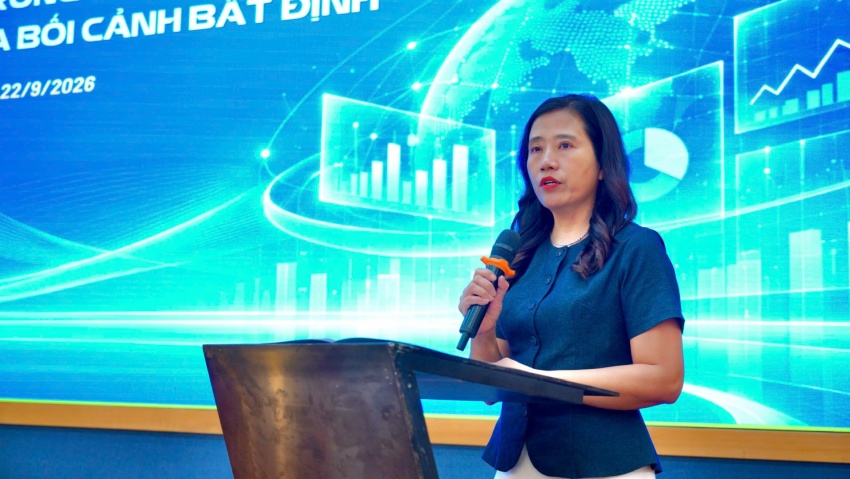 |
| Prof. Tran Thi Thanh Tu from VNU. Photo: VNU-UEB |
Prof. Tran Thi Thanh Tu, head of the Science and Innovation Board and director of the Science and Technology Development Fund at Vietnam National University in Hanoi, said AI, digital technologies, new business models, and changing global value chains were reshaping economies, businesses, and universities.
For Vietnam and the wider ASEAN region, she said, digital transformation had become a foundation for productivity, competitiveness, resilience, and sustainable growth.
"However, technology itself does not guarantee transformation. An impressive AI demonstration does not automatically create business value. More data does not necessarily lead to better decisions. And using AI in education does not automatically result in better learning outcomes,” Tu said.
She argued that the key question for businesses and institutions was no longer simply whether AI could perform a particular task, but whether it could generate “real, measurable, and repeatable value”.
This requires companies to assess AI through its impact on productivity, decision-making, cost efficiency, risk management, and value creation, rather than through the number of technologies or AI tools they have adopted. The shift is already becoming visible in enterprise applications.
She said the same principle should guide AI adoption more broadly: technology should strengthen human capability rather than simply replace human tasks.
“Technology can provide insights, but people must remain responsible for setting objectives, maintaining ethical boundaries, and making critical decisions,” she added.
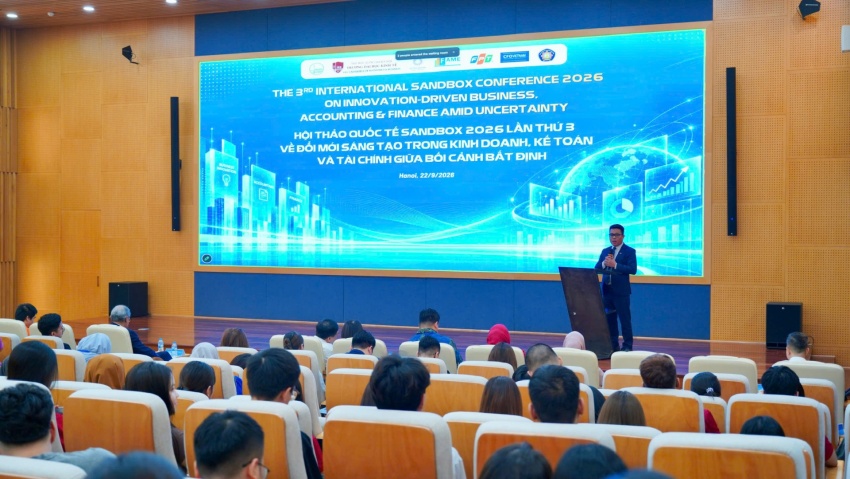 |
| Le Anh Ngoc, deputy director of FPT’s QACI. Photo: VNU-UEB |
At FPT Smart Cloud, AI is moving beyond individual productivity tools towards deeper integration into enterprise operating systems, with AI agents increasingly being deployed across customer service, sales, document processing, employee training, data analysis, and business process automation.
The shift means AI is evolving from a tool that assists individual employees into a broader component of corporate operating models, with businesses seeking to integrate AI into core processes and decision-making.
Le Anh Ngoc, deputy director of FPT’s Quantum AI and Cybersecurity Research Institute, said FPT was building its AI capabilities on advanced research and infrastructure, with a focus on quantum computing, AI, and information security.
“To meet this major shift, FPT’s technology development is built on strong research and powerful infrastructure,” Ngoc said.
FPT has also invested in computing infrastructure to support AI research, development, and deployment. Its AI Factories in Vietnam and Japan, together with its cloud and AI platforms, provide high-performance computing capabilities designed to enable enterprises to process data securely and run complex AI models at scale.
"The growing use of AI in management, finance, and accounting could deliver significant productivity gains, but would also require stronger security, transparent data management, and high standards of technological ethics. These are areas that FPT is actively supporting through our end-to-end AI ecosystem,” he added.
As businesses move from small-scale AI experiments towards broader deployment, FPT has also introduced the CASAN Methodology, a five-level AI-native capability framework designed to help companies assess their existing AI capabilities and develop a structured roadmap for AI adoption.
The framework is intended to help businesses move beyond isolated pilot projects and integrate AI into core operations, creating a clearer path towards long-term value from enterprise AI.
For businesses, the challenge therefore extends beyond deciding whether to adopt AI. Companies also need to determine where AI fits within their operating and growth models. Nguyen Duc Thai, CEO of SAPP Academy and a representative of CFO Vietnam, argued that AI should be linked to the specific management challenges businesses face at different stages of development.
"Companies move through different stages, from building their foundations and standardising operations to accelerating growth, scaling up, and managing portfolios and enterprise value. AI creates value when its capabilities are connected to the management priorities of each stage," he said.
This approach shifts the focus from AI as a standalone technology investment towards AI as part of a broader management infrastructure, connecting market signals with corporate strategy, value-creation priorities, operations, and decision-making. The ultimate objective is measurable performance, including revenue growth, profitability, cash flow, capital efficiency, and strategic advantage.
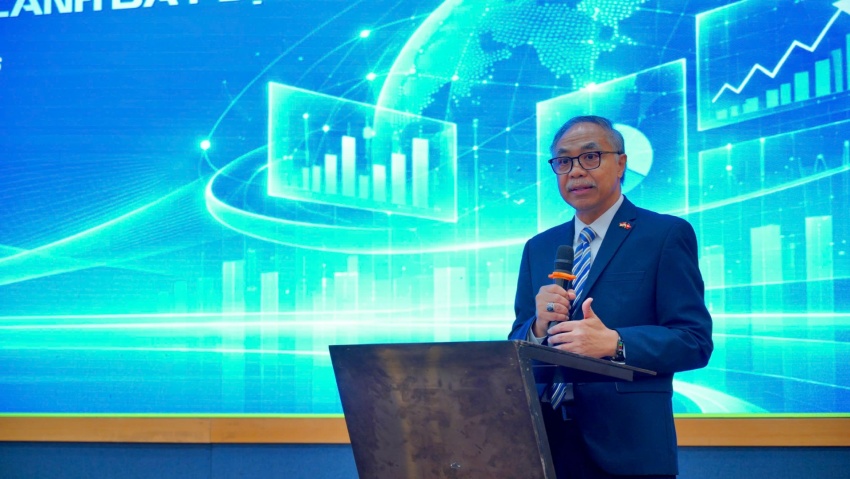 |
| Adam M.Tugio, Ambassador of Indonesia to Vietnam. Photo: VNU-UEB |
The implications are particularly significant for accounting and finance, where AI is changing how financial information is generated, analysed, and used. Adam M. Tugio, Ambassador of Indonesia to Vietnam, said the accounting profession had evolved alongside previous waves of technology, from paper ledgers to spreadsheets, enterprise resource planning systems, and data-driven assurance.
But he said AI represented a much deeper transformation. “We are witnessing not merely another cycle of automation. We are witnessing a fundamental transformation in how financial information is generated, verified, and trusted,” Tugio said.
AI can already automate or accelerate routine accounting processes, audit procedures, reporting, forecasting, and risk analysis. For finance professionals, this creates an opportunity to devote less time to gathering and processing information and more time to analysis, judgement, strategic decision-making, and risk management.
Tugio described the changing role of the accountant as a transition from bookkeeper to business partner, from sample tester to risk navigator, and from financial steward to architect of digital trust.
"Traditional regulation could struggle to keep pace with rapidly changing technologies, while a regulatory sandbox could provide a controlled environment in which new AI applications are tested under regulatory supervision before wider deployment," he added. “Rather than regulating from theory, regulators can regulate from evidence.”
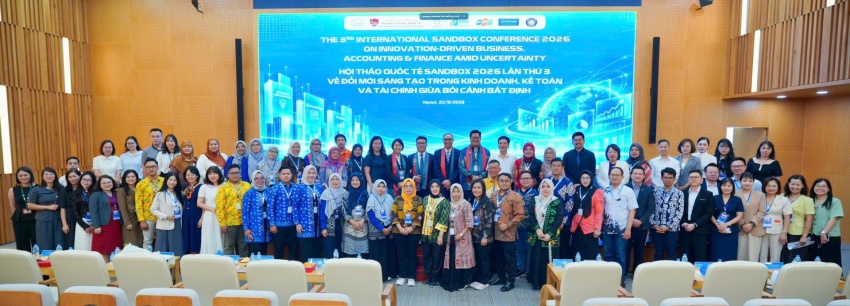 |
| Photo: VNU-UEB |
What the stars mean:
★ Poor ★ ★ Promising ★★★ Good ★★★★ Very good ★★★★★ Exceptional
 Tag:
Tag:Related Contents







Latest News



More News
- CYE 2026 announces top 5 finalists (October 09, 2026 | 16:55)
- Robotics inspires Vietnam’s next generation of engineers (October 08, 2026 | 15:18)
- Vietnam among fastest AI adopters, Pearson-AWS study finds (October 07, 2026 | 12:26)
- Ho Chi Minh City Oncology Hospital signs MoU with Novartis Vietnam (October 07, 2026 | 10:36)
- Expanding education partnerships to drive mutual growth (October 06, 2026 | 16:04)
- VTG 2026 to showcase textile and footwear innovation in Ho Chi Minh City (October 06, 2026 | 16:00)
- Infineon boosts Vietnam footprint with Ho Chi Minh City office (October 06, 2026 | 10:02)
- Vietnam Customs expands priority enterprise scheme to 74 firms (October 03, 2026 | 08:00)
- ASL Law opens Danang office (October 02, 2026 | 22:12)
- Project ACTIVE 2.0 launches in Vietnam to boost cervical cancer care (October 02, 2026 | 22:02)







 Mobile Version