
Vietnam’s growth ambitions hinge on effective policy reforms

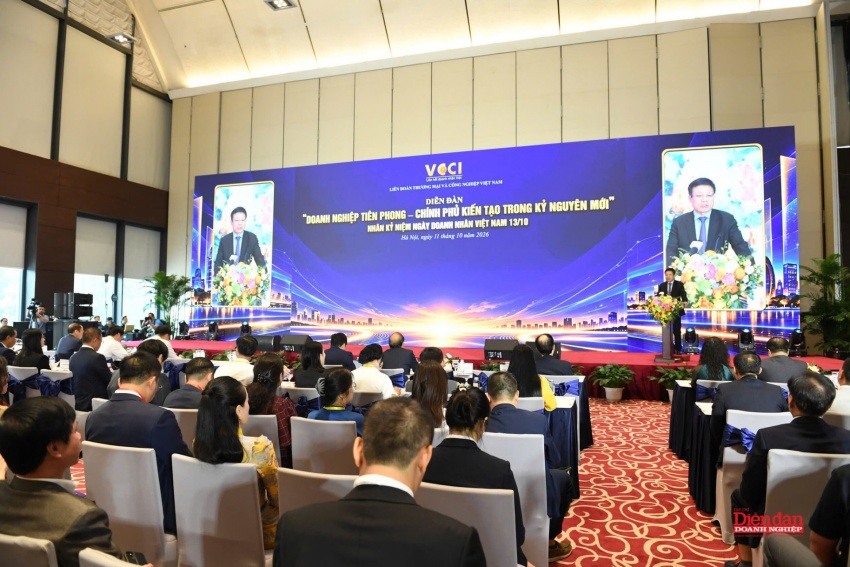 |
| Photo: VCCI |
These priorities took centre stage a forum enabling government, organised by the Vietnam Chamber of Commerce and Industry (VCCI) in Hanoi on October 11 to mark Vietnamese Entrepreneurs’ Day. The event brought together policymakers, experts, business associations, and enterprises to discuss institutional reforms and new growth drivers.
Ho Sy Hung, chairman of the VCCI, said at the forum that an enabling government and pioneering entrepreneurs were two essential conditions for unlocking a new period of economic growth. While the government could create greater development opportunities through better institutions, businesses needed to translate those opportunities into investment, production, employment, and economic value. Conversely, even enterprises with sufficient capital and innovative ideas would struggle to implement projects if regulations remained unpredictable, administrative procedures were prolonged, and resources were left untapped.
“If the previous period focused on institutional breakthroughs, the next must place greater emphasis on breakthroughs in implementation,” he said. “Businesses need stable regulations, transparent processing deadlines, and clearly defined responsibilities. Above all, they need a predictable business environment that allows them to invest confidently for the long term.”
According to Hung, Vietnam has witnessed considerable progress in policymaking over the past two years, with numerous resolutions, laws, and regulatory mechanisms introduced to remove barriers to business development. Nevertheless, the gap between policy formulation and implementation remains a significant challenge.
He cited nearly 900 business concerns consolidated into 53 groups of obstacles across 10 sectors at a July 2026 meeting between the government's permanent members and the business community. These concerns highlighted the importance of regulatory consistency, transparency, and policy predictability. Rapidly changing regulations, inconsistencies between legal documents, and prolonged investment approval procedures could increase operating costs and cause enterprises to miss market opportunities.
Phan Duc Hieu, a National Assembly deputy serving on its Economic and Financial Committee, highlighted significant changes in the speed and approach of legislative reform.
He cited Resolution No.198/2025/QH15, introducing special policies for private sector development, which was finalised and approved within just 12 days and nights. Meanwhile, Resolution No.206/2025/QH15 established mechanisms to address legal obstacles more rapidly without waiting for conventional legislative amendment procedures.
According to Hieu, the changing approach also seeks to unlock resources tied up in stalled ventures while ensuring accountability for violations. Reforms to investment approvals and overlapping planning regulations are similarly intended to reduce administrative requirements and accelerate project implementation.
Nguyen Xuan Tho, deputy director general of the Department of Private Enterprise and Collective Economy Development under the Ministry of Finance, presented figures demonstrating progress in administrative reform.
As of August 14, the ministry had reduced or simplified 837 of the 962 administrative procedures under review, equivalent to 87 per cent, while cutting total processing time by 54.88 per cent. During the first nine months of 2026, the ministry also advised on and implemented tax, fee, and charge exemptions, reductions, and payment extensions worth approximately VND245.6 trillion.
In addition, 146 of the 202 groups of business recommendations had been conclusively addressed by ministries and government agencies, representing approximately 72 per cent. However, administrative reforms must translate into measurable benefits for enterprises, including shorter approval times, lower compliance costs, and greater investment certainty.
Beyond institutional reform, achieving Vietnam's ambitious economic targets would require businesses to become more proactive in transforming growth models, strengthening competitiveness, and embracing technological innovation.
Nguyen Duc Hien, deputy head of the Central Policy and Strategy Commission, said Vietnam's target of average annual GDP growth of at least 10 per cent during 2026-2030 would demand substantial changes in the country's development approach.
Traditional growth drivers would need to be revitalised, while new sources of expansion should increasingly come from sci-tech and digital transformation.
Hien argued that Vietnam's export strategy should shift from prioritising shipment volumes towards generating greater added value. Industries with strong spillover effects, including logistics, energy, finance and banking, and research and development, should receive greater attention, alongside efforts to modernise traditional manufacturing sectors.
The importance of technological transformation was also reflected in the participation of Dang Tung Son, executive vice president and CEO of CMC Corporation.
Under its AI-X strategy, CMC is seeking to expand the application of AI and digital technologies across economic sectors, supporting productivity improvements and new growth opportunities.
“AI and digital transformation are no longer simply tools for improving operational efficiency. They are becoming fundamental drivers of productivity, competitiveness, and economic growth,” Son said. “Technology enterprises must take the lead in developing innovative solutions and helping businesses across sectors accelerate their digital transformation.”
Meanwhile, Tran Tien Dung, vice chairman of the Vietnam Logistics Business Association and chairman of the Haiphong Logistics Association, represented the logistics sector at the forum.
Logistics plays an important role in strengthening connections between manufacturers, exporters, and international markets. Improving infrastructure, accelerating digitalisation, and enhancing coordination across supply chains would help reduce business costs and support Vietnam's transition towards higher-value production and exports.
“Logistics costs and administrative obstructions remain important challenges for Vietnamese businesses seeking to strengthen their competitiveness. More consistent regulations, streamlined procedures, and better connectivity between transport networks would help enterprises operate more efficiently,” Dung said. “The logistics sector must also accelerate digital transformation and strengthen supply chain linkages to support Vietnam's ambitions for higher-value exports.”
Hien also noted the importance of developing an interconnected national business ecosystem in which enterprises of different sizes and capabilities could support one another.
Large corporations should lead supply chain development, creating opportunities for small and medium-sized enterprises, innovative startups, and cooperatives to participate more deeply in production networks.
Another priority was improving private enterprises' access to financial resources for sci-tech development. Support mechanisms needed further adjustments to enable businesses to access investment funds and other resources for technological applications.
Hieu similarly argued that institutional reforms were opening new development opportunities, but enterprises must take greater responsibility for improving corporate governance, pursuing sustainable development, and contributing to policymaking.
He particularly noted the role of major enterprises in supporting smaller businesses through stronger value-chain partnerships, while urging SMEs to improve their management capabilities, professional expertise, and business linkages.
What the stars mean:
★ Poor ★ ★ Promising ★★★ Good ★★★★ Very good ★★★★★ Exceptional
 Tag:
Tag:
Related Contents




Latest News



More News
- 100 entrepreneurs honoured with Thanh Giong Cup 2026 (October 12, 2026 | 08:00)
- French experts share AI and digital governance insights in Hanoi (October 11, 2026 | 08:00)
- Digital government push focuses on data connectivity and AI (October 10, 2026 | 08:00)
- Ho Chi Minh City holds dialogue with businesses to address operational hurdles (October 09, 2026 | 17:27)
- AI beginning to reshape recruitment criteria (October 09, 2026 | 16:49)
- Electronics firms boost raw material reserves sevenfold amid supply concerns (October 09, 2026 | 08:00)
- NSRP navigates global energy supply volatility (October 08, 2026 | 16:59)
- Minitab launches campaign to combat illegal software use in Vietnam (October 08, 2026 | 15:54)
- Raising construction materials supply chain standards amid green transition (October 08, 2026 | 14:00)
- Samsung Vietnam to deepen cooperation with local manufacturers (October 08, 2026 | 12:00)







 Mobile Version