
Vietnam M&A in 2027: Preparation becomes the competitive advantage

That is the common thread running through the four Asia contributors to Ansarada's 2027 M&A Predictions Report, Going All In. Speaking from Ho Chi Minh City, Kuala Lumpur, Bangkok, and Jakarta, they point to preparation and judgement as increasingly important competitive advantages. AI is speeding up analysis. Faster analysis is not necessarily translating into faster closings.
Banking and consumer lead the way back
For The Anh Dinh, Partner, Deal Advisory at KPMG Vietnam, 2025 was "the toughest year for M&A practitioners in Vietnam". The market rallied in the first half of the year, then slowed again in the second.
He expects 2027 to be the year the backlog starts to clear. Banking should lead, with roughly 50 lenders operating in the country and many looking to raise capital through bond and equity issuances. Consumer is his other pick, after a long lull in domestic spending. Mid-market companies will remain the mainstay, and cross-border buyers from Japan, South Korea, Thailand, and Singapore will remain involved in 60-70 per cent of deals. Decree 342, effective from 18 October, also eases the economic needs test for many foreign retailers.
 |
Longer deals, thinner fields
The recovery will not make deals easier. The Anh sees four frictions that Vietnamese sellers and their advisors need to plan around.
First, timelines have stretched from nine to 12 months to 14 or 15, and some shortlists are down to one serious bidder.
Second, buyers want granular numbers before they commit: monthly and quarterly financials broken down by channel, product line, and country.
Third, sellers increasingly favour investors already established in Vietnam over newcomers testing the market.
Finally, new tax registration and e-invoicing rules for household businesses and small online sellers have slowed parts of the consumer chain, with knock-on effects for larger brands that sell through them.
The upside sits in that same shift. With cautious buyers and fewer bidders, thorough early preparation now carries more weight than it once did.
Faster analysis, same judgement
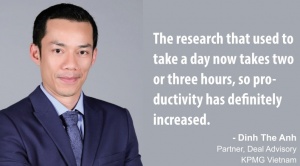
AI is already embedded in the deal process. The Anh says research that once took a day now takes two or three hours. "But the depth of what's required has increased too," he adds.
Speed without judgement is a risk. "If you don't know where to get the data, where the sources are, or whether that source is reliable, it can be a real problem if you rely on AI to give you information without knowing whether you can trust it," he warns. That is why AI-assisted work is still reviewed by experienced deal professionals.
Kuala Lumpur, Bangkok, and Jakarta agree
The region's other voices reach the same conclusion from different markets. Leslie Koh, Partner at EY-Parthenon Malaysia, says there is no shortage of capital. The harder part is converting interest into completed deals at valuations both sides accept. AI widens diligence rather than shortening it, he argues, and "a poorly prepared data room may result in a faster discovery of problems rather than a faster transaction".
Frank Janik, Advisory Partner at BDO in Thailand, puts it plainly: "AI is changing how deals are analysed much faster than it is changing how deals get done." Deals stall on valuation gaps, management responses, data quality, financing, and legal documentation. His rule of thumb is to expect them to run 50 per cent longer than planned.
In Indonesia, Oki Stefanus, Partner at EY-Parthenon, sees AI making diligence more efficient, while "interpretation of findings and the delivery of meaningful insights continue to rely heavily on human expertise".
Preparation is the 2027 differentiator
For Vietnam's deal community, the takeaway is practical. Bankers and advisors should build timetables with room for that extra 50 per cent, and keep experienced people on judgement while AI handles speed. Investors should ask for granular financials early, and test the AI claims of tech-enabled targets, including data governance, IP ownership, and AI oversight. Finance leaders and sellers should get their house in order before going to market, because, as Frank warns, "AI cannot compensate for incomplete, inaccurate or unreconciled information".
Ansarada has maintained an on-the-ground presence in Vietnam, working with deal teams who treat preparation as the first stage of a transaction rather than an afterthought. The question for 2027 is not how quickly a deal can be analysed, but how ready a seller is when the one serious bidder arrives. As Leslie puts it, "the differentiator in 2027 will not simply be the quality of the asset, but the quality of preparation."
 | Discipline shapes M&A environment Experts in Vietnam are cautiously positive in terms of dealmaking for the rest of 2026 after momentum improved in the second quarter, and new acquisitions continue to move forward. |
 | Why Vietnam deal teams may want to prepare for both IPO and sale With listed markets under pressure and some buyers still active, keeping both a sale and a listing open could be a useful part of what advisors offer Vietnamese sellers. Phi Bui, account executive at Ansarada Vietnam, gives his outlook on the current markets. |
 | Vietnam M&A set for 2027 rebound after tough year Vietnam’s buyer’s market has stretched deal timelines past a year and thinned bidder shortlists down to a single contender in some cases. But 2027 should be the year the country’s deal backlog starts to clear, as bank capital raisings and a consumer rebound reopen the pipeline, predicted Dinh The Anh, partner of Deal Advisory at KPMG Vietnam. |
What the stars mean:
★ Poor ★ ★ Promising ★★★ Good ★★★★ Very good ★★★★★ Exceptional
 Tag:
Latest News
More News
- Vietnam M&A set for 2027 rebound after tough year (November 16, 2026 | 08:00)
- Tax reforms carve the path for growth and confidence (November 03, 2026 | 11:25)
- Roland Berger expert outlines ways to mobilise capital for growth (October 29, 2026 | 16:21)
- Data-driven management for modern tax administration (October 19, 2026 | 09:28)
- Recent deals in Vietnam point to a quieter, more negotiated market (October 12, 2026 | 09:00)
- VIFC entrants need to build flexible structures as framework takes shape (October 12, 2026 | 08:52)
- Driving early detection and integrated liver disease management (September 30, 2026 | 13:58)
- Vietnam’s capital-markets upgrade creates a new deadline for deal readiness (September 14, 2026 | 09:00)
- Resolution 10 equals growth driven by strategic innovation (September 08, 2026 | 14:44)
- Partnerships streamline pathways for investors in Vietnam (September 08, 2026 | 08:58)



Latest News





 Mobile Version