
Vietnam, UN strengthen cooperation in digital technology, AI

Vietnam and the UN are strengthening collaboration in digital technology, AI, and technology governance, with a focus on developing specific, measurable, and scalable experimental models. As part of the 6th ASEAN Digital Ministers’ Meeting held in Hanoi, Minister of Science and Technology Nguyen Manh Hung met on January 14 with Amandeep Singh Gill, UN Under-Secretary-General and the UN Secretary-General’s envoy on technology, to discuss cooperation priorities in these areas.
 |
| Photo: MST |
“While physical infrastructure once drove connectivity and growth, data, digital platforms, computing power, and AI now underpin productivity in the digital age,” said Minister Hung. “Though intangible, this infrastructure has far-reaching impacts on governance effectiveness, business competitiveness, and quality of life.”
Vietnam views investment in digital technology and AI as an investment in long-term national capacity, requiring coordinated development of infrastructure, institutions, human resources, and policy frameworks, with the state playing a facilitating role. The minister welcomed the UN’s initiatives on digital public infrastructure, inclusive digital transformation, and responsible AI governance, noting their particular relevance for developing countries.
He stressed that effective cooperation must go beyond policy dialogue and be implemented through practical pilot models tailored to national conditions. In that spirit, Vietnam is ready to serve as a sandbox for global initiatives, from digital public infrastructure to AI governance, co-developed and refined through real-world application. With its large population, fast-growing digital market, and strong political commitment, Vietnam is well positioned to test solutions at scale and generate lessons for other countries.
At the meeting, Gill said digital technology and AI are entering a phase that will reshape not only economic growth, but also governance, social welfare, and development gaps. He stressed that the key challenge lies in countries’ institutional capacity and international cooperation to guide technology towards the common good.
“In this context, developing countries, particularly proactive ones like Vietnam, play a crucial role in bringing practical perspectives into global technology governance, ensuring standards reflect diverse development conditions and societal needs,” he said.
Gill said Vietnam has the potential to become a key UN partner in implementing global technology initiatives across the Asia-Pacific region.
Both sides agreed to maintain regular dialogue and advance concrete cooperation programmes on digital technology and AI, with a focus on measurable and scalable outcomes. Areas of cooperation include digital infrastructure development, digital transformation capacity-building, workforce training, and participation in regional and global AI governance frameworks.
 | Vietnam, UN reinforce development partnership amid global shifts Vietnam's finance minister and the United Nations' resident coordinator reaffirmed cooperation priorities at a meeting in Hanoi on May 21, emphasising sustainable development and policy advocacy. |
 | Law offers digital leap into the future Vietnam’s new Law on Digital Technology Industry will take effect at the start of next year. Prof. Dr. Andreas Stoffers from FOM University in Essen, Germany, explained how the new legal framework will work and how it aligns with the country’s wider vision. |
 | The 2025 Make in Vietnam Awards spotlight digital innovation The Ministry of Science and Technology (MoST) and the Vietnam Chamber of Commerce and Industry (VCCI) have launched the 2025 Make in Vietnam Awards. |
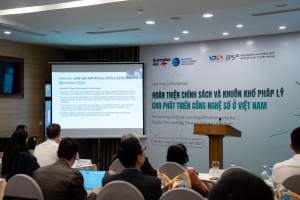 | Human-centred governance seen as key to AI development Drawing on both international experience and Vietnam’s policy trajectory, experts agreed that AI can deliver lasting value only when it is designed and deployed within a clear, human-centred governance framework. |
What the stars mean:
★ Poor ★ ★ Promising ★★★ Good ★★★★ Very good ★★★★★ Exceptional
 Tag:
Tag:Themes: Digital Transformation
- Amazon Kuiper licensed for private satellite telecommunications network in Vietnam
- AWS ramps up security tools amid growing AI risks
- Machine vision and 3D: How logistics and warehousing are catching up with manufacturing
- Nvidia proposes areas of strategic cooperation with Vietnam
- Draft legal amendments target red tape and decentralisation
Related Contents








Latest News



More News
- Expanding education partnerships to drive mutual growth (October 06, 2026 | 16:04)
- VTG 2026 to showcase textile and footwear innovation in Ho Chi Minh City (October 06, 2026 | 16:00)
- Infineon boosts Vietnam footprint with Ho Chi Minh City office (October 06, 2026 | 10:02)
- Vietnam Customs expands priority enterprise scheme to 74 firms (October 03, 2026 | 08:00)
- ASL Law opens Danang office (October 02, 2026 | 22:12)
- Project ACTIVE 2.0 launches in Vietnam to boost cervical cancer care (October 02, 2026 | 22:02)
- Vietnam launches first embodied AI conference to advance robotics ecosystem (October 02, 2026 | 17:00)
- DKSH Performance Materials – A trusted partner in Vietnam’s evolving personal care landscape (October 02, 2026 | 14:28)
- Ghanaian delegation reviews PSL Machinery’s cashew factory-management and implementation roadmap (October 02, 2026 | 10:18)
- People living with chronic kidney disease and diabetes should be aware of infectious disease risks (September 30, 2026 | 18:00)


Latest News




 Mobile Version