


Human-centred governance seen as key to AI development

On December 18 in Hanoi, the Vietnam Digital Communications Association (VDCA), in coordination with the Institute for Policy and Media Development Studies, held a workshop to discuss policies and legal frameworks for the development of digital technology in Vietnam.
The event took place against the backdrop of Vietnam’s recent major institutional advances, particularly following the National Assembly’s passage of the Artificial Intelligence Law along with legal documents governing data and electronic transactions on the afternoon of December 10.
The workshop also formed part of the Vietnam-Australia Responsible Technology Technical Cooperation Programme for the 2023-2026 period, which focuses on developing an appropriate AI governance framework and safeguarding human rights in the digital environment. The initiative aims to further refine policies, shape a safe and transparent digital ecosystem, and lay the foundation for sustainable innovation in Vietnam.
Sharing data at the event, Nguyen Minh Hong, chairman of VDCA, cited findings from the Southeast Asia Digital Economy Report, noting that Vietnam’s digital economy is estimated at $40 billion, ranking third in Southeast Asia, with growth of 17 per cent compared to 2024 and continuing to lead ASEAN in terms of growth rate.
“Vietnam is witnessing a rapid expansion and maturation of its digital ecosystem and digital economy,” said Hong. “However, digital technology development also presents significant challenges, particularly the ethical and responsible use of technology, and how to ensure that all citizens, including vulnerable and disadvantaged groups, can be included and benefit from technological progress.”
According to Hong, the workshop was organised to review Vietnam’s recent policy additions while discussing key issues such as safeguarding human rights in the digital environment, international experience in AI governance, and major highlights of the new law on AI.
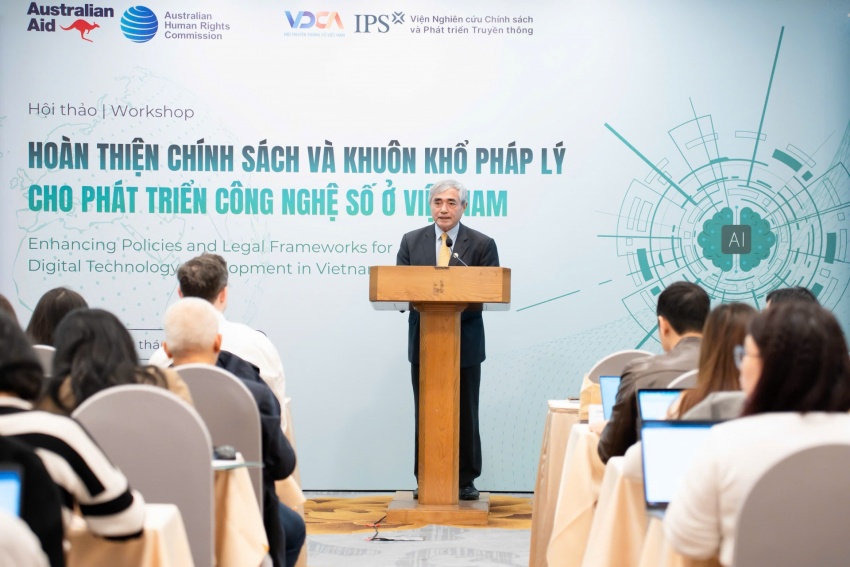 |
| Nguyen Minh Hong, chairman of the Vietnam Digital Communications Association |
From an international perspective, Joe Bourke, second secretary at the Australian Embassy in Vietnam, noted that Australia has recently launched its National AI Plan and established an AI Safety Institute to ensure that technology is developed in a safe and inclusive manner.
“The Australian government is committed to working alongside Vietnam through bilateral cooperation schemes with partners such as IPS, the Vietnam Chamber of Commerce and Industry, and the Ho Chi Minh National Academy of Politics to build a digital transformation roadmap grounded in human rights and aligned with international best practices,” he said.
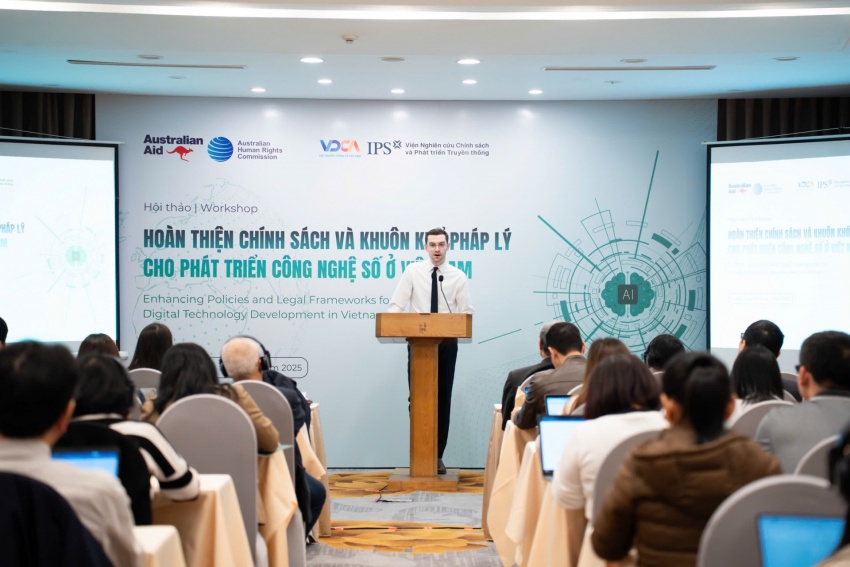 |
| Joe Bourke, second secretary at the Australian Embassy in Vietnam |
From the human rights protection angle, Joanna Mansfield, head of International Engagement at the Australian Human Rights Commission, stressed the importance of striking a balance between innovation and the protection of human rights.
“Emerging technologies, including AI, carry risks of misuse if not properly governed. AI therefore must be developed for people, rather than to infringe upon or undermine fundamental rights,” said Mansfield.
“Embedding human rights from the design stage, ensuring transparency and accountability, and paying particular attention to the protection of vulnerable communities are becoming increasingly urgent requirements in the current context,” she added.
Discussing policy aspects, Ho Duc Thang, director of the National Institute for Digital Technology and Digital Transformation under the Ministry of Science and Technology, observed that amid the rapid development of models such as ChatGPT, Vietnam is becoming the fourth market globally, after the EU, South Korea, and Japan, to make concerted efforts in AI governance.
“The newly enacted Artificial Intelligence Law is among the fastest-passed laws in Vietnam’s legislative history. Its core principle lies in striking a balance while prioritising development through mechanisms such as AI vouchers and free computing infrastructure for small and medium-sized enterprises,” he said.
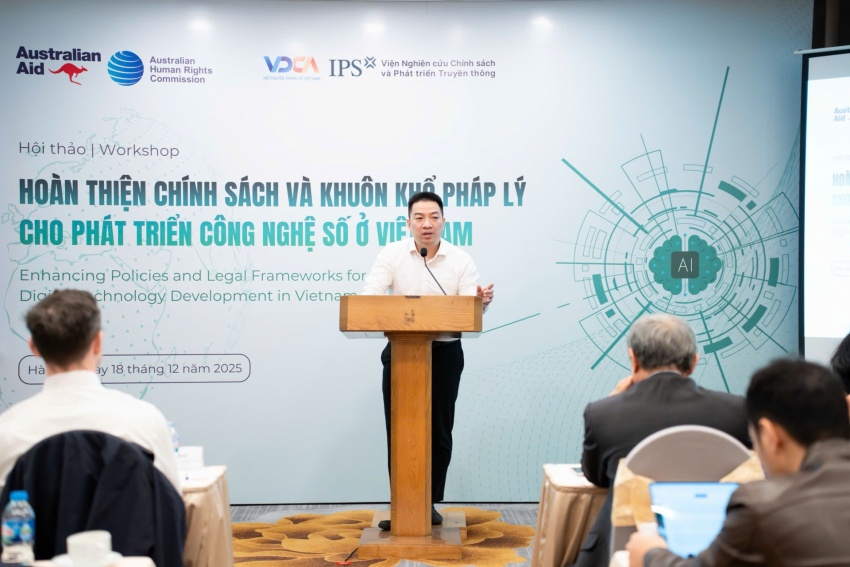 |
| Ho Duc Thang, director of the National Institute for Digital Technology and Digital Transformation |
One notable feature highlighted by Thang is the development of an AI ethics assessment framework.
“This is essentially a specialised certification examination for computer systems to ensure human-centricity and transparency in line with Vietnamese values before they are deployed at scale,” stated Thang.
Complementing this perspective, Prof. Jeannie Marie Paterson, director of the Centre for Artificial Intelligence and Digital Ethics at the University of Melbourne, Australia, offered comparative insights into the value frameworks underpinning Australia’s and Vietnam’s regulatory approaches.
Paterson proposed six principles for the responsible use of AI, including identifying accountable entities, understanding impacts and planning accordingly, measuring and managing risks, ensuring transparency, conducting testing and monitoring, and maintaining meaningful human oversight.
“While Australia tends to rely more on flexible, guidance-based mechanisms, or soft law, Vietnam demonstrates strong commitment through concrete legal obligations on safety and sustainable development,” she said.
 | SOAR initiative launched at TECHFEST Vietnam 2025 Vietnam is turning to social open innovation to bridge technology, people, and sustainable development, launching the SOAR initiative. |
 | MST to allocate $3.8 billion for sci-tech in 2026 State funding for science, technology, innovation, and digital transformation is set to rise sharply, signalling stronger policy support for these fields in the coming year. |
 | TECHFEST Vietnam 2025 links startups with policy and capital TECHFEST Vietnam continues to position itself as the country’s central platform for innovative entrepreneurship, linking ideas, capital, and expertise across the startup ecosystem. |
 | Why global standards matter in digital world Vietnam is advancing one of the most ambitious digital transformation agendas in Southeast Asia. From digital payments and e-government services to AI-driven manufacturing and smart city systems, digital technologies are reshaping the country’s economic landscape at remarkable speed. |
What the stars mean:
★ Poor ★ ★ Promising ★★★ Good ★★★★ Very good ★★★★★ Exceptional
 Tag:
Tag:
Latest News






More News
- ACCA marks 25 years in Vietnam (September 14, 2026 | 14:45)
- Hanoi welcomes education leaders from across Asia for GALTI 2026 (September 14, 2026 | 10:05)
- Workforce resilience will decide Vietnam’s advantage in the age of AI (September 14, 2026 | 09:00)
- Reform to resilience: How Vietnamese businesses build long-term strength (September 12, 2026 | 09:00)
- Flying halfway around the world to Vietnam for treatment of spinal stenosis (September 11, 2026 | 19:00)
- AI-ready digital marketing agency in Vietnam (September 11, 2026 | 17:49)
- Customs Law amended to advance digital and smart customs (September 11, 2026 | 13:52)
- Kim Long Motor ships first batch of electric buses to Thailand (September 11, 2026 | 11:45)
- GBA Oktoberfest Vietnam returns to Hanoi in October (September 11, 2026 | 10:00)
- Vietnam proposes lowering import tax exemption threshold to $4 (September 10, 2026 | 16:29)









 Mobile Version