
PM sets five key tasks to accelerate sci-tech development

On February 25, the government leader chaired the first meeting of 2026 of the Steering Committee on Science and Technology Development, Innovation, and Digital Transformation.
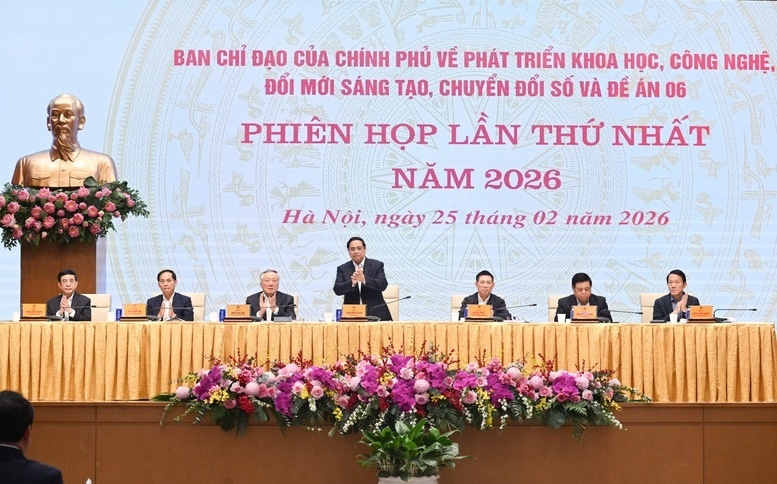 |
| Photo: VGP |
Several tasks under existing initiatives remain behind schedule, particularly those from 2025. The development and integration of national and sectoral databases has been slow, while digital infrastructure has not kept pace with economic growth potential.
Cybersecurity, data safety, and data governance mechanisms remain inadequate, alongside a shortage of high-quality workers in AI, big data, and cybersecurity. Coordination among ministries, sectors, and localities also requires improvement.
The PM stressed that 2026 marks the first year of implementing the Resolution of the 14th National Party Congress. He called on ministries, sectors, and localities to build detailed programmes and roadmaps aligned with their mandates.
PM Chinh identified data economy and AI as pillars for more sustainable and smarter development, creating breakthroughs in the digital economy.
The PM noted that if 2025 was a year of laying foundations and building momentum, then 2026 must be a year of innovation and acceleration. This requires a transition from passive administration to proactive development and service-oriented governance.
He outlined five key tasks for the period ahead. First, he called for more effective steering committee operations, urging ministries to overcome existing limitations and fully implement the seven task groups set by Party General Secretary To Lam for 2026.
The Ministry of Science and Technology (MST), in coordination with the Ministry of Public Security (MPS) and the Ministry of Home Affairs, will guide other bodies in developing implementation plans by February 2026. The MPS is also tasked with submitting draft regulations to the National Steering Committee on Data by the same month.
Second, institutions and innovative policy mechanisms must be improved, particularly in data economy and AI. The MST, together with the MPS and Ministry and Industry and Trade, is to urgently draft guiding documents for the Laws on Digital Transformation, AI, Cybersecurity, and E-commerce, ensuring they take effect alongside the laws themselves without legal gaps.
The MPS will also develop and submit three key decrees: on innovative mechanisms for the National Data Centre's innovation and data centre by the first quarter of 2026; on data platform organisation and operation by the second quarter of 2026; and on data economy development policies by the third quarter of 2026.
The Ministry of Finance, in coordination with the MPS, will develop a legal framework on data pricing, fees, tax incentives, and capital for data-related businesses by June 2026.
Third, accelerating digital infrastructure and critical databases is an urgent priority. Ministers and agency heads are to directly oversee progress and take full responsibility for the quality and effectiveness of these initiatives.
Key database deadlines include the national database on cadres, civil servants and public employees, led by the Ministry of Home Affairs, by March 2026; the social security database, also led by the Ministry of Home Affairs, by June 2026; the asset and income inspection database, led by the Government Inspectorate, by June 2026; the administrative violations database, led by the MPS, by the fourth quarter of 2026; and the agricultural and health sector databases, led by the Ministry of Agriculture and Environment and the Ministry of Health respectively, by the third quarter of 2026.
The MPS is also required to operationalise National Data Centre No.1 and coordinate with businesses on data labelling and digitalisation to support Vietnam's AI platforms in 2026. The MST will implement solutions to enable low-orbit satellite internet services by the end of 2026, while telecommunications enterprises, led by Viettel, will accelerate 5G base station coverage nationwide. The Ministry of Industry and Trade will direct Vietnam Electricity to ensure universal access.
Fourth, the government will accelerate Project06 alongside administrative procedure reform. The MPS will submit a comprehensive programme for Project06 towards 2030 by March, while driving the 2026-2030 administrative reform plan and simplifying procedures.
Fifth, resources and personnel development must be secured for the digital economy. The Ministry of Education and Training will submit a national scheme for AI human resource development in April.
The MPS will also develop a training framework on data governance for IT and digital transformation officers across ministries, sectors, and localities.
The Ministry of Finance has been tasked with prioritising funding for human resource training, completing the review and allocation of budget for key tasks in the first quarter of 2026. A minimum of 3 per cent of total annual state budget expenditure is to be allocated to digital transformation.
The MST will lead efforts to select and assign tasks for the development of priority strategic technology products, including AI, UAVs, nuclear power, digital transformation, green transformation, the creative economy, the low-level economy, and high-speed rail.
The Prime Minister also instructed the Government Office and the MST to complete a set of key performance indicators to assess, in real time, the performance of ministries and agencies in carrying out their assigned tasks, as well as to evaluate the implementation of Resolution 57 and other Politburo resolutions.
 | Vietnam, UN strengthen cooperation in digital technology, AI Vietnam is stepping up cooperation with the United Nations in digital technology and AI as it seeks to develop practical and scalable innovation models. |
 | Digital economy takes centre stage in Vietnam’s new growth model As the Political Report to the 14th National Party Congress places the digital economy at the centre of a new growth model, Le Trung Hieu, deputy director general of the National Statistics Office, reflects on progress over the past five years and the outlook to 2030. |
 | Digital banking enters season of transformation Each spring invites reflection on change, and within that shift the banking sector, once seen as distant and technical, is becoming deeply embedded in everyday transactions as digitalisation moves beyond the service interface to fundamentally reshape its operational core. |
What the stars mean:
★ Poor ★ ★ Promising ★★★ Good ★★★★ Very good ★★★★★ Exceptional
 Tag:
Tag:
Themes: Digital Transformation
- Amazon Kuiper licensed for private satellite telecommunications network in Vietnam
- AWS ramps up security tools amid growing AI risks
- Machine vision and 3D: How logistics and warehousing are catching up with manufacturing
- Nvidia proposes areas of strategic cooperation with Vietnam
- Draft legal amendments target red tape and decentralisation
Related Contents







Latest News




More News
- Expanding education partnerships to drive mutual growth (October 06, 2026 | 16:04)
- VTG 2026 to showcase textile and footwear innovation in Ho Chi Minh City (October 06, 2026 | 16:00)
- Infineon boosts Vietnam footprint with Ho Chi Minh City office (October 06, 2026 | 10:02)
- Vietnam Customs expands priority enterprise scheme to 74 firms (October 03, 2026 | 08:00)
- ASL Law opens Danang office (October 02, 2026 | 22:12)
- Project ACTIVE 2.0 launches in Vietnam to boost cervical cancer care (October 02, 2026 | 22:02)
- Vietnam launches first embodied AI conference to advance robotics ecosystem (October 02, 2026 | 17:00)
- DKSH Performance Materials – A trusted partner in Vietnam’s evolving personal care landscape (October 02, 2026 | 14:28)
- Ghanaian delegation reviews PSL Machinery’s cashew factory-management and implementation roadmap (October 02, 2026 | 10:18)
- People living with chronic kidney disease and diabetes should be aware of infectious disease risks (September 30, 2026 | 18:00)


Latest News




 Mobile Version