
Using circular economy to reduce food loss and waste

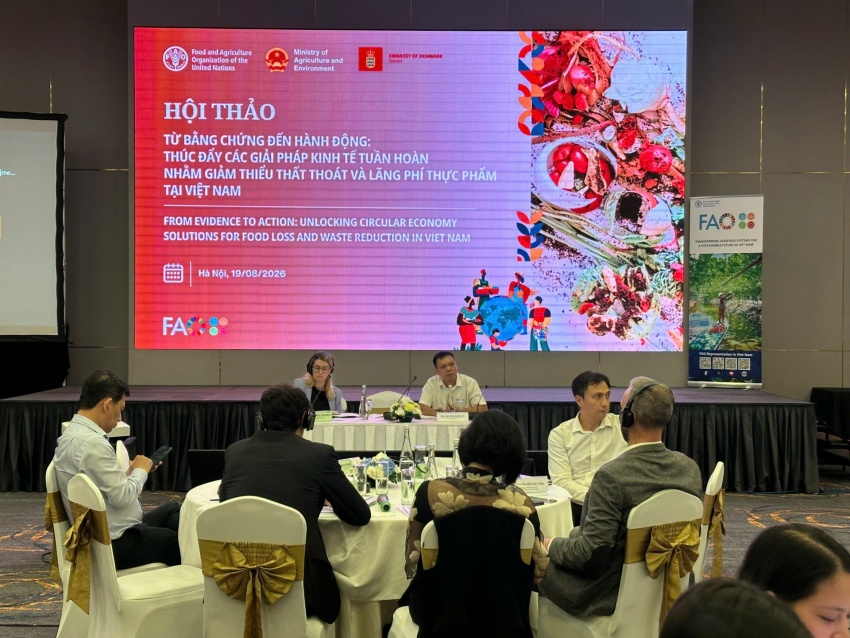 |
| Photo: Nguyen Huong |
The workshop aimed to contribute directly to the implementation of the National Action Plan for Transforming the Food System into a Transparent, Responsible, and Sustainable one under Decision No.300/QD-TTg, while celebrating the upcoming International Day of Awareness of Food Loss and Waste (September 29).
A key highlight of the workshop was the presentation of the draft White Paper on Food Loss and Waste in Vietnam, jointly prepared by the Institute of Policy and Strategy for Agriculture and Environment and FAO, providing a foundation to support policy development roadmap in Vietnam. The workshop also opened a consultation session to gather feedback and recommendations from key stakeholders.
In addition, the workshop introduced a series of highly practical circular economy solutions and business models, ranging from post-harvest preservation (paddy dryers, modified atmosphere packaging – MAP technology) to upcycling agricultural by-products into high-value products (organic fertiliser, straw mushrooms, straw pellets, optimisation of the pork/chicken and the brewing industry).
Notably, the multi-stakeholder panel discussion focused on addressing policy, financial, and technical standard barriers to scale up the commercialisation of these models nationwide.
Nguyen Do Anh Tuan, director general of the Ministry of Agriculture and Environment’s International Cooperation Department said, “What matters now is moving from awareness to action; from isolated studies to an evidence platform supporting decision-making; from pilot models to scalable solutions; and from the individual efforts of single agencies or businesses to a coordinated, system-wide approach.”
Vinod Ahuja, FAO representative in Vietnam said, “The ambition is not simply to produce less waste. It is to keep value circulating in the food system for as long as possible, and at the highest possible level. Scaling is not simply about doing more projects. It is about creating the conditions in which good solutions can grow on their own.”
Mette Ekeroth, deputy head of Mission, Emebassy of Denmark in Vietnam, said, “Waste is not always the end of a process, it can be the beginning of another. The challenge is to turn evidence into practical solutions. The value of initiatives is not only what they achieve individually, but what others can learn from them, adapt, and take further. Denmark is pleased to continue this cooperation with Vietnam in the green transition of food systems.”
Participants agreed that reducing food loss and waste is key to unlocking a “triple win”: enhancing food security and nutrition, curbing greenhouse gas emissions to protect the environment, and driving green economic growth.
Recommendations and insights gathered during the workshop will be used to finalise a White Paper and establish an inter-agency action plan.

What the stars mean:
★ Poor ★ ★ Promising ★★★ Good ★★★★ Very good ★★★★★ Exceptional
 Tag:
Tag:Related Contents



Latest News


More News
- GreenYellow and Vina Paper partner on rooftop solar project (October 05, 2026 | 09:00)
- Consultation workshop refines Vietnam's clean hydrogen strategy (October 04, 2026 | 08:00)
- JBIC considers new financing options for Vietnam’s energy projects (October 03, 2026 | 08:00)
- Vestas to supply 16 turbines for two new Vietnam wind farms (October 01, 2026 | 07:00)
- Inter-sectoral cooperation on Montreal protocol (September 30, 2026 | 17:20)
- EV battery recycling rate proposed at 8 per cent from 2029 (September 29, 2026 | 16:00)
- Bankability remains hurdle for Vietnam's JETP projects (September 29, 2026 | 12:08)
- Binh Minh Plastics extends clean water project to border communities (September 29, 2026 | 10:57)
- Coca-Cola Vietnam expands packaging collection programme (September 25, 2026 | 08:15)
- Pacifico Energy secures sea survey licence for offshore wind project in Lam Dong (September 24, 2026 | 18:02)








 Mobile Version