
Bankability remains hurdle for Vietnam's JETP projects

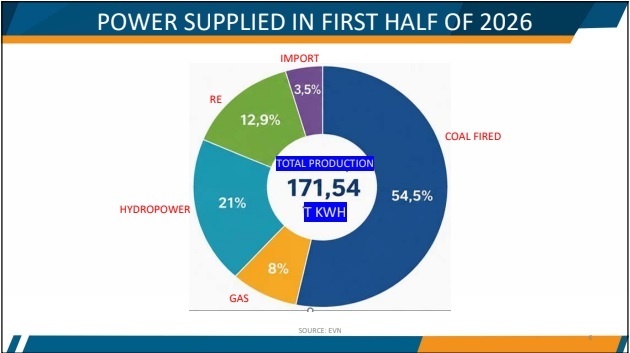 |
| Power supply in first half of 2026. Photo: Vietnam Electricity |
Speaking at a workshop in Hanoi on September 21, on improving the readiness of Just Energy Transition Partnership (JETP) schemes, Pham Van Tan, senior policy adviser at the United Nations Development Programme (UNDP), said 48 projects had so far been identified as aligned with JETP principles, with total financing needs of more than $11 billion.
“The figure is significant against the original financing ambition,” he said. “Yet only three projects have so far secured announced JETP-related financing, totalling about $722 million,” Tan said. “That represents less than 6.6 per cent of the estimated capital requirement of the current pipeline.”
The formation of such a pipeline is an important first filter, but alignment with JETP principles does not automatically translate into financing,” said Hoang Thi Thuy Nguyet, UNDP financial adviser. “The ability to mobilise capital ultimately depends on how well each project is prepared, the strength of its revenue model, risk allocation, and the overall financial structure.”
Initiatives considered for JETP support are expected to contribute to renewable energy development, energy efficiency, greenhouse gas emissions reductions, and national energy security. They must also generate clear socioeconomic benefits, have a catalytic effect on investment, and contribute to a just energy transition.
The screening process has expanded significantly over the past two years, with proposed projects progressively added to the pipeline.
“However, selection is only the beginning of the financing process. One of the most persistent obstacles is the cost and risk of preparing large and technically complex energy schemes before financing can even be considered,” Nguyet said.
Under Vietnam's current regulatory framework, developers proposing projects themselves may have to finance surveys and pre-feasibility studies before it is approved or generates revenue. If it subsequently fails to secure approval or an investor, those costs may remain with the proposer.
“For private investors in particular, this creates an upfront financial burden and increases the risk of investing in development without certainty that preparation costs will eventually be recovered,” Nguyet said.
“This gap could be addressed by expanding the use of grants and technical assistance to finance early-stage surveys, data standardisation, feasibility studies, and other preparatory work for projects that meet JETP requirements,” she added.
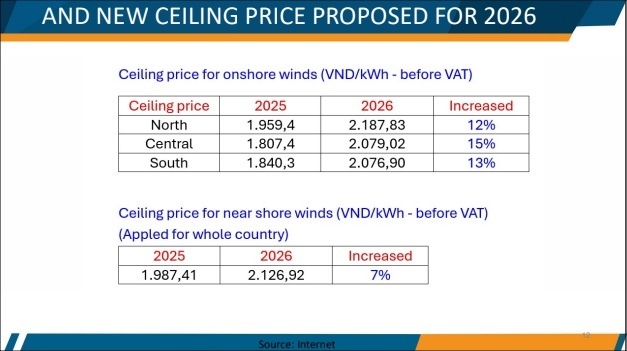 |
| New ceiling price proposed for 2026. Photo: Bui Van Thinh |
Vietnam's experience with the Team Europe Energy Transition Facility (ETEF) illustrates how technical assistance can help bridge existing gaps.
ETEF brings together the European Union and various financial institutions to support Vietnam's energy transition. Its approach combines preparation, implementation support, capacity building, and investment. The programme is designed to provide technical assistance before and alongside financing, rather than treating preparation as a final administrative step.
“The facility's technical assistance has generated a substantial leverage effect, with one euro of technical assistance supporting a much larger volume of potential investment,” said Bui Thanh Trung, an ETEF official.
One of its most prominent examples is the 1,200 MW Bac Ai pumped storage hydropower complex. Vietnam Electricity asked the French Development Agency (AFD) to take the lead in arranging financing, while ETEF provided technical assistance covering additional environmental and social studies, a biodiversity action plan, technical design reviews against international standards, and specialist support for dam safety. The project subsequently progressed towards financing involving six development finance institutions.
The Bac Ai initiative is now one of Vietnam's flagship energy-transition investments. A financing package involving AFD, Proparco, the Japan International Cooperation Agency, and others has been developed, with a broader international support package also involving the EU.
“The key lesson is that technical assistance has to begin early,” Trung said. “Environmental and social work is often on the critical path of a project. It should be treated as an integral part of preparation from the feasibility-study stage, rather than as an administrative requirement added at the end of the financing process.”
ETEF's experience also suggests that preparation can be more efficient when different lenders' requirements are addressed through a common project package. Instead of requiring a developer to repeat similar studies for each potential lender, international-standard documentation can allow several financiers to undertake due diligence on the same information base.
“This can shorten appraisal time, improve investor confidence, and make co-financing easier,” Trung said. The Bac Ai case also highlights the importance of ownership. Consultants can provide international expertise, but the project owner needs to retain responsibility for the underlying studies, decisions, and final documentation.
“The consultant can support the owner, but cannot replace their role. The knowledge and outputs need to remain with the owner so that capacity is built for the next venture as well,” Trung said.
 | Vietnam sharpens focus on offshore wind Vietnam is planning to develop renewable energy industrial and service centres with offshore wind (OSW) at the core, as part of the country’s broader implementation of the Just Energy Transition Partnership. |
 | Vietnam advances Just Energy Transition projects Vietnam’s push towards a greener future took a step forward this week, as key international partners gathered to review progress and chart the next phase of the Just Energy Transition Partnership (JETP). |
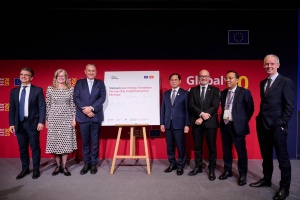 | EU offers $500 million package to facilitate Vietnam’s Just Energy Transition The European Commission and other European actors have announced a comprehensive €430 million (nearly $500 million) package to advance the Bac Ai Pumped Hydro Storage project, a flagship investment under Vietnam’s Just Energy Transition Partnership (JETP). |
What the stars mean:
★ Poor ★ ★ Promising ★★★ Good ★★★★ Very good ★★★★★ Exceptional
 Tag:
Tag:
Related Contents




Latest News


More News
- GreenYellow and Vina Paper partner on rooftop solar project (October 05, 2026 | 09:00)
- Consultation workshop refines Vietnam's clean hydrogen strategy (October 04, 2026 | 08:00)
- JBIC considers new financing options for Vietnam’s energy projects (October 03, 2026 | 08:00)
- Vestas to supply 16 turbines for two new Vietnam wind farms (October 01, 2026 | 07:00)
- Inter-sectoral cooperation on Montreal protocol (September 30, 2026 | 17:20)
- EV battery recycling rate proposed at 8 per cent from 2029 (September 29, 2026 | 16:00)
- Binh Minh Plastics extends clean water project to border communities (September 29, 2026 | 10:57)
- Coca-Cola Vietnam expands packaging collection programme (September 25, 2026 | 08:15)
- Pacifico Energy secures sea survey licence for offshore wind project in Lam Dong (September 24, 2026 | 18:02)
- Vietnam secures $221 million in UN development programmes for 2027-2031 (September 23, 2026 | 17:39)








 Mobile Version