
Toyota calls for hybrid incentives in Vietnam's green vehicle policy

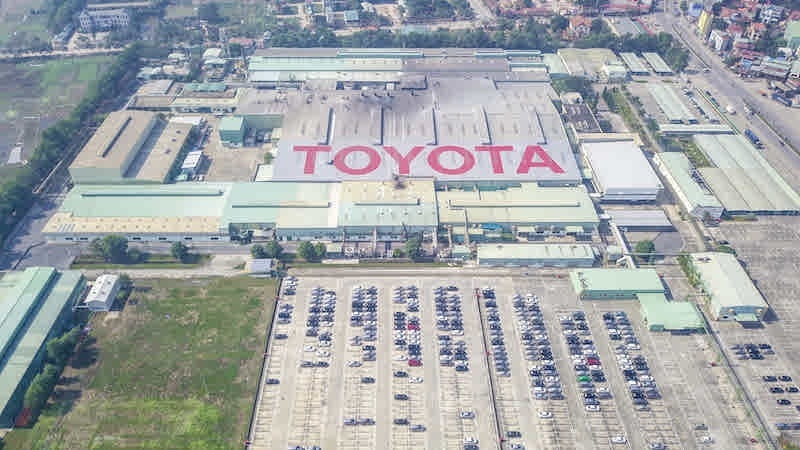 |
| Toyota Vietnam’s plant in Vinh Yen ward, Phu Tho province. Photo: Toyota |
At the second Vietnam-Japan Local Cooperation Forum in Hue on September 6, Toyota Vietnam general director Hirata Osamu proposed that self-charging hybrid electric vehicles (HEVs) be recognised alongside battery electric vehicles (BEVs) for preferential circulation in Ho Chi Minh City's planned low-emission zones.
He also proposed gradually shifting the special consumption tax (SCT) regime from one based on engine capacity towards one based on CO2 emissions.
On Toyota’s proposal regarding SCT for self-charging hybrids specifically, the prime minister asked the Ministry of Finance to study the issue and report to the government in October.
Hirata said HEVs could significantly reduce fuel consumption and CO2 emissions without requiring charging infrastructure or motorists to change their vehicle-use habits. He also argued that emissions should be assessed because the energy mix can significantly affect the overall emissions of different vehicle technologies.
Supporting both types, according to Hirata, would give Vietnam a practical route to reducing transport emissions while maintaining and developing its existing automotive manufacturing and supporting-industry ecosystem.
The policy push comes as Toyota is putting considerably more capital behind local production. On August 28, Toyota Vietnam received an amended investment policy decision and its 12th revised investment registration certificate for its manufacturing project in Phu Tho province. The adjustment added the production and assembly of electrified vehicles, including Hybrid Electric models, to the project’s objectives.
Toyota registered an additional $283.7 million in capital. The project covers more than 28.6 hectares and has annual production capacity of around 52,000 vehicles. Toyota plans to begin work on new stamping and painting workshops in May 2027, with operations scheduled for 2029, creating the manufacturing infrastructure for new completely knocked-down (CKD) models in Vietnam.
“This investment will continue to strengthen and develop the supporting industry and contribute to sustainable development towards Vietnam’s carbon neutrality goal,” Hirata said, while reiterating Toyota’s long-term commitment to Vietnam.
The investment represents a significant change in Toyota’s hybrid strategy. Many of its popular hybrid models sold in Vietnam have largely depended on completely built-up imports. Preparing the infrastructure for domestic assembly could give the Japanese carmaker greater control over supply and costs while creating room to develop a local component ecosystem.
The shift is taking place against a rapidly changing market backdrop. Vietnam’s transition towards electrified transport has accelerated, particularly in BEVs, increasing demand for charging infrastructure and forcing traditional carmakers to decide how quickly they should move their green models from imports to domestic production.
Figures cited by the Ministry of Industry and Trade show that over 17,500 BEVs were sold in Vietnam in the first six months of this year, already exceeding the 15,670 units recorded for the whole of 2023. Of the first-half total, 17,480 were domestically manufactured or assembled.
The charging market is expanding alongside vehicle sales. Estimates cited in the material put Vietnam’s EV market at $3.71 billion in 2026, potentially reaching $8.84 billion by 2031, while the domestic EV charging-station market could grow from around $81.7 million in 2025 to $459.5 million by 2034.
Hybrids present carmakers with a different calculation. Self-charging HEVs do not depend on external charging infrastructure, but their powertrains require the integration of petrol engines, electric motors, batteries and power-control systems. CKD production therefore requires more sophisticated assembly and testing systems and specialised workers.
Toyota is not the first Japanese manufacturer to move into local hybrid assembly. Honda has already become the first Japanese carmaker to assemble hybrid vehicles in Vietnam, bringing its e:HEV technology onto a domestic CKD production line.
Hybrid CKD production requires significant initial investment in assembly and testing capabilities. Manufacturers need sufficient sales volumes to spread those fixed costs; otherwise, importing finished vehicles from established ASEAN production centres can remain economically attractive according to insider experts
Localisation presents another hurdle, as bringing final assembly to Vietnam does not automatically create a domestic hybrid supply chain. More sophisticated components require suppliers capable of meeting higher technological and quality standards, meaning manufacturers that develop their production infrastructure and supplier networks earlier could gain greater control over costs.
What the stars mean:
★ Poor ★ ★ Promising ★★★ Good ★★★★ Very good ★★★★★ Exceptional
Latest News



More News
- Vestas to supply 16 turbines for two new Vietnam wind farms (October 01, 2026 | 07:00)
- Inter-sectoral cooperation on Montreal protocol (September 30, 2026 | 17:20)
- EV battery recycling rate proposed at 8 per cent from 2029 (September 29, 2026 | 16:00)
- Bankability remains hurdle for Vietnam's JETP projects (September 29, 2026 | 12:08)
- Binh Minh Plastics extends clean water project to border communities (September 29, 2026 | 10:57)
- Coca-Cola Vietnam expands packaging collection programme (September 25, 2026 | 08:15)
- Pacifico Energy secures sea survey licence for offshore wind project in Lam Dong (September 24, 2026 | 18:02)
- Vietnam secures $221 million in UN development programmes for 2027-2031 (September 23, 2026 | 17:39)
- Carlsberg Vietnam shows how resource efficiency can shape green industrial growth (September 18, 2026 | 09:03)
- Vietnam and France exchange financing agreements for water management project in Dien Bien (September 11, 2026 | 16:18)







 Mobile Version