

Businesses face challenges in greenhouse gas inventories

 |
| Businesses face challenges in greenhouse gas inventories |
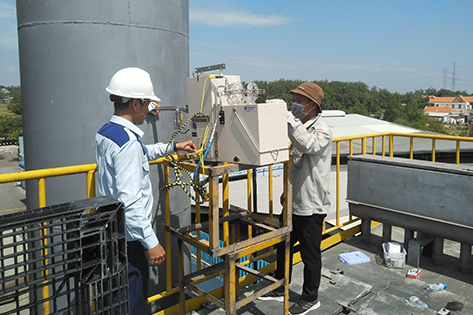
The Ministry of Agriculture and Environment is drafting the decision on the issuance of the list of greenhouse gas (GHG) emission sectors and facilities required to conduct a GHG inventory in 2026.
The draft proposes adding 1,237 more facilities compared to the updated list in Decision No.13/2024/QD-TTg, which enacted a list of GHG-emitting sectors and facilities subject to GHG inventory (updated) (2,166 facilities).
The list of GHG emission sectors required to conduct a GHG inventory includes: energy, transportation (energy consumption in transportation), construction (energy consumption in the construction industry; industrial processes in the production of construction materials), industrial processes, agriculture, forestry and land use, and waste.
GHG inventory still puts pressure on businesses due to many pending issues relating to data and personnel sources.
More than 100 businesses in terms of thermal power, cement and iron and steel sectors participated in the two-day training course on strengthening the capacity of the GHG inventory reporting system at the grassroots level. The training course was organised by the Department of Climate Change (DCC) under the Ministry of Agriculture and Environment.
The training course is to help these businesses to improve their capacity in preparing a GHG inventory report for the 2025-2026 period, which must be submitted before March 31, 2027.
“The biggest difficulty for enterprises is the collection of activity data due to inconsistent and scattered activity data systems. Many enterprises do not have automatic energy or emission management software systems, which are scattered across multiple departments (accounting, engineering, production) in the form of paper vouchers or discrete Excel files," said Luong Quang Huy, head of the Greenhouse Gas Emissions Management and Ozone Layer Protection Division at the DCC. "Thus, retrieving past data for the inventory period encounters many errors, lacks consistency, and faces difficulties in cross-checking when the verification body requests evidence. The transition from an encouraging to a mandatory mechanism creates financial pressure. Enterprises have to pay many new types of costs: costs for hiring consultants to prepare reports, costs for hiring independent verification bodies, investment costs to upgrade data collection systems. Thus, for small and medium-sized enterprises in the mandatory list, these costs directly affect product prices and short-term competitiveness."
According to the DCC, in some cases, a business submitted three reports with different data to the department. Besides this, the current list of national emission factors does not cover all specific production technologies. Meanwhile, self-measurement to develop separate emission factors at the facility incurs high costs for laboratory hiring and equipment inspection. Thus, enterprises are forced to use default values, resulting in inventory results with high measurement uncertainty that does not accurately reflect the actual emission-reduction efforts of the applied technology.
Meanwhile, with the experience in organising training courses and consulting for businesses, Vietnam Energy and Environment Consultancy JSC (VNEEC) showed the shortage of dedicated personnel with professional capacity GHG inventory is an intersectional field between operational engineering, environment, and carbon economics.
“The management team at enterprises has not been systematically trained in the MRV (Measurement, Reporting, Verification) methodology and ISO14064 standards. As a result, enterprises often have to rely entirely on external consulting units, leading to a lack of mastery of the process and difficulties in maintaining annual periodic reporting under new regulations,” said Nguyen Tien Hai, VNEEC technical director. “GHG inventory is a complicated work; however, in some cases, enterprises sent different personnel to join training courses, causing inconsistency in receiving information. Even, we receive similar questions from different specialised personnel.”
At present, to resolve the difficulties in GHG inventories, enterprises often hire consulting firms.
“This work is new and complicated, especially for domestic firms when collecting data. Besides that, the level of difficulty also depends on sectors; for example, the data relating to consumption of coal, power, and capacity do not match with each other. Thus, if enterprises do this mission by themselves, it will be risky and fail to complete the inventories,” a representative of VICEM Song Thao Cement JSC told VIR. “Our company decided to hire a consulting firm to do this work, and simultaneously train technical personnel. They do a complete form, and our team will learn from that.”
According to the information published on the National Accreditation Office system, there are approximately 28 accredited bodies in GHG inventory, recognised according to international standards. With around 110 pilot facilities, the current number of accreditation bodies is considered sufficient. The average accreditation time ranges from two weeks to one month, depending on the size of the facility.
“The online greenhouse gas inventory reporting system is being finalised, allowing businesses to complete the entire process from data entry to report submission. The system will connect businesses, ministries, and local authorities,” Huy said. “By the way, businesses can adjust data if errors are detected through written explanations accompanied by data updates. Reports are submitted periodically and must be submitted on time. Authorities also note that failure to submit reports on time will result in penalties under Decree 45 on administrative sanctions in the environmental sector.”
 | DFI Retail Group Launches Low-Carbon Rice Pilot to Cut GHG Emissions by 30% DFI is turning everyday staples into climate solutions, starting with rice and real results in emissions reduction. |
 | VCCI agrees with proposal to extend tax incentives for EVs The Vietnam Chamber of Commerce and Industry agrees with the Ministry of Finance's proposal to extend the special consumption tax on motor vehicles under 24 seats powered by batteries. |
 | Over 100 businesses train on GHG inventory reporting More than 100 businesses in terms of thermal power, cement and iron and steel sectors participated in the two-day training course on strengthening the capacity of the greenhouse gas inventory reporting system at the grassroots level. |
 | Businesses urged to join carbon market Deputy Prime Minister Nguyen Van Thang has urged businesses to be transparent with environmental data and participate in the carbon market after the exchange begins its pilot operation. |
What the stars mean:
★ Poor ★ ★ Promising ★★★ Good ★★★★ Very good ★★★★★ Exceptional
 Tag:
Tag:Related Contents




Latest News


More News
- JBIC considers new financing options for Vietnam’s energy projects (October 03, 2026 | 08:00)
- Vestas to supply 16 turbines for two new Vietnam wind farms (October 01, 2026 | 07:00)
- Inter-sectoral cooperation on Montreal protocol (September 30, 2026 | 17:20)
- EV battery recycling rate proposed at 8 per cent from 2029 (September 29, 2026 | 16:00)
- Bankability remains hurdle for Vietnam's JETP projects (September 29, 2026 | 12:08)
- Binh Minh Plastics extends clean water project to border communities (September 29, 2026 | 10:57)
- Coca-Cola Vietnam expands packaging collection programme (September 25, 2026 | 08:15)
- Pacifico Energy secures sea survey licence for offshore wind project in Lam Dong (September 24, 2026 | 18:02)
- Vietnam secures $221 million in UN development programmes for 2027-2031 (September 23, 2026 | 17:39)
- Carlsberg Vietnam shows how resource efficiency can shape green industrial growth (September 18, 2026 | 09:03)


Latest News




 Mobile Version